Market Trends
Biggest Cities in India 2026: Area, Population, GDP, Safety, Cleanliness & Real Estate Rankings
03 Feb 2026
Market Trends
03 Feb 2026
Content
No Blogs content found
It looks like there haven’t been any blogs yet!
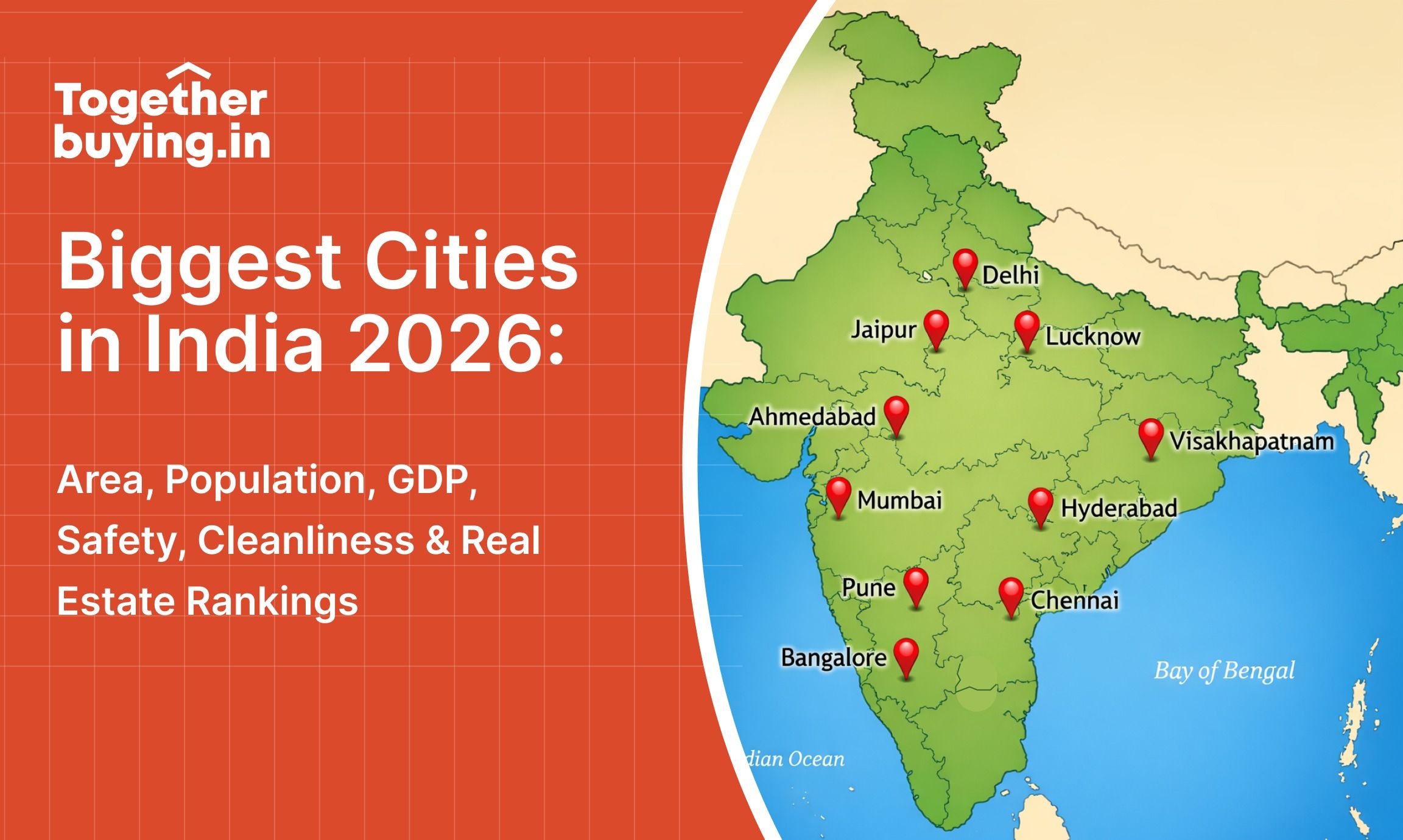
India has over 500 million urban residents living in cities of all sizes. This guide covers the biggest cities in India by area, population, GDP, safety, cleanliness, infrastructure, and real estate investment potential. All data is updated for 2026 with official statistics and rankings.
Here's a list of India's largest cities by total area in square kilometers under their municipal corporations.
| Rank | City | State / UT | Area (sq km) |
|---|---|---|---|
| 1 | Delhi | Delhi | 1,484 |
| 2 | Bangalore | Karnataka | 741 |
| 3 | Hyderabad | Telangana | 650 |
| 4 | Visakhapatnam | Andhra Pradesh | 682 |
| 5 | Lucknow | Uttar Pradesh | 631 |
| 6 | Mumbai | Maharashtra | 603 |
| 7 | Jaipur | Rajasthan | 467 |
| 8 | Ahmedabad | Gujarat | 464 |
| 9 | Pune | Maharashtra | 500 |
| 10 | Chennai | Tamil Nadu | 426 |
Delhi is India's largest city by area at 1,484 square kilometers. Bangalore ranks second at 741 square kilometers. Mumbai, despite being the most populous, covers only 603 square kilometers.
| Rank | City | State / UT | Population (City Proper) |
|---|---|---|---|
| 1 | Mumbai | Maharashtra | 18,394,912 |
| 2 | Delhi | Delhi | 16,349,831 |
| 3 | Kolkata | West Bengal | 14,035,959 |
| 4 | Chennai | Tamil Nadu | 8,653,521 |
| 5 | Bangalore | Karnataka | 8,520,435 |
| 6 | Hyderabad | Telangana | 7,674,689 |
| 7 | Ahmedabad | Gujarat | 6,361,084 |
| 8 | Pune | Maharashtra | 5,057,709 |
| 9 | Surat | Gujarat | 4,591,246 |
| 10 | Jaipur | Rajasthan | 3,046,163 |
| 11 | Kanpur | Uttar Pradesh | 2,920,496 |
| 12 | Lucknow | Uttar Pradesh | 2,902,920 |
Mumbai has the highest city proper population at 18.39 million. Delhi follows with 16.35 million. Kolkata ranks third with 14.04 million.
| Rank | City | Metropolitan Population |
|---|---|---|
| 1 | Delhi NCR | 33–35 million |
| 2 | Mumbai | 20–22 million |
| 3 | Kolkata | 15–16 million |
| 4 | Bangalore | 12–14 million |
| 5 | Chennai | 11–12 million |
| 6 | Hyderabad | 10–11 million |
| 7 | Ahmedabad | 8–9 million |
| 8 | Pune | 7–8 million |
| 9 | Surat | 6–7 million |
| 10 | Jaipur | 4–5 million |
Delhi NCR is India's most populous metropolitan area with 33 to 35 million residents. Mumbai Metropolitan Region has 20 to 22 million people.
The table below lists the biggest cities in India based on Gross Domestic Product (GDP) in 2025. These are also among the richest cities in the country due to the cost of final goods and services produced there.
| Rank | Indian City | GDP (2025) |
|---|---|---|
| 1 | Mumbai | USD 310 billion |
| 2 | Delhi | USD 293.6 billion |
| 3 | Kolkata | USD 150 billion |
| 4 | Bangalore | USD 110 billion |
| 5 | Chennai | USD 78.6 billion |
| 6 | Hyderabad | USD 75 billion |
| 7 | Pune | USD 69 billion |
| 8 | Ahmedabad | USD 68 billion |
| 9 | Surat | USD 59.8 billion |
| 10 | Visakhapatnam | USD 43.5 billion |
Mumbai leads with $310 billion GDP, equivalent to ₹25.73 lakh crore. Delhi follows at $293.6 billion. Mumbai contributes 4.98 percent to India's national GDP, while Delhi contributes 5.71 percent.
Based on NCRB data released in October 2025 (reflecting 2023 statistics), here are India's safest cities by IPC crime rate per lakh population.
| Rank | City Name | IPC Crime Rate (per lakh) |
|---|---|---|
| 1 | Kolkata | 78.20% |
| 2 | Chennai | 173.50% |
| 3 | Coimbatore | 211.20% |
| 4 | Surat | 215.30% |
| 5 | Pune | 219.30% |
| 6 | Hyderabad | 266.70% |
| 7 | Bangalore | 260.50% |
| 8 | Ahmedabad | 360.10% |
| 9 | Mumbai | 376.30% |
| 10 | Kozhikode | 397.50% |
Kolkata is India's safest major city with a crime rate of 83.9 cognizable offences per lakh population (78.20% IPC rate). This is significantly lower than the national urban average of 448.3 per lakh. Kolkata has held this position for four consecutive years with a charge sheeting rate of 94.7 percent.
Chennai ranks second with 173.5 per lakh crime rate. Coimbatore, Surat, and Pune also rank among the safest cities. Kochi has the highest crime rate at 3,192.4 per lakh.
Based on Swachh Survekshan 2025 rankings conducted by the Ministry of Housing and Urban Affairs.
| Rank | City | State | Category |
|---|---|---|---|
| 1 | Indore | Madhya Pradesh | Above 10 lakh population |
| 2 | Surat | Gujarat | Above 10 lakh population |
| 3 | Navi Mumbai | Maharashtra | Above 10 lakh population |
| 4 | Vijayawada | Andhra Pradesh | Above 10 lakh population |
| 5 | Noida | Uttar Pradesh | 3 to 10 lakh population |
| 6 | Chandigarh | Chandigarh | 3 to 10 lakh population |
| 7 | Mysuru | Karnataka | 3 to 10 lakh population |
| 8 | Ujjain | Madhya Pradesh | 3 to 10 lakh population |
| 9 | Gandhinagar | Gujarat | 3 to 10 lakh population |
| 10 | Guntur | Andhra Pradesh | 3 to 10 lakh population |
Indore secured the top spot as India's cleanest city for the eighth consecutive year. Surat and Navi Mumbai ranked second and third among cities with populations over 10 lakh.
Noida topped rankings for cities with populations between 3 and 10 lakh. Sasvad in Maharashtra topped the list of cities with population less than 50,000.
Madurai, Ludhiana, and Chennai ranked among the lowest due to waste disposal and sanitation issues.
These are the top Indian cities with the most promising real estate markets. Prospective homebuyers can consider investing in any of these cities for significant returns. The list highlights average property prices in these cities.
| Rank | City | Starting Price for Apartment (₹/sq ft) |
|---|---|---|
| 1 | Mumbai | ₹10,850 |
| 2 | Chandigarh | ₹4,350 |
| 3 | Hyderabad | ₹4,100 |
| 4 | Bangalore | ₹3,900 |
| 5 | Gurgaon | ₹3,850 |
| 6 | Chennai | ₹3,800 |
| 7 | Noida | ₹3,500 |
| 8 | Delhi | ₹3,000 |
| 9 | Pune | ₹2,750 |
| 10 | Ahmedabad | ₹2,550 |
| 11 | Ghaziabad | ₹2,550 |
| 12 | Kolkata | ₹2,300 |
Bangalore: Thriving IT and startup ecosystem drives steady property appreciation. High rental demand from IT professionals in Whitefield, Electronic City, and Sarjapur. Rental yields of 3 to 6 percent.
Pune: IT and manufacturing boom with infrastructure improvements. Healthy rental returns from apartments in Hinjewadi and Kharadi. Property appreciation of 5 to 10 percent annually.
Hyderabad: Tech hub expansion and business friendly policies. Relatively low entry costs with strong residential and commercial demand in HITEC City and Kondapur. Gachibowli commands premium rates.
Mumbai: Financial capital with high demand and premium pricing. Cosmopolitan appeal sustains rentals in Bandra, Powai, and Thane. South Mumbai areas like Worli command ₹1 to 1.5 lakh per square foot.
Chennai: Industrial and IT stability with affordable living. Steady long term growth and good rental demand near OMR and Guindy. Anna Nagar commands ₹17,000 per square foot.
Based on the Ease of Living Index that ranks Indian cities on quality of life, considering institutional quality, social factors, economic conditions, and physical infrastructure.
| Rank | City | Key Strengths |
|---|---|---|
| 1 | Pune | Overall livability leader |
| 2 | Navi Mumbai | Institutional quality leader |
| 3 | Greater Mumbai | Physical infrastructure leader |
| 4 | Tirupati | Social factors leader |
| 5 | Chandigarh | Economic conditions leader |
| 6 | Thane | High livability |
| 7 | Raipur | High livability |
| 8 | Indore | High livability |
| 9 | Vijayawada | High livability |
| 10 | Bhopal | High livability |
Pune ranks as the most livable city in India. Navi Mumbai leads in institutional quality. Tirupati excels in social factors. Chandigarh tops economic conditions. Greater Mumbai ranks highest for physical infrastructure.
Ahmedabad, ranked 19th overall, offers affordable housing, pleasant climate, lower crime rates, and efficient social facilities.
Based on World's Best Cities 2026 rankings and infrastructure assessments.
| S. No | City | Global Ranking | Infrastructure Strengths |
|---|---|---|---|
| 1 | Bangalore | 29th globally | Tech ecosystem, metro expansion |
| 2 | Mumbai | 40th globally | Financial hub, extensive local trains |
| 3 | Delhi | 54th globally | Metro network (390+ km), airports |
| 4 | Hyderabad | 82nd globally | Metro rail, airport connectivity |
Delhi leads Indian cities in governance, infrastructure, and connectivity. The city has the largest metro network at over 390 kilometers.
Bangalore ranks highest among Indian cities globally at 29th despite weaker infrastructure compared to Delhi or Mumbai. The entrepreneurial ecosystem and talent pool drive this ranking.
Mumbai has an extensive suburban railway network and metro expansion underway. The city has excellent port and airport connectivity.
Traffic congestion costs Delhi, Mumbai, Bangalore, and Kolkata $22 billion annually. Indian cities lag global peers in productivity and liveability.
Average property rates per square foot in major Indian cities.
| City | Average Rate (₹ per sq ft) | Premium Areas Rate |
|---|---|---|
| Mumbai | 19,079 | ₹1,00,000–1,50,000 (South Mumbai) |
| Delhi NCR | 8,108 | ₹55,660 (Jor Bagh) |
| Bangalore | 7,881 | ₹18,837 (Jayanagar) |
| Hyderabad | 7,412 | Premium in Gachibowli / HITEC City |
| Pune | ₹9,000–25,000 | ₹25,000 (Koregaon Park) |
| Chennai | ₹3,000–22,000 | ₹17,000 (Anna Nagar) |
| Kolkata | ₹10,000–28,000 | ₹27,758 (Park Street) |
| Ahmedabad | 4,728 | Moderate premium areas |
Average home prices are projected to increase 7 percent in major cities in 2026. The sharpest increases are expected in NCR, Bangalore, and Chennai at 7 percent each.
Average prices in top seven cities reached ₹8,990 per square foot in Q2 2025, a 50 percent increase from Q2 2023.
Monthly living expenses for individuals in major Indian cities (2026).
| City | Monthly Expenses Range | Family of Four (Excluding Rent) |
|---|---|---|
| Mumbai | ₹30,000–60,000 | ₹82,000 |
| Delhi | ₹22,000–50,000 | ₹70,000 |
| Bangalore | ₹20,000–50,000 | ₹65,000 |
| Pune | ₹25,000–45,000 | ₹60,000 |
| Kolkata | ₹20,000–40,000 | ₹55,000 |
| Hyderabad | ₹12,000–50,000 | ₹50,000 |
| Chennai | ₹15,000–50,000 | ₹52,000 |
| Ahmedabad | ₹22,500–42,000 | ₹58,000 |
Mumbai has the highest cost of living in India. Hyderabad and Chennai offer lower costs among major metros. Thiruvananthapuram, Coimbatore, and Bhopal are the least expensive cities.
| City | Primary Industries | Employment Sectors |
|---|---|---|
| Mumbai | BFSI, IT, Media, Logistics | Finance, Bollywood, port operations |
| Bangalore | IT services, aerospace, biotech | Software, startups, electronics |
| Delhi NCR | Services, government, manufacturing | IT, BFSI, consulting, auto |
| Chennai | Automobile, IT, healthcare | Manufacturing, software, medical |
| Hyderabad | IT, pharmaceuticals, biotech | Software, bulk drugs, research |
| Pune | IT, automobile, education | Software, auto components, teaching |
| Ahmedabad | Textiles, chemicals, pharma | Manufacturing, GIFT City finance |
| Surat | Diamond cutting, textiles | Gems (90% global), fabrics |
| Kolkata | Services, IT, manufacturing | Finance, software, industry |
Mumbai's BFSI sector is the largest employer. The gig economy accounts for 18 percent of India's total. Bangalore employs millions in IT services. Surat handles 90 percent of the world's diamond cutting and polishing.
India's urban population stands at 36 percent of 1.48 billion total population, translating to over 500 million urban residents. This will reach 40 percent by 2036 and 50 percent by 2050.
| State | Urbanization Rate |
|---|---|
| Tamil Nadu | 48.4% |
| Kerala | 47.7% |
| Maharashtra | 45.2% |
| Gujarat | 42.6% |
| Bihar | 11.3% |
| Assam | 14.1% |
| Odisha | 16.7% |
| State | Growth Percentage |
|---|---|
| Rajasthan | 51.74% |
| Haryana | 31.74% |
| Gujarat | 23.98% |
| Uttar Pradesh | 18.20% |
By 2030, Ahmedabad, Bangalore, Chennai, and Hyderabad will become megacities with populations over 10 million, joining Delhi and Mumbai.
India needs to build more than 144 million new homes by 2070 to accommodate urban population growth. Over 50 percent of infrastructure needed by 2050 is yet to be built.
Property prices are projected to grow 7 percent annually in major cities. IT hubs like Bangalore, Hyderabad, and Pune will see strongest appreciation.
Delhi is India's largest city by area at 1,484 square kilometers and the most populous metropolitan region with 35 million people. Mumbai leads in GDP at $310 billion despite a smaller area of 603 square kilometers.
Kolkata is India's safest major city with 78.20 percent IPC crime rate. Indore is the cleanest city for the eighth consecutive year. Pune ranks as the most livable city.
Bangalore ranks 29th globally in World's Best Cities 2026, highest among Indian cities. Mumbai, Delhi, and Hyderabad also feature in the global top 100.
For real estate investment, Bangalore, Pune, Hyderabad, Mumbai, and Chennai offer the best opportunities with property appreciation of 5 to 10 percent annually and rental yields of 3 to 6 percent.
India's urban population of 500 million will add 200 million more by 2050, making it the world's largest contributor to urban growth. Property prices increased 50 percent from Q2 2023 to Q2 2025, with continued growth projected.
Contact Us
Fill out this form
& we'll get back
to you
Recommended for you