Market Trends
CARPET AREA VS BUILT UP AREA VS SUPER BUILT UP AREA
19 May 2026
Market Trends
19 May 2026
Content
No Blogs content found
It looks like there haven’t been any blogs yet!
You walk into a real estate showroom and the salesperson tells you about a beautiful 2000 square foot apartment. You imagine spacious rooms, a large living area, and plenty of natural light. You picture yourself moving around comfortably. Then you sign the documents and move in. The apartment feels smaller than expected. The bedrooms are cramped. The living area is not nearly as spacious as you imagined. What happened?
The 2000 square feet the builder quoted was not the actual usable space in your apartment. It was the super built up area, which includes common areas you do not own or control. Your actual carpet area, the space you truly own and use, might be only 1200 to 1400 square feet. You paid for 2000 square feet but received approximately 60 to 70 percent less usable space.
This is not an accident. This is how the real estate industry works. Builders use three different area calculations: carpet area, built up area, and super built up area. Each number tells a different story. Most buyers understand only one of these terms, if any. This confusion costs homebuyers hundreds of thousands of rupees in overpayment.
This article explains what each term means, how builders use loading factors to inflate numbers, what RERA (Real Estate Regulation and Development Act) actually requires, and most importantly, how you can avoid getting misled before you sign the dotted line.
The difference between carpet area and super built up area directly impacts your money. Consider this real scenario:
The same apartment could be available at a different builder for the stated rate of Rs 30,000 per sq ft (carpet area). That apartment would cost Rs 39 lakh for the same usable space instead of Rs 50 lakh. The difference is Rs 11 lakh, enough for a second bedroom or complete apartment furnishing.
Understanding area calculations is not pedantic detail work. It directly impacts how much you overpay for your home.
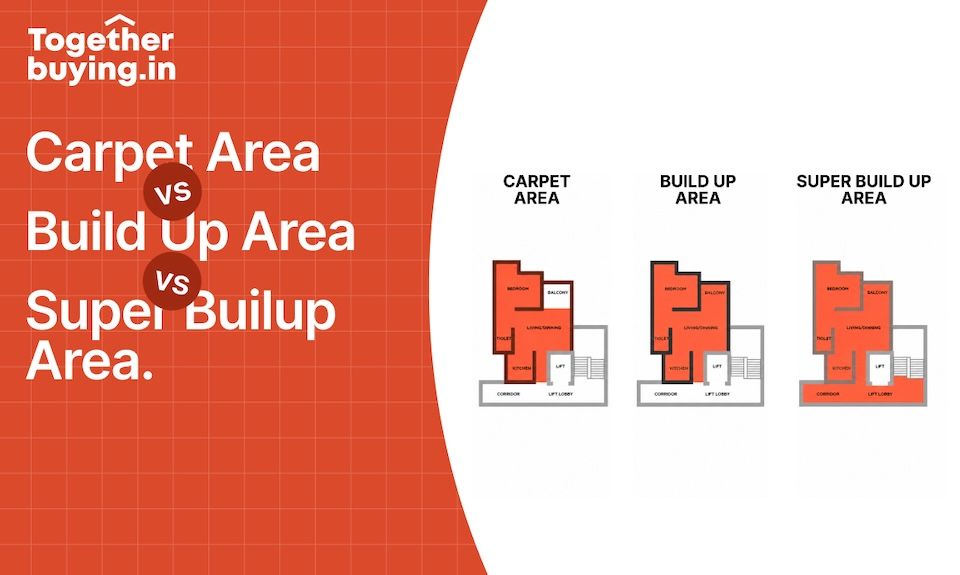
Carpet area is the total unobstructed floor area of the residential space within your apartment walls. It is the space you actually live in, walk on, and use for your daily activities. This is the ONLY area you truly own as property.
According to RERA (Real Estate Regulation and Development Act), carpet area includes:
RERA explicitly excludes from carpet area:
Example: A 2 bedroom apartment
This 720 sq ft is what you truly own and use. This is your actual home size. Not 2000 sq ft, not 1500 sq ft. 720 sq ft.
Built up area is carpet area PLUS the thickness of walls around your apartment PLUS the balcony area. It represents the total constructed space in your unit including structural elements.
Formula: Built Up Area = Carpet Area + Wall Thickness + Balcony Area
Using the same 2 bedroom apartment:
Built up area is what most banks and valuers consider when assessing a property. It is larger than carpet area, but still significantly smaller than the super built up area the builder advertises.
Super built up area is built up area PLUS your share of common areas in the building. Common areas include lobbies, staircases, lifts, corridors, clubhouses, parking areas, security centers, and all shared facilities.
This is the number builders emphasize in advertisements. This is why you see "2000 sq ft apartment" written in bold letters. Not because your apartment is 2000 sq ft. But because 2000 sq ft sounds more impressive than the actual 1200 to 1400 sq ft you will receive.
Formula: Super Built Up Area = Built Up Area + (Your share of common areas)
Your share of common areas depends on several factors:
Continuing the previous example:
But wait. The builder advertised 2000 sq ft. What happened?
Many builders manipulate loading factors. Instead of calculating only the actual common areas used, they apply inflated loading percentages. Instead of 40 to 50 percent loading (which is typical), they apply 60 to 80 percent loading, artificially inflating the super built up area.
A building with a 60 percent loading factor means the super built up area is 160 percent of the built up area. Using our example:
Still not 2000 sq ft. But if a builder applies an 80 percent loading factor:
This is not uncommon. High rise residential buildings in metropolitan areas frequently apply 70 to 90 percent loading factors, some even higher. The more common areas a building has, the higher the loading.
Understanding the differences requires looking at what each includes and excludes:
A: This is standard industry practice. Builders are not breaking laws (since RERA does mandate carpet area disclosure), but they strategically use the largest possible number in advertisements to attract buyers. Knowing the psychological impact of numbers, they quote super built up area prominently while burying carpet area in fine print.
What you see: Stunning advertisement: '2000 sq ft luxury apartment for Rs 50 lakh.' Price per sq ft: Rs 25,000. What is not visible: The apartment is actually 1200 sq ft (carpet area). The real price per sq ft is Rs 41,667. The Rs 25,000 per sq ft is marketing deception using inflated area numbers.
What you see: A luxury high rise with gym, pool, clubhouse, community center, parking, and extensive common areas justifies 70 to 80 percent loading. What is not disclosed: The actual common area used per apartment is only 30 to 40 percent. The extra 40 percent loading is buffer added to increase apparent size.
What you see: Bold 2000 sq ft in the advertisement and on the showroom model. What is in small print: 1200 sq ft carpet area mentioned briefly at the bottom of brochure or in legal documents few people read.
The showroom model apartment is often displayed at a different scale or with exaggerated proportions to make spaces look larger. When you visit the actual apartment, it feels smaller because the marketing model was not to actual scale.
Some builders use the term saleable area to mean super built up area (area you can legally claim ownership). This is different from usable area (carpet area you actually use). A casual buyer might assume they are the same.
A: Loading factor is the percentage of common area added to your built up area to calculate super built up area. If a building has 40 percent loading, the super area is 140 percent of built up area. An 80 percent loading makes super area 180 percent of built up area.
Formula: Super Built Up Area = Built Up Area × (1 + Loading Factor Percentage)
A reasonable loading factor is 30 to 40 percent for most residential buildings. This reflects actual common areas needed for elevators, staircases, lobbies, corridors, and parking.
Red flag loading factors:
A: Legitimate reasons include large amenities (pools, gyms, banquet halls), extensive parking, large lobbies, security facilities, and multiple elevators. But many times, loading is inflated simply to make the advertised area larger than the actual apartment size. The builder uses a high loading percentage not because the building genuinely has that much common area per unit, but to inflate the marketing number.
Example of inflated loading: A 20 story building with 100 apartments and a huge clubhouse on the top floor. The clubhouse occupies 5,000 sq ft. That is 50 sq ft per apartment. But the builder might allocate 100 to 150 sq ft per apartment in the loading calculation, counting additional areas not truly shared by that apartment unit.
Let us work through a real world example of a 3 bedroom apartment.
Step 1: Calculate Carpet Area
Total Carpet Area = 150 + 120 + 110 + 280 + 100 + 120 + 50 + 40 + 200 = 1,170 sq ft
Step 2: Calculate Wall Thickness and Balcony
Total Wall and Balcony = 200 + 30 + 100 = 330 sq ft
Step 3: Calculate Built Up Area
Built Up Area = Carpet Area + Wall Thickness + Balcony = 1,170 + 330 = 1,500 sq ft
Step 4: Determine Loading Factor and Calculate Super Built Up Area
If builder states 50 percent loading:
A: Under the Real Estate Regulation and Development Act (RERA), builders are required to:
A: If your apartment carpet area falls short by more than 5 percent of what was promised, the builder must refund the additional amount paid. If promised 1,200 sq ft but receive 1,100 sq ft (less than 5 percent shortfall, which is 60 sq ft), no refund. If you receive 1,130 sq ft (5.8 percent shortfall, which is 70 sq ft), the builder must refund the amount paid for the excess 70 sq ft.
Important Note: RERA protects you against shortfall in carpet area, not super built up area. This is why knowing the exact carpet area is critical.
Wrong approach: 'Builder A is selling at Rs 25,000 per sq ft. Builder B is selling at Rs 30,000 per sq ft. Builder A is cheaper.' What is missing: If both are quoting super area, Builder A might have 60 percent loading while Builder B has 40 percent loading. Builder A has a lower carpet area percentage. Builder B might actually be cheaper on actual usable space.
Wrong approach: Accepting the super built up area quoted without asking what percentage is actual carpet area. Missing question: 'If super area is 2000 sq ft, what is the carpet area percentage?' A healthy ratio is 55 to 70 percent carpet area. If the answer is 50 percent or lower (1000 sq ft carpet on 2000 sq ft super), the apartment is inefficiently designed or loading is inflated.
Wrong thinking: '2000 sq ft sounds spacious. I will be comfortable.' The problem: You are not using the full 2000 sq ft. You own only 60 to 70 percent of that. The actual usable space is 1,200 to 1,400 sq ft, which might feel confined.
Wrong assumption: Assuming the balcony is included in carpet area or built up area. Reality check: Ask explicitly: 'Is the balcony included in the carpet area or built up area?' Most builders include balcony in built up area, not carpet area. This makes a difference when comparing actual usable interior space.
A: Compare the carpet area percentage. Divide carpet area by super area to get the ratio. Healthy carpet area percentages:
Apartment A:
Apartment B:
Surface level comparison: Apartment A looks cheaper at Rs 25,000 per sq ft vs Rs 25,714. Someone might think A is a bargain. Smart buyer comparison: Looking at carpet area basis, Apartment B is cheaper at Rs 39,130 per carpet sq ft vs Rs 41,667. For the same usable space, Apartment B saves approximately Rs 3,000 per sq ft of actual living area. Real savings: For 1,150 sq ft of usable space, the difference is 1,150 × (Rs 41,667 - Rs 39,130) = Rs 2.91 lakh. Apartment B is the better value.
The difference between carpet area and super built up area costs you significant money. A 50 lakh rupee apartment with 60 percent loading versus 50 percent loading might mean Rs 5 to 10 lakh difference in actual value depending on carpet area percentage.
Builders are not necessarily breaking laws by quoting super built up area. But they are strategically using psychology and numbers to make apartments sound larger and cheaper than they actually are. Smart buyers focus on carpet area. They understand loading factors. They negotiate based on actual usable space. They get better value for their money.
Before signing any property agreement, ensure you know: the exact carpet area, the loading factor applied, the price per sq ft based on carpet area, and your refund rights under RERA. These numbers will determine whether you are making a sound investment or overpaying for illusion.
A: Carpet area is your home. Built up area is your home plus the structure (walls). Super built up area is your home plus structure plus a share of everything else in the building. Carpet is what you own. Super is what you pay for.
A: Yes. If the builder is quoting a high super area with inflated loading, negotiate based on actual carpet area. Insist on a per sq ft rate based on carpet area, not super area. You have RERA backing you for this.
A: Only if you can verify that the high loading is justified by actual amenities. If a 20 story building has a 3,000 sq ft clubhouse and 400 parking spaces, maybe the 60 percent loading is justified. If it has minimal amenities but 70 percent loading, walk away.
A: Yes, typically. Even though balcony is not part of carpet area, you pay maintenance charges on it. This is another cost builders do not clearly communicate. Ask for exact maintenance charges per sq ft of super built up area.
A: If carpet area is less than promised by more than 5 percent, you can legally demand a refund. Document the exact carpet area measurement and compare it to the promised area in your agreement. Contact the builder and RERA authority if needed.
A: Parking space, being a common facility you share, is typically included in common area loading. If a building has 100 apartments and 150 parking spaces (to account for visitors), the extra 50 spaces are distributed across all apartments as part of common area loading. This can significantly increase the loading percentage.
A: Once the apartment is sold based on agreed super built up area, the loading factor is fixed. However, during construction, if the actual common areas end up being different, the super built up area might be adjusted. This should be in the agreement terms.
A: Yes. Hire a professional surveyor to measure the apartment and compare it to the promised carpet area. Do this within the specified timeline (usually 30 days of possession) before making final payment. This is your proof if you need to claim refund for shortfall.
Contact Us
Fill out this form
& we'll get back
to you
Recommended for you