Investments
Complete Guide to Real Estate Investment Trusts (REITs) in India

31 Dec 2025
Investments
31 Dec 2025
Content
No Blogs content found
It looks like there haven’t been any blogs yet!
Real Estate Investment Trusts have transformed how Indians invest in commercial real estate. Before REITs, investing in premium office buildings or shopping malls required capital of 1 to 5 crores. Today, you can own a piece of Grade A office space in Bangalore or Mumbai with just 50,000 rupees.
The Indian REIT market has grown to over 1.2 lakh crores in assets under management as of 2026, with four listed REITs providing investors access to institutional quality real estate. These trusts distribute 90 percent of their rental income as dividends, offering yields of 6 to 7.5 percent annually, significantly higher than fixed deposits or government bonds.
This comprehensive guide explains everything you need to know about REITs in India, from basic concepts to investment strategies, helping you decide if REITs deserve a place in your investment portfolio.
Real Estate Investment Trusts are companies that own, operate, or finance income generating real estate properties. They pool money from multiple investors to purchase and manage commercial properties like office buildings, shopping malls, hotels, warehouses, and data centers.

REITs collect rent from tenants occupying their properties. After deducting operating expenses, property management costs, and interest on debt, they distribute at least 90 percent of the remaining income to unit holders as dividends. This structure ensures regular income for investors while providing professional management of complex commercial properties.
Indian REITs must comply with SEBI (Securities and Exchange Board of India) regulations that mandate:
The structure includes a sponsor (typically a real estate developer), a trustee (to protect investor interests), and a manager (to handle day to day operations).
REITs are classified based on the properties they own and how they generate income.
Equity REITs own and operate income producing real estate. They generate revenue primarily through rental income from tenants. This is the most common REIT type in India.
Example: Embassy Office Parks REIT owns office buildings in Bangalore, Pune, and Mumbai, leasing space to IT companies and multinational corporations.
Mortgage REITs provide financing for real estate by purchasing or originating mortgages and mortgage backed securities. They earn income from interest on these financial assets rather than rental income.
Mortgage REITs are not currently permitted under SEBI regulations. All listed Indian REITs are equity REITs.
Hybrid REITs combine strategies of both equity and mortgage REITs, owning properties and providing financing.
Not currently available. Indian regulations focus on equity REITs for now.
REITs can specialize in specific property types:
As of 2026, four REITs are listed on Indian stock exchanges, all focused on office properties.

Launch Date: April 2019 (India's first REIT)
JP Morgan, Goldman Sachs, Walmart, Microsoft, Amazon, Accenture, Cognizant
| Metric | Value |
|---|---|
| Assets Under Management | ₹35,000+ crores |
| Annual Rental Income | ₹2,800+ crores |
| Dividend Yield | 6.5–7% |
| Occupancy Rate | 92–94% |
| Weighted Average Lease Expiry | 6.5 years |
Unit Price Range (2026): ₹350 to 380 per unit
Minimum Investment: Approximately ₹35,000 to 38,000 (for 100 units)
Launch Date: August 2020
Accenture, Cognizant, TCS, Capgemini, HSBC, JP Morgan
| Metric | Value |
|---|---|
| Assets Under Management | ₹28,000+ crores |
| Annual Rental Income | ₹2,200+ crores |
| Dividend Yield | 6–6.5% |
| Occupancy Rate | 88–91% |
| Weighted Average Lease Expiry | 7 years |
Unit Price Range (2026): ₹320 to 350 per unit
Minimum Investment: Approximately ₹32,000 to 35,000 (for 100 units)
Launch Date: February 2021
American Express, Barclays, Genpact, WNS, Accenture
| Metric | Value |
|---|---|
| Assets Under Management | ₹22,000+ crores |
| Annual Rental Income | ₹1,800+ crores |
| Dividend Yield | 6.5–7% |
| Occupancy Rate | 85–88% |
| Weighted Average Lease Expiry | 6 years |
Unit Price Range (2026): ₹280 to 310 per unit
Minimum Investment: Approximately ₹28,000 to 31,000 (for 100 units)
Launch Date: May 2023 (India's first retail REIT)
Zara, H&M, Lifestyle, Shoppers Stop, PVR, McDonald's, Starbucks
| Metric | Value |
|---|---|
| Assets Under Management | ₹12,000+ crores |
| Annual Rental Income | ₹950+ crores |
| Dividend Yield | 6–6.5% |
| Occupancy Rate | 92–95% |
| Footfall | 150+ million annually |
**Unit Price Range (2026): **₹110 to 125 per unit
Minimum Investment: Approximately ₹11,000 to 12,500 (for 100 units)
Investing in REITs in India is similar to buying stocks on the stock exchange.

Step by Step Investment Process
You need a demat account to hold REIT units and a trading account to buy and sell them. Open accounts with any registered broker like Zerodha, Upstox, ICICI Direct, HDFC Securities, or Angel One.
Account Opening Time: 1 to 3 days for online applications
Complete your Know Your Customer (KYC) verification through your broker. This is a one time process that enables you to trade in stocks, mutual funds, and REITs.
Transfer money from your bank account to your trading account. The amount should cover the cost of REIT units you want to purchase plus brokerage charges.
Log in to your trading platform and search for the REIT you want to invest in using its ticker symbol:
Enter the number of units you want to purchase and place a buy order. You can choose between:
Market Order: Buy at current market price (executes immediately) Limit Order: Buy only if price reaches your specified level (may not execute)
Minimum Purchase: Most REITs require buying in lots of 100 units, though some brokers allow single unit purchases.
Once your order executes, the REIT units will be credited to your demat account within 2 trading days (T+2 settlement).
REITs distribute dividends quarterly or semi annually. Dividends are credited directly to your bank account linked to your demat account.
Total Transaction Cost: Approximately 0.3 to 0.8 percent of investment value
REIT returns come from two sources: dividend income and capital appreciation.
REITs must distribute at least 90 percent of their net distributable cash flows as dividends. This creates a steady income stream for investors.
| REIT | Dividend Yield | Distribution Frequency |
|---|---|---|
| Embassy Office Parks | 6.5–7% | Quarterly |
| Mindspace Business Parks | 6–6.5% | Quarterly |
| Brookfield India REIT | 6.5–7% | Quarterly |
| Nexus Select Trust | 6–6.5% | Semi-annually |
Investment: ₹5 lakhs in Embassy Office Parks REIT Dividend yield: 6.8 percent Annual dividend: ₹34,000 Quarterly dividend: ₹8,500
This dividend income is significantly higher than fixed deposit rates (6 to 7 percent) and provides regular cash flow.
REIT unit prices fluctuate based on property values, rental income growth, occupancy rates, and market sentiment.
| REIT | Launch Price | Current Price (2026) | Appreciation |
|---|---|---|---|
| Embassy Office Parks | ₹300 | ₹365 | 21.7% |
| Mindspace Business Parks | ₹275 | ₹335 | 21.8% |
| Brookfield India REIT | ₹275 | ₹295 | 7.3% |
| Nexus Select Trust | ₹100 | ₹118 | 18% |
Embassy Office Parks REIT investors who bought at launch have earned:
This compares favorably with equity mutual funds (12 to 15 percent) while providing lower volatility and regular income.
| Investment | Annual Return | Income Regularity | Volatility |
|---|---|---|---|
| REITs | 10–12% | Quarterly dividends | Moderate |
| Equity Mutual Funds | 12–15% | No regular income | High |
| Fixed Deposits | 6–7% | Fixed interest | Very Low |
| Direct Property | 8–12% | Monthly Rent | Low |
| Corporate Bonds | 7–9% | Fixed interest | Low |
REITs offer a middle ground between the stability of fixed income and the growth potential of equities.
Understanding REIT taxation helps you calculate post tax returns and plan your investments efficiently.
REIT dividends are taxed differently based on their source.
Annual REIT dividend received: ₹50,000 Your tax slab: 30 percent TDS deducted: ₹5,000 (10 percent) Additional tax payable: ₹10,000 (20 percent of ₹50,000) Total tax: ₹15,000 Post tax dividend: ₹35,000 Effective post tax yield: 5.25 percent (if investment was ₹6.67 lakhs)
When you sell REIT units, capital gains tax applies based on holding period.
Purchase price: ₹3 lakhs (1,000 units at ₹300) Sale price: ₹3.6 lakhs (1,000 units at ₹360) after 4 years Capital gain: ₹60,000
Without Indexation: Tax at 10 percent: ₹6,000
With Indexation: Indexed cost: ₹3.36 lakhs (assuming 12 percent inflation over 4 years) Indexed gain: ₹24,000 Tax at 20 percent: ₹4,800
You pay ₹4,800 (lower of the two options)
Hold for Long Term: Holding REIT units for more than 36 months provides indexation benefits, reducing your tax liability on capital gains.
Invest Through NPS/PPF: While direct REIT investment through retirement accounts is not yet allowed, future regulations may permit this, providing tax free growth.
Offset Losses: Capital losses from REIT sales can be offset against capital gains from other investments, reducing overall tax liability.
Stagger Dividend Income: If you are in a high tax bracket, consider spreading REIT investments across multiple years to manage dividend income and stay in lower tax slabs.
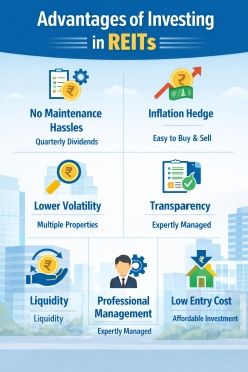
Traditional commercial real estate investment requires 1 to 5 crores. REITs allow you to start with just 50,000 rupees, making institutional quality real estate accessible to retail investors.
Quarterly dividend distributions provide steady cash flow, similar to rental income from direct property ownership but without management hassles.
Experienced real estate professionals handle property acquisition, tenant management, maintenance, and lease negotiations. You benefit from their expertise without any effort.
A single REIT investment gives you exposure to multiple properties across different cities. Embassy Office Parks REIT, for example, owns 33 million square feet across Bangalore, Pune, Mumbai, and Noida.
Unlike physical real estate that takes months to sell, REIT units can be sold on the stock exchange within seconds during trading hours. This liquidity is invaluable during emergencies.
REITs must disclose financial results quarterly, property valuations annually, and major transactions immediately. This transparency helps you make informed decisions.
REIT prices are less volatile than individual stocks because they are backed by physical assets generating stable rental income. During the 2020 market crash, REITs fell 20 to 25 percent compared to 35 to 40 percent for equity indices.
Rental income typically increases with inflation through escalation clauses in lease agreements. This protects your returns from inflation erosion.
Direct property ownership involves dealing with tenants, repairs, legal issues, and property taxes. REIT investment eliminates all these headaches while providing similar returns.
REIT valuations are sensitive to interest rate changes. When interest rates rise, REIT prices often fall as:
Impact: A 1 percent interest rate increase can reduce REIT prices by 5 to 10 percent.
REIT performance correlates with economic conditions. During recessions:
The 2020 pandemic saw office REIT occupancy rates drop 3 to 5 percent as companies adopted work from home policies.
Indian REITs are heavily concentrated in office properties (75 to 100 percent of portfolios). Sector specific challenges like work from home trends or IT sector slowdowns disproportionately impact returns.
The oldest Indian REIT has only 5 years of history. Long term performance through multiple economic cycles remains unknown.
Changes in SEBI regulations, tax laws, or real estate policies can impact REIT operations and returns. The 2024 budget proposal to change REIT taxation created temporary price volatility.
Some REITs have significant exposure to a few large tenants. If a major tenant vacates or defaults, rental income and property values can decline sharply.
While REITs are more liquid than physical property, trading volumes are lower than large cap stocks. Selling large quantities may require accepting lower prices.
Unlike equity dividends (tax free up to ₹10 lakhs), REIT dividends are fully taxable at your slab rate, reducing post tax returns for high income investors.
**Income Seekers: **Retirees or investors needing regular cash flow benefit from quarterly dividend distributions yielding 6 to 7.5 percent.
Diversification Seekers: Investors with portfolios concentrated in equities or fixed income can add real estate exposure through REITs without buying physical property.
Small Investors: Those unable to afford direct commercial property investment (requiring 1 to 5 crores) can access institutional quality real estate with 50,000 rupees.
Passive Investors: People wanting real estate returns without tenant management, property maintenance, or legal hassles find REITs attractive.
Long Term Wealth Builders: Investors with 5 to 10 year horizons benefit from dividend compounding and capital appreciation.
Short Term Traders: REIT price volatility and dividend focus make them unsuitable for quick profit seeking.
High Growth Seekers: Investors expecting 20 to 30 percent annual returns should look at growth stocks or equity mutual funds instead.
Tax Sensitive High Earners: Those in the 30 percent tax bracket may find post tax REIT returns (7 to 8 percent) less attractive than tax free equity gains.
Liquidity Seekers: Investors needing to access capital frequently should maintain emergency funds in liquid instruments rather than REITs.
Allocate 10 to 15 percent of your investment portfolio to REITs as a core holding for diversification and income. Rebalance annually to maintain target allocation.
Automatically reinvest REIT dividends to purchase additional units, compounding your returns over time. A 6.8 percent dividend yield reinvested annually doubles your investment in approximately 10.5 years.
Instead of concentrating in one REIT, spread investments across multiple REITs to reduce concentration risk.
Invest a fixed amount monthly or quarterly in REITs through systematic purchase plans, averaging your entry price and reducing timing risk.
Example: Invest ₹10,000 monthly in REITs regardless of price, accumulating units over time.
Purchase REIT units when prices fall below net asset value (NAV) or during market corrections, providing a margin of safety and higher potential returns.
Trigger: Buy when REIT trades at 10 to 15 percent discount to NAV.
The Indian REIT market is expected to grow significantly over the next decade:
Retail REITs: Additional retail focused REITs expected to list, providing exposure to shopping malls and retail centers beyond Nexus Select Trust.
Industrial and Logistics REITs: Warehousing and logistics REITs anticipated as e-commerce growth drives demand for distribution centers.
Data Center REITs: Digital infrastructure REITs owning data centers may launch as cloud computing and digitalization accelerate.
Hospitality REITs: Hotel and resort focused REITs possible once the hospitality sector stabilizes post pandemic.
Fractional Ownership: SEBI may allow fractional REIT unit purchases, reducing minimum investment from ₹50,000 to ₹5,000 or less.
Mutual Fund Investment: Debt and hybrid mutual funds may be permitted to invest in REITs, increasing institutional participation.
Tax Reforms: Potential changes to dividend taxation or capital gains treatment could improve REIT attractiveness.
Retail Participation: Efforts to increase retail investor awareness and participation through financial literacy programs.
| Factor | REITs | Direct Property |
|---|---|---|
| Minimum Investment | ₹50,000 | ₹30 lakhs – ₹5 crores |
| Liquidity | High (sell in seconds) | Low (months to sell) |
| Management | Professional, hands-off | Self-managed, time-consuming |
| Diversification | Multiple properties, cities | Single property |
| Income | Quarterly dividends | Monthly rent (if occupied) |
| Returns | 10–12% annually | 8–12% annually |
| Volatility | Moderate | Low |
| Transparency | High (quarterly reports) | Low (self-assessed) |
| Leverage | Built-in (REITs use debt) | Requires home loan |
| Tax Benefits | Limited | Section 80C, 24(b) deduction |
| Maintenance | None | Tenant management, repairs |
| Entry / Exit Costs | 0.5–1% | 8–10% (stamp duty, brokerage) |
REITs represent a valuable addition to diversified investment portfolios, offering regular income, professional management, and real estate exposure without the capital requirements and hassles of direct property ownership.
REITs are not a replacement for direct property ownership or equity investments, but they fill a unique niche in providing stable income with moderate growth potential. For investors seeking exposure to commercial real estate without the capital intensity and management complexity of direct ownership, REITs offer an accessible and efficient solution.
The Indian REIT market is still in its early stages, with significant growth potential as awareness increases and new property types are introduced. Early investors who understand REIT fundamentals and invest systematically stand to benefit from this emerging asset class over the coming decades.
Book through TogetherBuying.in and save 15-20% through group buying. Join smart investors maximizing returns.
Contact Us
Fill out this form
& we'll get back
to you
Recommended for you