Market Trends
Cost Sheet Explained for Homebuyers: Complete Guide to Understanding Your Property's True Cost
23 Jul 2026
Market Trends
23 Jul 2026
Content
No Blogs content found
It looks like there haven’t been any blogs yet!
A builder advertises a flat for ₹95 lakh. You walk in excited, ready to book. Then you receive the cost sheet, and the final payable amount reads ₹1.14 crore.
That is nearly ₹19 lakh more than the number in the advertisement. Nothing illegal happened. No one lied to you. The extra money was always part of the deal. It was just never part of the headline price.
This gap is the single biggest source of confusion, frustration, and budget shock for Indian homebuyers. The fix is simple once you know where to look: learn to read the builder's cost sheet, line by line, before you sign anything.
This guide breaks down every component of a property cost sheet, what is mandatory, what is negotiable, what is often hidden, and how to compare two builder quotations without getting misled by a lower base price.
A property cost sheet is an itemized document a builder gives you that breaks down every rupee you will pay for a flat, from the base price of the unit to government taxes, builder-levied charges, and one-time deposits.
It is not the same as the advertised price. The advertised price (often quoted "starting from ₹X per sq ft" or a round headline figure) is usually just the Basic Sale Price of the smallest or lowest-floor unit. The cost sheet is the full picture.
Builders provide a cost sheet because RERA requires transparent, itemized pricing disclosure, and because a serious buyer cannot arrange financing without knowing the actual out-of-pocket number. A well-prepared cost sheet protects the builder too, since it becomes a reference point during later disputes about what was promised.
Buyers should never treat the advertised price as the number to budget against. Treat it as a starting point for a conversation, not a final figure.
A cost sheet does more than list numbers. It is the single document that lets you:
Every builder formats a cost sheet a little differently, but most Indian residential cost sheets include some combination of the following line items.
| Component | Meaning | Mandatory | Negotiable |
|---|---|---|---|
| Basic Sale Price (BSP) | The core price of the unit, usually quoted per sq ft of carpet area or built-up area and multiplied by the total area | Yes | Often, especially in slow-moving inventory or during launch offers |
| Preferential Location Charge (PLC) | Premium for a specific location advantage: park-facing, corner unit, low-density side, road-facing | Only if you choose such a unit | Often |
| Floor Rise Charges | Additional amount per floor as you go higher in the building | Only if applicable to your floor | Sometimes |
| Car Parking | Charge for one or more covered/open parking slots | Usually mandatory for at least one slot | Sometimes, particularly for a second slot |
| Club Membership | One-time fee for access to the project's clubhouse and amenities | Often mandatory in gated projects | Occasionally |
| Interest Free Maintenance Security (IFMS) | A one-time refundable-in-theory deposit held by the builder/RWA to cover future major repairs | Yes | Rarely |
| Maintenance Charges (advance) | Monthly maintenance collected in advance, often for 12–24 months | Yes | Rarely |
| Corpus Fund | A one-time contribution to a long-term sinking fund for the society, separate from IFMS | Yes, where charged | Rarely |
| GST | Central government tax on under-construction property (see below) | Yes, statutory | No |
| Stamp Duty | State government tax on the property transfer, paid at registration | Yes, statutory | No |
| Registration Charges | Fee paid to the Sub-Registrar's office to record the sale deed | Yes, statutory | No |
| Legal Charges | Builder's cost for drafting the Agreement to Sell / Builder Buyer Agreement, sometimes passed to buyer | Often | Sometimes |
| Documentation Charges | Administrative fee for processing paperwork | Often | Sometimes |
| Power Backup Charges | One-time fee for diesel generator/inverter backup capacity allotted to your unit | Often mandatory | Rarely |
| Electric Meter / Connection Charges | Cost of the individual electricity meter and utility connection | Yes | No |
| Water Connection Charges | Cost of connecting the unit to the water supply network | Yes | No |
| External Development Charges (EDC) | A government-mandated charge (common in states like Haryana) collected by the builder and passed to the state authority to fund infrastructure outside the project boundary (roads, drainage, water supply to the area) | Yes, where levied by the state | No |
| Infrastructure Development Charges (IDC) | A related government charge, again mainly seen in Haryana-regulated projects, meant to fund larger infrastructure (highways, regional utilities); definitions of what IDC covers can differ slightly by state notification, so always ask the builder to show the government circular it is based on | Yes, where levied by the state | No |
| Lease Rent | Applicable mainly on leasehold land (common in Delhi/DDA projects); an annual or one-time charge for the leasehold interest in the land | Yes, where the land is leasehold | No |
At the simplest level:
Total Cost = Basic Sale Price + Builder-Levied Charges + Government Charges + Other Applicable Charges
Breaking that down further:
The figures below are illustrative to show how a cost sheet is structured. They are not representative of any specific city, project, or current market rate. Always request the actual, project-specific cost sheet in writing.
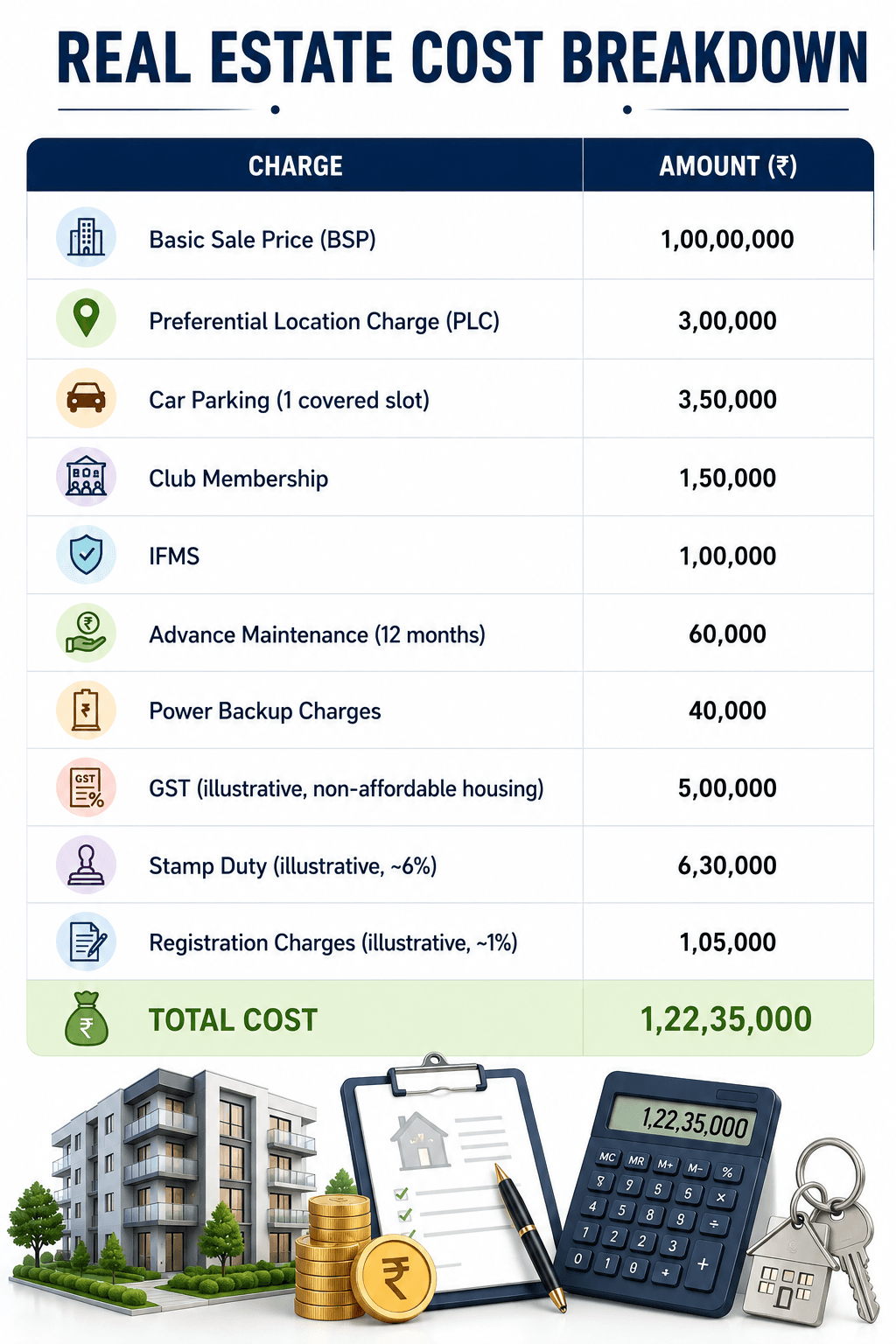
Notice how the ₹1 crore BSP becomes a ₹1.22 crore total. GST, stamp duty, and registration alone add over ₹12 lakh in this example. This is exactly the kind of gap referenced in the introduction, and it is why the advertised price should never be your budgeting number.
| Aspect | Government Charges | Builder Charges |
|---|---|---|
| Set by | Central/state government, GST Council, State Registration Department | The builder, based on project positioning and market demand |
| Examples | GST, stamp duty, registration, EDC/IDC, lease rent | BSP, PLC, floor rise, parking, club membership, IFMS, maintenance |
| Negotiable | No | Sometimes |
| Paid to | Government treasury / Sub-Registrar | Builder's project account |
| Uniform across buyers | Yes, for the same property value and category | Can vary by buyer, timing, and negotiation |
A lower BSP does not automatically mean a better deal. The example below shows why.
| Item | Builder A | Builder B |
|---|---|---|
| Basic Sale Price | ₹95,00,000 | ₹1,00,00,000 |
| PLC | ₹5,00,000 | ₹2,00,000 |
| Parking | ₹4,50,000 | ₹3,00,000 |
| Club Membership | ₹2,00,000 | ₹1,00,000 |
| IFMS + Maintenance | ₹1,80,000 | ₹1,20,000 |
| GST (illustrative) | ₹4,75,000 | ₹5,00,000 |
| Stamp Duty + Registration (illustrative) | ₹8,20,750 | ₹7,66,000 (assuming lower agreement value if circle rate permits) |
| Total Cost | ₹1,21,25,750 | ₹1,19,86,000 |
Builder A looked cheaper on the headline BSP by ₹5 lakh, but by the time PLC, parking, and club charges are added, Builder B is actually the lower total-cost option. This is why every comparison should be done on the final "Total Cost" row, never on BSP alone.
Lenders vary in exactly what they finance, and policy differs by bank, loan product, and property type. As a general pattern:
| Usually Financed | Usually Not Financed |
|---|---|
| Basic Sale Price | Stamp duty (most lenders exclude this) |
| GST on under-construction property (with some lenders, subject to policy) | Registration charges |
| Parking, if included in the sale agreement value | IFMS, club membership, and other one-time deposits, in most cases |
| PLC, if included in the sale agreement value | Advance maintenance |
| Any charge paid in cash or outside the registered sale deed |
Because stamp duty and registration are typically excluded from the loan amount, buyers need to plan for this as a separate cash requirement, on top of the down payment percentage the lender does finance.
The cost sheet is the builder's internal pricing document that lists every component of what you owe. The Agreement Value is the specific number stated in the Agreement to Sell or Builder Buyer Agreement, and it is this figure that stamp duty and registration are calculated against (or the applicable government circle/guideline value, whichever is higher).
In practice, the Agreement Value should mirror the cost sheet's core components (BSP, PLC, parking, and any other charges the builder chooses to include in the registered value), but it will typically exclude items like advance maintenance, IFMS, or club membership, which are collected under separate receipts rather than as part of the registered sale consideration.
Always confirm which cost-sheet items are folded into the Agreement Value and which are billed separately, since this affects both your stamp duty calculation and your ability to claim these payments under Section 80C where eligible.
The cost sheet is a pricing document. The Builder Buyer Agreement (or Agreement to Sell) is a legal contract. The cost sheet tells you how much you will pay and for what; the BBA tells you the legal terms under which you are paying it, including possession timelines, penalty clauses for delay, specifications, and your rights under RERA if the builder defaults.
A cost sheet has commercial value as a reference document, but it is the BBA, registered where required, that carries legal weight in a dispute. Always cross-check that every cost-sheet line item that matters to you (area basis, PLC, parking allocation, payment schedule) is also reflected accurately in the BBA before signing.
Comparing cost sheets across multiple builders and projects is one of the most time-consuming parts of the home-buying process, precisely because formats and terminology differ from one developer to another. TogetherBuying encourages members to look at the complete, itemized cost sheet for every shortlisted project rather than reacting to the advertised starting price alone.
Where a group of buyers is purchasing together, collective negotiation can sometimes help members secure better commercial terms on builder-imposed charges, such as PLC, parking, or club membership, in projects where the developer is open to group discussions. This depends entirely on the specific builder and project, and it applies only to the negotiable, builder-set portion of the cost sheet.
Statutory charges, including GST, stamp duty, and registration, are fixed by law and cannot be reduced through group buying or any other form of negotiation. TogetherBuying's role is to help members read and compare cost sheets accurately, not to alter what the government charges on a property transaction.
It is an itemized document from the builder that lists every charge that makes up the total cost of a flat, including the base price, builder charges, and government taxes.
On its own, a cost sheet is a pricing reference, not a binding legal contract. It becomes enforceable once its terms are incorporated into the registered Agreement to Sell or Builder Buyer Agreement.
Generally, no, if the terms are already reflected in a signed agreement. RERA requires builders to disclose costs upfront, and unilateral post-booking changes to disclosed charges can be challenged before the state RERA authority.
It should. A well-prepared cost sheet lists GST as a separate, clearly labeled line item rather than folding it into the base price.
It often lists registration as a separate line item for buyer reference, but registration is paid to the Sub-Registrar's office, not to the builder.
Interest Free Maintenance Security is a one-time deposit collected by the builder or resident welfare association to cover major future repairs and upkeep of common areas.
Preferential Location Charge is a premium charged for a unit's specific positional advantage, such as park-facing, corner placement, or a lower floor near amenities.
Carpet area is the net usable floor area within the walls of the flat, as defined under Section 2(k) of RERA. Super built-up area adds the flat's share of common areas like lobbies and stairwells, and is typically 25 to 35% larger than the carpet area.
No. Once a project has received its Occupancy or Completion Certificate, the sale is exempt from GST under Schedule III of the CGST Act. Only stamp duty and registration apply.
As of the current GST structure, affordable housing (broadly, units priced up to ₹45 lakh with carpet area limits of 60 sq metres in metros and 90 sq metres in non-metros) attracts 1% GST without input tax credit. Other under-construction residential units attract 5% GST without input tax credit. These thresholds and rates are set by the GST Council and can change, so confirm the current rate with the builder's GST invoice or the CBIC portal before finalizing your budget.
Cross-check statutory charges (GST rate, stamp duty percentage for your state, registration fee) against official government sources, and cross-check the RERA registration number and disclosed project cost on your state's RERA portal.
You can generally negotiate BSP, PLC, parking, and club membership. You cannot negotiate GST, stamp duty, or registration charges, since these are fixed by law.
Confirm the area basis (carpet area), verify every charge against the draft Agreement to Sell, confirm which charges your home loan will cover, and ensure any discount discussed verbally is written into the final document.
A corpus fund is a one-time contribution toward a long-term sinking fund for major society expenses, while IFMS is typically meant for near-term maintenance and repair needs. Builders sometimes use the terms loosely, so ask for a written definition of what each fund covers in your specific project.
No. Stamp duty is a state subject and rates vary widely, roughly in the range of 3% to 8% of property value depending on the state, with several states offering a 1-2% concession for women buyers. Always confirm the current rate with your state's Registration Department.
Under Section 194-IA of the Income Tax Act, a buyer must deduct 1% TDS on the purchase of immovable property (other than agricultural land) if the transaction value or applicable stamp duty value exceeds ₹50 lakh, and deposit it using Form 26QB.
External Development Charges and Infrastructure Development Charges are government-mandated levies, most commonly seen in Haryana-regulated projects, meant to fund infrastructure outside and around the project. They are collected by the builder on the government's behalf and are not negotiable.
In most gated projects with shared amenities, yes, it is bundled into the cost sheet as a mandatory one-time charge, though its exact treatment can vary by builder.
Generally not. Most lenders exclude stamp duty and registration charges from the financed amount, so buyers need to arrange this separately in cash.
Under RERA, if the delivered carpet area is smaller than what was stated in the agreement, the builder must refund the buyer for the shortfall, typically with interest, within a defined period after possession.
No. Stamp duty is charged on whichever is higher: the actual transaction value or the government's circle rate/guideline value/ready reckoner value for that location. Declaring a lower value than the circle rate does not reduce your stamp duty liability.
It applies to leasehold land, common in some Delhi Development Authority projects, where the buyer pays periodic or one-time lease rent for use of land the government technically still owns, as opposed to freehold ownership.
Always compare the total cost. A lower per-sq-ft BSP can be offset entirely by higher PLC, parking, or club charges, as shown in the Builder A vs Builder B comparison above.
Contact Us
Fill out this form
& we'll get back
to you
Recommended for you