Market Trends
Delhi’s Zone O: The Complete Guide to the Yamuna Floodplain Planning Zone
26 Jun 2026
Market Trends
26 Jun 2026
Content
No Blogs content found
It looks like there haven’t been any blogs yet!
If you have recently heard about Delhi's Zone O in the context of demolition notices, DDA boundary signboards, or Delhi High Court orders, you are probably wondering whether your home or property is affected.
The Yamuna flows approximately 48 kilometres through Delhi, from Palla in the north to Jaitpur in the south. Within this broader corridor, the Delhi Development Authority (DDA) designates the Wazirabad-to-Okhla floodplain as the core Zone O planning area, covering approximately 9,700 hectares. Zone O is the planning zone established for this stretch under Delhi's Master Plan framework, with the Master Plan for Delhi 2021 (MPD 2021) setting its current planning controls.
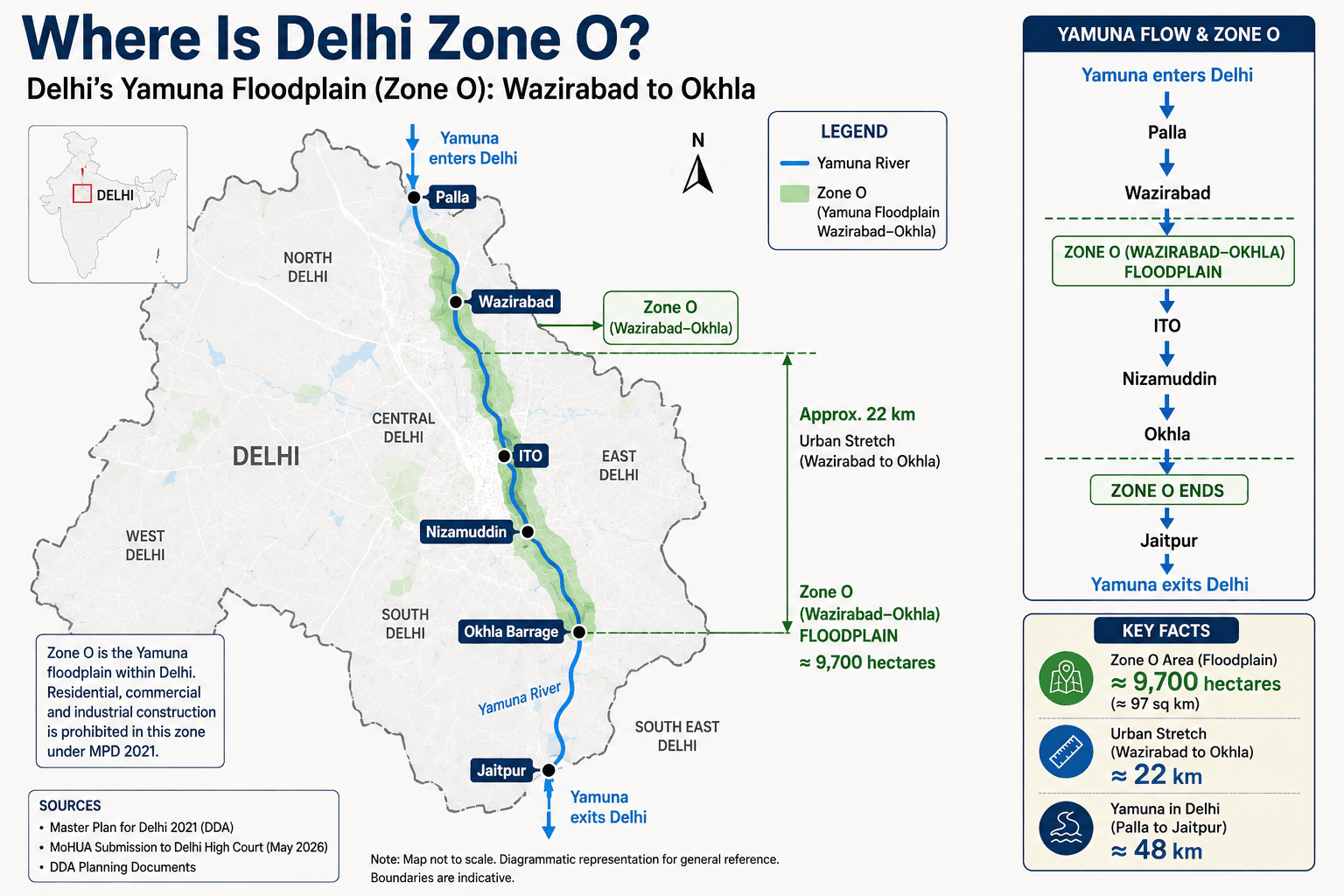
Within Zone O, residential, commercial, and industrial construction is prohibited, while certain ecological, agricultural, and public utility activities are permitted. Understanding this distinction has become urgent for hundreds of thousands of people, because the zone includes numerous residential settlements, unauthorised colonies, agricultural areas, and ecological restoration sites that grew up over decades in the absence of active enforcement.
Zone O has become one of the most contested planning designations in Delhi. An estimated 91 unauthorised colonies containing approximately five to six lakh residents and roughly one lakh homes exist inside its boundaries. In May 2026, the Delhi High Court declared the existence of residential colonies within Zone O to be "completely impermissible," bringing the zone to the forefront of urban policy debate across India.
| Parameter | Figure | Source |
|---|---|---|
| Total Area of Zone O | ~9,700 hectares (~97 sq km) | MPD 2021 / DDA |
| Yamuna Total Length Inside Delhi | ~48 kilometres (Palla to Jaitpur) | DDA / MPD 2021 |
| Zone O Urban Stretch (Wazirabad to Okhla) | ~22 kilometres | MPD 2021 / DDA |
| Extent of Zone O as % of Delhi's Area | ~7% of the NCT area | DDA Master Plan |
| Unauthorised Colonies Inside Zone O | ~91 colonies | MoHUA submission to Delhi High Court (May 2026) |
| Estimated Population Inside Zone O | 5 to 6 lakh persons | MoHUA submission to Delhi High Court (May 2026) |
| Estimated Number of Homes Inside Zone O | ~1 lakh homes | Delhi High Court Order (May 2026) |
| Active Eco-restoration Projects | 11 projects covering ~1,600 hectares | DDA (as of 2025) |
| Highest Recorded Flood Level (1978) | 207.49 metres at Old Railway Bridge | Irrigation and Flood Control Department, Delhi |
| New Flood Record (July 2023) | 208.66 metres at Old Railway Bridge | Central Water Commission |
Delhi's land area is divided into planning zones under the MPD 2021, each with its own permitted uses and development controls. These zones guide what can be built, demolished, regularised, or restricted within their boundaries.
The main zones relevant to understanding Zone O are:
| Zone | Description | Key Characteristic |
|---|---|---|
| Zone O | Yamuna Floodplain | Residential, commercial, and industrial construction is generally prohibited. Ecological restoration, public utilities, recreation, and other permitted uses are allowed under planning regulations. |
| Zone A | City Zone (Old Delhi) | Historic core of Delhi with dense mixed-use development, heritage precincts, and traditional commercial areas. |
| Zone F, G, H | Residential Zones (Various) | Predominantly planned and unplanned residential neighbourhoods with supporting social and commercial infrastructure. |
| Zone P-I, P-II | North Delhi Sub-cities | Mixed urban expansion areas comprising residential developments, institutional uses, and peri-urban settlements. |
| Zone N | Rural Areas | Primarily agricultural land, villages, and rural settlements with limited urban development. |
Zone O is unique among Delhi's planning zones because it does not have a sub-zonal development plan in the conventional sense. Instead, its regulations are set directly by the MPD 2021 and by successive orders of the National Green Tribunal and Delhi High Court. Unlike residential or commercial zones, Zone O does not permit private construction, colonisation, or change of land use for residential purposes.
The Draft Master Plan for Delhi 2041, released in June 2021 and which had received approximately 33,000 public objections as of April 2026, proposed to subdivide the floodplain into two sub-zones:
Zone O-I would cover the active riverbed and immediate bank areas closest to the water channel, with a strict prohibition on any permanent construction.
Zone O-II would cover the outer floodplain margin, where limited regulated development was proposed, including green infrastructure, eco-parks, urban agriculture, and public recreational uses.
This proposed subdivision has been controversial. Environmental groups argued that Zone O-II's allowance for "regulated development" could open floodplain edges to commercial exploitation. As of June 2026, the Draft MPD 2041 remains unnotified by the Ministry of Housing and Urban Affairs. The operative legal instrument remains MPD 2021.
This is the question most readers arrive with. Zone O covers the Yamuna floodplain, and many Delhi localities sit fully or partially within its boundaries. Some of the well-known areas that fall wholly or partially within Zone O include:
Majnu Ka Tilla (New Aruna Nagar), Sonia Vihar, Jagatpur, Old Usmanpur, Garhi Mandu, Yamuna Bazaar (Kashmere Gate), Wazirabad, Chilla Khadar (Chilla Saroda Khadar), Jaitpur, Meethapur, Madanpur Khadar, Shastri Park Khadar, and the Okhla floodplain in the south.
However, in most cases only portions of these localities lie within the floodplain boundary. Zone O follows the Yamuna's khadar contour, not administrative ward or constituency lines. Residents should verify the exact location of any property through official DDA zonal maps before making any property-related decisions. A step-by-step verification method is provided in the section "How to Check if Your Property Falls in Delhi Zone O" below.
The floodplain is not uniformly wide: it narrows where embankments (bunds) confine the river and widens where no embankments exist on one or both sides.
The following localities fall wholly or partially within Zone O:
| Locality | Bank | Status | Planning Significance |
|---|---|---|---|
| Wazirabad | West / North | Partially Inside Zone O | Northern entry point of Zone O; located near the Wazirabad Water Treatment Plant. |
| Jagatpur | West | Partially Inside Zone O | Area where unauthorised construction was highlighted by the Delhi High Court in May 2026. |
| Old Usmanpur | West | Partially Inside Zone O | Low-lying settlement located close to the Yamuna riverbank. |
| Majnu Ka Tilla (New Aruna Nagar) | West | Partially Inside Zone O | Fresh construction was flagged in May 2026; includes the Tibetan settlement along the riverbank. |
| Yamuna Bazar (Kashmere Gate) | West | Fully Inside Zone O | Contains approximately 310 dwellings and 32 ghats; eviction notices were issued in May 2026. |
| Garhi Mandu | West | Partially Inside Zone O | Traditional village settlement located close to the Yamuna river corridor. |
| Bela Estate (Bela Gaon, Moolchand Basti, China Colony) | West | Largely Cleared | Subject to multiple demolition drives since 2006; around 550 homes were removed in 2018. |
| Asita East (ITO Area) | East | Restored | A 197-hectare biodiversity park and ecological restoration project opened to the public in 2022. |
| Chilla Khadar (Chilla Saroda Khadar) | East | Under Active Pressure | Agricultural settlement opposite Mayur Vihar; around 1,500 families; demolition activity reported in 2024. |
| Sonia Vihar | East / North-East | Partially Inside Zone O | Portions near the Yamuna fall within Zone O; located close to the Sonia Vihar Water Treatment Plant. |
| Shastri Park Khadar | East | Partially Inside Zone O | Includes low-lying riverside areas along the Yamuna floodplain. |
| Jaitpur | South-East | Partially Inside Zone O | Located near the southern boundary of the Zone O corridor. |
| Madanpur Khadar | East | Partially Inside Zone O | South-East Delhi locality comprising agricultural land and low-density residential development. |
| Meethapur | East | Portions Adjacent to Zone O | Areas near Badarpur are located adjacent to the Zone O boundary. |
| Okhla Floodplain | East | Partially Inside Zone O | Forms the southern end of the Zone O floodplain corridor, with ecological restoration activities underway in some sections. |
Important clarification: Zone O follows the Yamuna's floodplain boundary, not the boundaries of assembly constituencies or administrative wards. Most constituencies along the Yamuna corridor have only portions of their area inside Zone O. Entire constituencies such as Shahdara, Kasturba Nagar, or Seemapuri do not fall inside Zone O; only their floodplain-facing portions do.
The Yamuna floodplain is a functional ecological system, not merely land adjacent to a river. When left intact, it performs several irreplaceable services:
Flood storage: During monsoon peaks, the floodplain absorbs excess water from the river channel, reducing the height and speed of floodwaters downstream. The Kalindi Biodiversity Park's restored wetland can reportedly store up to 500 million gallons of floodwater annually.
Groundwater recharge: As floodwater spreads across the khadar, it percolates through sandy soils and recharges the underlying aquifer, a critical function for a city that depends heavily on groundwater extraction.
Biodiversity: Restored sections of the Zone O corridor have attracted migratory birds, aquatic species, and native vegetation that had disappeared from Delhi for decades.
The 2023 floods powerfully illustrated what happens when floodplains are encroached. In July 2023, the Yamuna reached 208.66 metres at the Old Railway Bridge, surpassing the previous record of 207.49 metres set in 1978 by 1.17 metres, despite Hathnikund Barrage releasing less than half the discharge volume that had characterised earlier high-flood years without a record breach. SANDRP researchers concluded that reduced flood-carrying capacity in the Delhi stretch, caused by floodplain encroachment and elevated riverbed levels, was a principal reason why lower water volumes produced higher flood levels. This pattern repeated in September 2025.
Approximately 91 unauthorised colonies exist inside Zone O, housing an estimated five to six lakh residents in roughly one lakh homes. Understanding their current legal status requires separating several distinct frameworks:
Delhi's housing deficit and rapid population growth over decades led millions of residents to occupy and build on land without formal planning permission. Floodplain land, often without visible land title or active enforcement, was particularly vulnerable to informal settlement. Many Zone O colonies predate the MPD 2021's formal classification; some communities trace their presence to before India's independence.
The Pradhan Mantri Unauthorized Colonies in Delhi Awas Adhikar Yojana (PM-UDAY), notified in October 2019, confers ownership rights on residents of 1,731 unauthorized colonies across Delhi. However, colonies falling inside Zone O are explicitly excluded from PM-UDAY regularisation. No ownership rights, conveyance deeds, or authorisation slips are being issued to Zone O residents under this scheme. When MoHUA notified a fresh batch of colonies for regularisation in April 2026, colonies in Zone O were again excluded, as the Ministry confirmed before the Delhi High Court in May 2026.
The National Capital Territory of Delhi Laws (Special Provisions) Second Act, 2011, grants temporary protection from demolition and punitive action to residents of unauthorised colonies across Delhi. This act has been extended multiple times. The most recent extension, passed in December 2023, extended protection until 31 December 2026.
This protection is important but limited. It shields existing structures from demolition drives during the protection period but does not confer ownership rights, does not regularise the colony, and does not prevent action against fresh or new construction.
On 23 May 2026, a Division Bench of the Delhi High Court comprising Justice Prathiba M. Singh and Justice Manmeet Pritam Singh Arora observed that the existence of any residential colonies in Zone O is "completely impermissible." The court directed the DDA to ensure no fresh construction takes place in Zone O, "even under the garb of repair or renovation." It also asked the Ministry of Housing and Urban Affairs to present its decision regarding the future of the 91 colonies at the next hearing.
The court set a deadline of 8 June 2026 for a coordinated action plan and scheduled the next hearing for 25 July 2026.
Delhi Chief Minister Rekha Gupta subsequently clarified that existing structures would not face immediate demolition consequences and that the court's orders targeted fresh construction. As of the time of writing, discussions between the Centre, the Delhi government, and other departments on rehabilitation and future treatment of Zone O colonies are ongoing.
Demolition action on the Yamuna floodplain is not new. The DDA has conducted multiple demolition drives across Zone O over the past two decades. Key episodes include:
| Year | Site | Action | Outcome |
|---|---|---|---|
| 2006 Onwards | Bela Estate (Bela Gaon, China Colony) | Multiple demolition drives carried out to remove encroachments from the Yamuna floodplain. | Around 550 homes were demolished in May 2018, with affected residents offered plots in Bawana for relocation. |
| September 2020 | Asita East | Demolition and site clearance undertaken as part of ecological restoration efforts. | The area was redeveloped into the DDA's Asita East Biodiversity Park, which opened to the public in 2022. |
| July 2024 | Chilla Khadar | Approximately 200 houses were demolished during an anti-encroachment drive. | Affected families were offered temporary shelter through DUSIB, while no permanent rehabilitation plan was publicly announced. |
| May 2026 | Yamuna Bazar | Eviction notices were issued to approximately 310 dwellings within the floodplain. | Residents were given a 15-day period for voluntary compliance, after which demolition action was proposed for non-compliance. |
| May 2026 | Jagatpur, Ram Ghat, and New Aruna Nagar | The Delhi High Court flagged ongoing unauthorised construction activities in these areas. | The Delhi Development Authority (DDA) was directed to prevent any fresh construction within the identified floodplain areas. |
The pattern across demolition cycles has been consistent: enforcement action against structures, temporary rehabilitation via the Delhi Urban Shelter Improvement Board (DUSIB), and slow or incomplete permanent resettlement.
What is targeted vs what is protected:
Fresh or new construction in Zone O is prohibited and subject to demolition regardless of who builds it. The DDA's April 2026 public notice announced it would remove all encroachments from Zone O except those covered under PM-UDAY, which itself excludes Zone O colonies.
Existing structures in Zone O colonies enjoy temporary protection from punitive action under the Special Provisions Act until 31 December 2026. What happens after that date depends on policy decisions currently under deliberation between the Centre, the Delhi government, and other agencies.
Drone surveys and physical boundary signboards have been installed by the DDA across the floodplain following a March 2026 NGT direction to accelerate physical demarcation of boundaries.
The DDA has launched 11 eco-restoration projects across the Zone O corridor as part of a broader Yamuna Riverfront Restoration programme. These projects represent a shift from earlier concrete-heavy interventions toward nature-first restoration, using native plantings, unpaved trails, seasonal wetland design, and solar-powered lighting. Following a high-level government meeting in May 2025, plans were announced to integrate all 11 projects into a single riverfront corridor.
Asita East (ITO area): A restored zone on the eastern bank between the Old Railway Bridge and the ITO Barrage, opened to the public in September 2022. Named after the ancient name for the Yamuna, it features native riverine species including Amaltas, Sheesham, Arjun, and wild sugarcane.
Baansera (Kalindi Aviral Extension): A restored bamboo-themed public space near Kalindi Colony in south Delhi. The first phase is complete, though it suffered flood damage in July 2023 and September 2025.
Mayur Nature Park: The largest project in the DDA's current pipeline, located in East Delhi near Mayur Vihar, with completion re-targeted to October 2026.
Both the 2023 and 2025 floods inundated multiple project sites, washing away plantings and requiring costly remediation, highlighting the inherent tension between floodplain restoration and any form of constructed development within Zone O.
| Myth | Fact |
|---|---|
| Entire Sonia Vihar falls inside Zone O. | Only certain portions near the Yamuna riverbank fall within the Zone O floodplain. Sonia Vihar as a whole is not classified as Zone O. |
| Registering a property makes it legal. | Property registration merely records the transaction. It does not regularise land use, validate an unauthorised structure, or protect it from demolition. |
| PM-UDAY covers Zone O colonies. | Zone O colonies are explicitly excluded from the PM-UDAY scheme. The scheme does not confer ownership rights on properties located within Zone O. |
| Every house in Zone O will be demolished immediately. | Existing structures currently have temporary protection under the National Capital Territory of Delhi Laws (Special Provisions) Act until December 2026. The Delhi High Court's May 2026 directions primarily target fresh or ongoing unauthorised construction rather than immediate demolition of all existing homes. |
| Zone O covers the entire Yamuna stretch through Delhi. | Zone O covers the Yamuna floodplain along the Wazirabad-to-Okhla urban stretch. The Yamuna flows for approximately 48 km through Delhi, but not every section of its banks falls within Zone O. |
| You can freely buy and sell property in Zone O. | Property transactions in Zone O carry significant legal and financial risks. Bank financing is often unavailable, ownership rights are not being conferred under current policies, and demolition or enforcement action may remain a possibility after December 2026. |
For anyone buying, selling, or assessing a property near the Yamuna corridor, verification of Zone O status is a critical first step. The following process applies to any property in North, North-East, East, or South-East Delhi near the river.
Step 1: Check the DDA Zonal Development Plan Visit dda.gov.in and open the Zonal Development Plan for the relevant zone (Zone P-II covers North Delhi; Zone L, J, and S cover East and South-East Delhi). The Zone O boundary is excluded from all adjacent zonal plans, so the map boundary clearly shows what falls inside Zone O.
Step 2: Use GIS Maps The Geospatial Delhi Limited (GSDL) portal provides interactive GIS-based land use layers for Delhi. Compare the property's location against the notified Zone O land use layer. The National Green Tribunal case records also contain a "Tentative Map of O Zone and 1:25 Year Flood Plain" submitted by the Delhi Environment Department, which is publicly accessible.
Step 3: Verify the Khasra Number If buying land or a plotted property, obtain the Khasra number and verify its planning and revenue status through the appropriate revenue records or authorities. Properties in the khadar (floodplain) revenue category are almost certainly inside Zone O.
Step 4: Consult the Local Planning Authority If the property's status is unclear after map verification, seek written clarification from the DDA or the relevant planning authority before making any purchase decision. Verbal assurances are not a substitute for documentary confirmation.
Step 5: Get Professional Verification For any significant transaction involving a property near the Yamuna corridor, obtain a legal opinion from a qualified advocate or hire a licensed surveyor to confirm whether the property falls within the notified Zone O boundary. This step is not optional for high-value decisions.
Buying property inside Zone O carries substantial legal, financial, and practical risk. The following is informational context only and does not constitute legal or financial advice. Anyone considering a property transaction in or near the Yamuna floodplain should obtain independent legal counsel before proceeding.
| Risk Category | What to Know |
|---|---|
| Legal Title | Most properties within Zone O do not have clear legal title. Ownership rights are not being granted under the PM-UDAY scheme for colonies located inside Zone O. |
| Registration | Sale deeds for properties in unauthorised colonies may be registered at the Sub-Registrar's office. However, registration only records the transaction and does not legalise the land use or the construction. |
| Bank Financing | Most scheduled banks are unlikely to provide home loans for properties in unauthorised floodplain colonies. Lenders generally require approved building plans, clear title documents, and legally compliant land use before sanctioning finance. |
| Demolition Risk | Structures inside Zone O have no guaranteed protection from demolition after December 2026 under the current legal framework. The Delhi High Court has also held that residential colonies in Zone O are impermissible. |
| Resale | The resale value of Zone O properties is uncertain and is likely to remain constrained while legal uncertainty and enforcement actions continue. |
| Flood Risk | Properties within Zone O are located on the Yamuna floodplain and are exposed to recurring flood risk. Flood events in 2023 and 2025 highlighted the increasing severity of flooding even with comparatively lower upstream water releases. |
| Insurance | Standard property insurance policies are generally unlikely to cover structures classified as illegal encroachments or lacking the required legal approvals. |
| Year | Event |
|---|---|
| January 2007 | The Master Plan for Delhi (MPD) 2021 was notified, formally designating Zone O as the planning zone for the Yamuna floodplain. |
| 2011 | The National Capital Territory of Delhi Laws (Special Provisions) Second Act came into force, providing temporary protection from demolition for unauthorised colonies. |
| 2011–2023 | The Special Provisions Act was extended multiple times by Parliament, continuing temporary protection for specified unauthorised developments. |
| October 2019 | The PM-UDAY scheme was notified. Colonies located within Zone O were explicitly excluded from the grant of ownership rights. |
| June 2021 | The Draft Master Plan for Delhi 2041 (MPD 2041) proposed subdividing Zone O into Zone O-I and Zone O-II and received approximately 33,000 public objections and suggestions. |
| September 2022 | The Asita East Biodiversity Park was opened to the public following ecological restoration of the former encroached floodplain. |
| July 2023 | The Yamuna exceeded the previous 1978 flood record. Floodplain encroachments were widely cited as one of the factors affecting flood management. |
| December 2023 | The Special Provisions Act was extended until December 2026. |
| July 2024 | Demolition action took place at Chilla Khadar, while permanent rehabilitation for affected residents remained incomplete. |
| March 2026 | The National Green Tribunal (NGT) directed authorities to accelerate the physical demarcation of the Yamuna floodplain boundaries. |
| April 8, 2026 | The Ministry of Housing and Urban Affairs (MoHUA) notified eligible colonies for regularisation, while explicitly excluding colonies located within Zone O. |
| April 30, 2026 | The Delhi Development Authority (DDA) issued a public notice announcing the removal of encroachments within Zone O. |
| May 7, 2026 | The Delhi Disaster Management Authority (DDMA) issued eviction notices to households in Yamuna Bazar. |
| May 23 / May 26, 2026 | The Delhi High Court held that residential colonies in Zone O are "completely impermissible" and directed authorities to prevent any fresh construction. |
| June 8, 2026 | Deadline fixed by the Delhi High Court for authorities to submit a consolidated action plan. |
| July 25, 2026 | Next hearing in the Delhi High Court scheduled for reviewing compliance and further action. |
Key forward milestone:
31 December 2026 — Current expiry date of the Special Provisions Act protection for Zone O colonies. After this date, existing structures lose their temporary legal shield from demolition action under current law. No confirmed extension or rehabilitation policy has been announced as of June 2026. This is the most consequential date for Zone O residents and anyone considering a property transaction in the area.
Under MPD 2021, the following activities are restricted or permitted within Zone O:
| Activity Type | Status Under MPD 2021 |
|---|---|
| Residential Construction (New) | Prohibited. |
| Commercial Construction (New) | Prohibited. |
| Unauthorised Colony Development | Prohibited and explicitly excluded from regularisation schemes such as PM-UDAY. |
| Agricultural Use (Traditional) | Permitted in principle, subject to applicable planning regulations, floodplain restrictions, and encroachment norms. |
| Ecological Restoration and Biodiversity Parks | Permitted and actively promoted by planning authorities. |
| Public Recreational Use (Non-Constructed) | Permitted in restored floodplain areas, subject to planning approvals. |
| Sewage Treatment Plants | Existing facilities continue to operate. New permanent installations generally require approvals from the DDA, MoEF&CC, and other competent authorities. |
| Religious / Heritage Structures Existing Before MPD 2021 | Considered on a case-by-case basis. There is no blanket protection for such structures. |
| Repair or Renovation of Existing Structures | Prohibited in areas covered by the Delhi High Court's May 2026 directions, subject to applicable court orders and enforcement actions. |
If you currently live in Zone O: Document your occupancy clearly, including any photographs, utility connection records, voter ID registrations, and any existing ration card or government-issued documentation. Monitor official communications from MoHUA, DDA, and the Delhi government closely. The next Delhi High Court hearing on 25 July 2026 will clarify the direction of enforcement and rehabilitation policy. Seek legal counsel if you receive any notices.
If you are considering buying property in or near Zone O: Verify the Zone O boundary through DDA's official zonal maps or the GSDL portal before any transaction. Confirm whether the specific plot falls inside Zone O or in an adjacent zone. Properties inside Zone O carry demolition risk, absence of legal title, and near-certain inability to obtain institutional financing. Properties adjacent to Zone O but outside it carry fewer legal risks but may still experience value uncertainty given ongoing enforcement.
If you are a real estate professional: Any transaction involving a property in or near the Yamuna khadar requires disclosure of Zone O status to prospective buyers. Non-disclosure could expose professionals to liability. Always obtain and share zonal verification documentation.
Delhi Zone O is one of the most consequential planning designations in India's urban landscape. Created to protect the Yamuna's floodplain corridor from Wazirabad to Okhla, it covers approximately 9,700 hectares of ecologically vital land that the city has, for decades, treated as an informal housing reserve. The May 2026 Delhi High Court ruling that residential colonies in Zone O are "completely impermissible" marks a turning point in how this tension is being officially resolved.
For the roughly five to six lakh people living inside Zone O, the stakes are existential. For the Yamuna, whose 2023 and 2025 floods demonstrated the consequences of reduced flood-carrying capacity, the ecological argument for restoring the floodplain is compelling and urgent. For property buyers and investors, Zone O represents a zone of substantial legal, financial, and physical risk where clear-eyed due diligence is not optional.
The current protection period under the Special Provisions Act expires in December 2026. What happens after that date will be shaped by the government's rehabilitation policy, court orders at upcoming hearings, and the pace of DDA enforcement. Anyone with stakes in Zone O, whether as a resident, buyer, or investor, should treat the period between now and December 2026 as a critical window to seek legal advice, verify property status on official maps, and monitor official communications from the DDA and MoHUA.
If your property is inside the Yamuna floodplain area classified as Zone O, any structure on that land is technically in violation of the Master Plan for Delhi 2021. The structure may currently benefit from temporary protection under the Special Provisions Act until December 2026, but that protection does not make it legal. After December 2026, the legal status of structures will depend on policy decisions currently under discussion.
The Delhi High Court in May 2026 declared residential colonies in Zone O to be completely impermissible and directed action against fresh construction. However, neither the court order nor any government statement as of June 2026 has called for simultaneous demolition of all approximately one lakh homes. The Chief Minister stated existing structures would not face immediate consequences; only new or ongoing construction was targeted. Demolition action is expected to be phased, site-specific, and tied to rehabilitation discussions.
A sale deed for a property inside an unauthorised colony can be registered at the Sub-Registrar's office. However, registration of a document does not make the underlying land use legal, does not confer ownership under PM-UDAY, and does not protect the structure from demolition. Registration and legality are distinct concepts.
Most scheduled banks are unlikely to extend home loans against properties in unauthorised floodplain colonies. Banks typically require approved building plans, clear title, and legal land-use compliance. Absence of these documents is grounds for loan rejection in most institutional lending frameworks.
Zone O is the only planning zone in Delhi that primarily serves an ecological rather than a developmental function. It has no residential, commercial, or industrial sub-zonal plan. Its regulation comes from environmental legislation, court orders, and MPD 2021 land use designations rather than from standard urban development plans.
Visit dda.gov.in and access the Zonal Development Plan section for the relevant zone. The Geospatial Delhi Limited (GSDL) portal also provides GIS-based land use layers. Any property within the Yamuna khadar area should be cross-checked against both sources before any transaction.
The riverbed is the active channel where water flows year-round. The floodplain is the broader low-lying area that the river inundates during high-flow periods. Zone O is the planning designation applied to the Yamuna floodplain within Delhi, covering approximately 9,700 hectares. Not every metre of Zone O is a riverbed; the zone includes khadar land that may look dry for much of the year but is defined as flood-prone.
No confirmed legislative or executive decision on the post-2026 status of Zone O colonies has been announced as of June 2026. Discussions between the Centre, the Delhi government, and other departments are ongoing. The outcome could range from another extension of the Special Provisions Act, to a policy framework for gradual rehabilitation, to acceleration of demolition drives. Readers should monitor official MoHUA and DDA communications for updates.
The Delhi High Court in May 2026 explicitly directed the DDA to ensure no fresh construction takes place in Zone O "even under the garb of repair or renovation." This direction suggests that even repair work may be treated as prohibited construction in enforcement terms. Residents should obtain independent legal advice before undertaking any work.
PM-UDAY (Pradhan Mantri Unauthorized Colonies in Delhi Awas Adhikar Yojana) is a 2019 scheme that confers ownership rights on residents of 1,731 notified unauthorised colonies. Zone O colonies were excluded from the scheme because they occupy ecologically protected floodplain land. PM-UDAY applies only to colonies on non-floodplain land. As confirmed by MoHUA before the Delhi High Court in May 2026, no ownership rights are being conferred on Zone O residents.
Yes. Some infrastructure exists in Zone O with prior legal sanction or government backing, including sewage treatment plants, metro infrastructure, certain religious and heritage sites, and DDA-developed biodiversity parks. These were established under specific clearances and are not comparable to private residential encroachments.
Traditional agricultural use of floodplain land is permitted in principle under the MPD 2021. However, in practice, the DDA has demolished shelters and cleared farming areas as part of restoration drives. Tenant farmers at Chilla Khadar have faced repeated eviction despite multi-generational claims on the land. The Draft MPD 2041 mentions urban farming as permitted along floodplains, but this document remains unnotified.
The 1978 Yamuna flood, which occurred on 5-6 September 1978, set a record flood level of 207.49 metres at the Old Railway Bridge with a discharge of approximately 2,53,350 cusecs. It inundated large parts of North Delhi and caused 18 deaths. This record stood for 45 years. In July 2023, despite discharge from Hathnikund Barrage being less than half the 1978 volume, the Yamuna surpassed this record by 1.17 metres, reaching 208.66 metres. Researchers attribute this amplification directly to encroachment reducing the floodplain's carrying capacity.
Official maps are available at dda.gov.in under the Zonal Development Plans section. The MPD 2021 land use plan, which shows Zone O's boundaries, is also available on the DDA website. The GSDL portal at gsdl.org.in offers interactive GIS-based land use layers for Delhi. The National Green Tribunal case records also contain a "Tentative Map of O Zone and 1:25 Year Flood Plain" submitted by the Delhi Environment Department.
Yes. The July 2023 floods inundated the entire Zone O corridor and multiple DDA restoration project sites including Amrut Biodiversity Park, Asita East, and Kalindi Aviral. The DDA reportedly invested approximately Rs 40.6 crore in three near-completed projects; the flood required substantial remediation. Thousands of families living in Zone O colonies also required emergency evacuation and relief operations.
The Yamuna enters Delhi from Wazirabad, where water is drawn for treatment and supply. By the time the river flows through the urban stretch, it has absorbed a large volume of untreated or partially treated wastewater from Delhi's 18 major drains. Many Zone O colonies lack proper sewage systems and discharge wastewater directly into or near the river. The NGT and Delhi Jal Board have documented this problem repeatedly. River restoration projects inside Zone O aim to create buffer zones that reduce direct discharge, but the Yamuna's water quality through the Delhi stretch remains severely impaired.
No. The Draft MPD 2041 proposes changes including Zone O-I and O-II sub-classifications and the concept of regulated development in outer floodplain margins. However, as of June 2026, the Draft MPD 2041 has not been notified by MoHUA and has no legal force. The MPD 2021 remains the operative planning law for Zone O.
The phrase, used by the Delhi High Court in May 2026, reflects the court's conclusion that residential colonies cannot coexist with the ecological designation of Zone O. It means that from a planning and environmental law standpoint, the existence of these colonies is not just irregular but fundamentally incompatible with the zone's purpose and legal framework. The court did not issue an immediate blanket demolition order, but its language strengthens the legal basis for future enforcement action.
Contact Us
Fill out this form
& we'll get back
to you
Recommended for you