articles
Gurugram to Alwar in 90 Minutes: Route, Stations, Timeline & Real Estate Impact
20 Jun 2026
articles
20 Jun 2026
Content
No Blogs content found
It looks like there haven’t been any blogs yet!
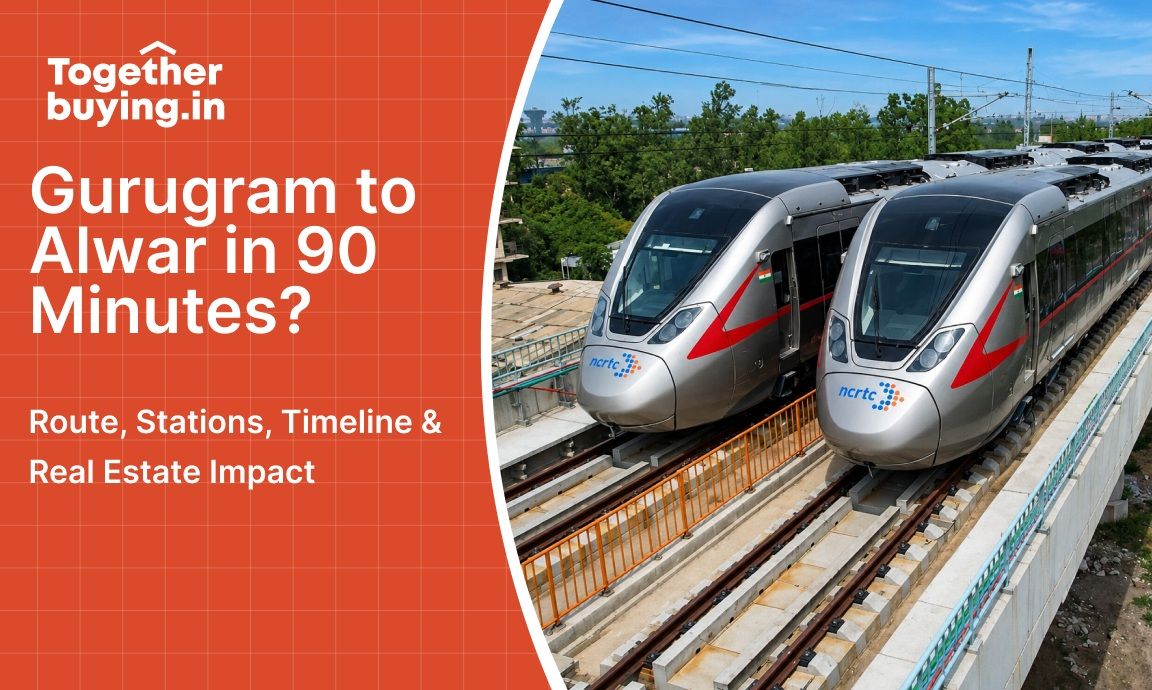
What if you could leave Gurugram after breakfast and reach Alwar in around 90 minutes without worrying about NH-48 traffic? That is the promise of the proposed Delhi–Alwar Namo Bharat corridor, one of the most ambitious transport projects planned for the NCR region.
Anyone who has made the drive from Gurugram toward Rewari, Bawal, or further into Rajasthan knows what NH-48 can turn into during peak hours or monsoon season — a three-to-four-hour grind through some of NCR's busiest industrial traffic. The Delhi–Gurugram–SNB–Alwar corridor, developed under India's Namo Bharat brand by the National Capital Region Transport Corporation (NCRTC), is designed to change that equation entirely.
The proposed Delhi–Alwar Namo Bharat corridor is expected to significantly reduce travel time between Gurugram and Alwar, with reports indicating the journey could take around 90–100 minutes once the full corridor becomes operational. This guide covers what changes for daily travel, why the project matters, the complete route and station list, the latest construction timeline, and — most importantly for TogetherBuying readers — a location-by-location look at what this corridor means for property and investment decisions across Gurugram, Manesar, Dharuhera, Rewari, Bawal, Neemrana, Behror, and Alwar.
Here is the corridor at a glance before diving into the details.
| Parameter | Details |
|---|---|
| Project Name | Delhi–Alwar Namo Bharat Corridor |
| Length | ~164 km |
| Stations | 22 |
| Maximum Speed | 180 kmph |
| Operational Speed | 160 kmph |
| Route | Delhi–Gurugram–Rewari–Bawal–Neemrana–Alwar |
| Travel Time | Around 90–100 minutes |
| Status | Planning / Approval Stage |
| Implementing Agency | NCRTC |
Before getting into the project's technical details, here's the practical picture: what actually changes for someone making this journey regularly.
| Travel Aspect | Today | After Namo Bharat |
|---|---|---|
| Travel Time | 3–4 hours | Around 90–100 minutes |
| Reliability | Traffic dependent | Scheduled rail service |
| Peak-Hour Delays | Common | Significantly reduced |
| Comfort | Road travel | Air-conditioned rapid rail |
| Connectivity | Limited public transport | Direct regional rail network |
For residents, this isn't just a faster commute — it's a shift from an unpredictable, traffic-dependent journey to a scheduled, fixed-duration one. That predictability matters as much as the raw time saving: a 90-minute trip you can plan your day around is a different experience from a "3 hours, maybe 4" drive that depends on the time of day, the weather, and whatever's happening on NH-48 that morning. For daily commuters working in Gurugram but living further down the corridor, and for industrial workers moving between Manesar, Dharuhera, and Rewari, this shift from road dependency to rail reliability is the project's most immediate, tangible benefit.
This corridor isn't just about shaving time off a commute. It sits at the intersection of several major forces reshaping the NCR region.
NH-48 congestion has outgrown the highway's capacity. As the primary road link between Delhi, Gurugram, and the Haryana–Rajasthan industrial belt, NH-48 now carries a mix of daily commuter traffic, inter-state freight, and rapidly growing local vehicle ownership a combination that has made peak-hour travel increasingly unpredictable.
NCR's population and workforce keep expanding outward. As Gurugram's core has matured and prices have climbed, both residents and employers have pushed further down the corridor toward Manesar, Dharuhera, and Rewari, increasing the daily volume of people who need fast, reliable transit between these towns and Delhi.
Industrial workforce mobility is a real economic bottleneck. The manufacturing clusters along this belt — auto components in Manesar, Hero MotoCorp's ecosystem in Dharuhera, the wider Rewari–Bawal industrial zone — depend on large daily inflows of skilled and semi-skilled labor. Faster transit directly expands how far companies can recruit from without requiring relocation.
The corridor runs through the Delhi–Mumbai Industrial Corridor (DMIC). This roughly $90-billion India–Japan infrastructure initiative includes two investment regions directly on this alignment — Manesar–Bawal in Haryana and Khushkhera–Bhiwadi–Neemrana in Rajasthan — making this one of the few RRTS corridors in India that doubles as a backbone for an active industrial megaproject.
Housing demand is rising well beyond Gurugram's city limits. As affordability pressure pushes homebuyers and investors outward, towns like Dharuhera, Rewari, and Bawal are increasingly being evaluated on their own merits — and a credible rail connectivity story changes that calculus meaningfully.
Beyond the headline travel-time numbers, the Delhi–Alwar corridor is likely to reshape ordinary routines for thousands of households along the route in fairly concrete ways:
Living in Rewari and working in Gurugram: A commute that today eats 2.5 - 3 hours each way to Delhi — and a similarly long haul to Gurugram by road — could shrink enough to make a daily commute realistic rather than exhausting, opening up Rewari as a genuine residential option for people who currently feel tied to Gurugram's expensive housing market.
Living in Neemrana and accessing NCR jobs: For a town that already has a strong industrial base but limited fast transit, rail access into Gurugram and Delhi would widen the pool of NCR jobs that are practically reachable without relocating, benefiting both employees and the companies trying to hire them.
Easier airport access: With the alignment routing through Aerocity, travelers from Manesar, Dharuhera, Rewari, and further down the corridor would gain a more predictable rail option to IGI Airport, removing one of the more stressful variables in pre-flight planning — road traffic on travel day.
Students traveling between cities: Students based in towns like Rewari or Bawal who study or take coaching in Gurugram or Delhi could see a meaningful cut in daily or weekly travel time, making it more feasible to commute rather than relocate for education.
Business travel: for the industrial and trading businesses concentrated along this belt, a fixed-duration rail option between Delhi, Gurugram, and the Rewari–Bawal–Neemrana cluster would make same-day round trips for meetings, vendor visits, or factory inspections far more practical than they are on today's traffic-dependent roads.
At full build-out, the corridor is designed to run approximately 164 km from Sarai Kale Khan in Delhi through Gurugram, Dharuhera, Rewari, the SNB (Shahjahanpur–Neemrana–Behror) urban complex, and on to Alwar, with 22 stations across the main line and spur sections. Trains are designed for a top speed of 180 kmph, an operational speed of 160 kmph, and an average speed of around 100 kmph factoring in stops.
The corridor's alignment, town by town:
Delhi → Aerocity → Gurugram → Manesar → Dharuhera → Rewari → Bawal → Neemrana → Behror → Alwar
This route largely tracks NH-48, threading through Delhi's airport zone, Gurugram's commercial core, and the dense industrial belt that stretches from Manesar through to the Rajasthan border, before continuing into Alwar district.
| Segment | Key Locations |
|---|---|
| Delhi | Sarai Kale Khan, INA, Aerocity |
| Gurugram | Cyber City, IFFCO Chowk, Rajiv Chowk |
| New Gurugram | Kherki Daula, Manesar |
| Haryana Industrial Belt | Dharuhera, Rewari, Bawal |
| Rajasthan | Neemrana, Behror, Alwar |
Delhi: Sarai Kale Khan, INA, Munirka, Aerocity Gurugram: Cyber City, IFFCO Chowk, Rajiv Chowk, Hero Honda Chowk, Kherki Daula, Manesar, Panchgaon, Bilaspur Chowk Rewari district: Dharuhera Depot, MBIR, Rewari, Bawal Rajasthan: SNB Urban Complex, Khairthal, Alwar Spur line: Shahjahanpur, Neemrana, Behror, Sotanala
Sarai Kale Khan in Delhi is the convergence point for all Phase-1 RRTS lines, linking this corridor to the already-operational Delhi–Meerut line and the planned Delhi–Panipat corridor. Within Gurugram, IFFCO Chowk and Rajiv Chowk are designed to interchange with Delhi Metro's Yellow Line, and the alignment routes through Aerocity, connecting directly to Delhi's IGI Airport.
| Factor | Today | After Namo Bharat |
|---|---|---|
| Gurugram–Alwar Travel Time | 3–4 hours | Around 90–100 minutes |
| Rewari–Delhi Travel Time | 2.5–3 hours | Under 1 hour |
| Delhi–Alwar Travel Time | 4+ hours | Around 2 hours |
| Connectivity Type | Road-dominated, traffic-dependent | High-speed regional rail |
| Gurugram–Rewari/Bawal Travel Time | 1.5–2 hours | Approx. 30–45 minutes |
| Delhi–Behror Travel Time | 2.5–3.5 hours | Under 70 minutes |
These reductions are the project's core value proposition: converting some of NCR's most congestion-prone commutes into predictable, sub-90-minute or sub-two-hour journeys, with the largest proportional gains for towns furthest from Delhi by road today.
The corridor has moved through several concrete milestones over the past year. In November 2025, the Public Investment Board cleared the Sarai Kale Khan–Bawal corridor (alongside a separate Sarai Kale Khan–Karnal line), together valued at approximately ₹65,000 crore, sending it forward for Union Cabinet approval. In January 2026, the Union Ministry of Housing and Urban Affairs formally approved the Delhi–Bawal section as the confirmed first phase of construction. By February 2026, the 93.1-km Delhi–Bawal line — combining 55.2 km of elevated track and 37.9 km underground, with 13 new stations — was awaiting final Union Cabinet sign-off, and as of March 2026 remained under active government consideration at that stage. NCRTC has also floated a General Consultant tender, with bid submissions drawing interest from more than 30 infrastructure and consultancy firms.
Current reports indicate construction could begin around 2026, with operations targeted around 2031, subject to approvals and project execution. The extension beyond Bawal toward Behror and Alwar is planned for a subsequent phase, with its own approval and construction timeline still to be finalized.
| Project Parameter | Detail |
|---|---|
| Estimated Phase-1 Cost | ₹32,000–37,000 crore (varies by source and revision) |
| Funding Sources | Central and state government contribution, plus loans from World Bank, ADB, and JICA |
| Estimated Daily Ridership | 8.5–9+ lakh passengers per day by 2030 |
| Construction Start | Targeted around 2026 |
| Commissioning Target | Targeted around 2031 |
Gurugram gains the corridor's densest interchange access, with Cyber City, IFFCO Chowk, Rajiv Chowk, and Kherki Daula linking the city's commercial core directly into the wider Namo Bharat network, Delhi Metro, and the airport.
Manesar benefits as a major auto-component manufacturing hub, where faster, more predictable transit widens the practical commuting radius for its large daily workforce.
Dharuhera, anchored by Hero MotoCorp and an established ancillary industrial base, gains a planned RRTS depot and station that reinforces its position as a residential and industrial alternative to Gurugram.
Rewari stands to see the most dramatic proportional time saving on the corridor — from a 2.5–3 hour road journey to Delhi down to a projected under-an-hour commute.
Bawal anchors the corridor's currently confirmed construction phase, with direct DMIC-linked industrial significance.
Neemrana, India's best-known "Japanese zone" for manufacturing investment, gains a meaningful regional rail link as the corridor extends toward Rajasthan.
Behror is set to become an emerging transit node along the Rajasthan stretch of the corridor.
Alwar, the corridor's full terminus and the focal point of most public interest in this project, stands to gain the most transformative long-term connectivity upgrade of any town on the route, anchoring the corridor's growth story into Rajasthan.
The Delhi–Alwar RRTS alignment runs through one of India's most significant industrial development zones: the Delhi–Mumbai Industrial Corridor (DMIC), a roughly $90-billion India–Japan infrastructure initiative. Two DMIC investment regions sit directly on or near the RRTS route — the Manesar–Bawal Investment Region in Haryana, a major automotive and component manufacturing cluster, and the Khushkhera–Bhiwadi–Neemrana Investment Region in Rajasthan, a roughly 165 sq. km zone across 42 villages in Alwar district that's home to significant Japanese investment in electronics, auto components, and precision manufacturing, including names like Daikin, Nissin Brake, and Toyoda.
For these industrial clusters, RRTS connectivity functions as workforce infrastructure. Faster, more reliable transit expands the geographic radius from which factories can draw skilled and semi-skilled labor without requiring relocation, while also freeing up NH-48's road capacity for the logistics and freight movement tied to the DMIC's dedicated freight corridor. RRTS is best understood as a strong complement to this industrial growth story; land cost, state industrial policy, and freight infrastructure all play comparably important roles alongside it.
This is where the Delhi–Alwar corridor's significance extends well beyond commute times. Each town along the alignment is at a different stage of infrastructure maturity, industrial demand, and housing development — and these differences matter directly for property decisions.
| Location | Why It Matters |
|---|---|
| New Gurugram | Established employment hub with mature commercial and residential infrastructure. |
| Manesar | Major manufacturing growth corridor with multiple converging transit projects. |
| Dharuhera | Affordable alternative to Gurugram, anchored by Hero MotoCorp's industrial base. |
| Rewari | Among the largest connectivity gains on the corridor, from hours to under an hour to Delhi. |
| Bawal | Anchors the corridor's currently confirmed construction phase. |
| Neemrana | India's leading Japanese industrial zone, with active developer interest already in place. |
| Behror | Emerging transit node positioned for growth as the Rajasthan stretch develops. |
| Alwar | Long-term growth potential as the corridor's eventual full terminus. |
Already NCR's most mature corridor market, with strong existing connectivity via NH-48, Dwarka Expressway, and Delhi Metro's Yellow Line. RRTS adds a regional layer atop this, but with average rates already around ₹12,982 per sq. ft., appreciation here is likely to be proportionally smaller than in less-developed corridor towns — best suited to buyers prioritizing immediate livability over upside.
Existing connectivity: NH-48 access plus Rapid Metro and Delhi Metro extension plans already shaping the market. Upcoming infrastructure: RRTS station planned; multiple transit projects converging in this micro-market. Housing demand: Growing, driven by industrial workforce needs. Industrial demand: Very high — established auto-component manufacturing base. Long-term investment potential: Favorable, with multiple infrastructure tailwinds beyond RRTS alone. Risks/limitations: Industrial-residential mix can mean uneven amenity development; verify specific micro-market maturity before investing.
An affordable alternative to Gurugram, anchored by Hero MotoCorp's industrial base, with a planned RRTS depot and station along the corridor. Plotted listings range broadly from roughly ₹35 lakh for compact plots to several crore for larger industrial-adjacent parcels. Infrastructure and social amenities are still maturing relative to Gurugram or Manesar, but the combination of industrial demand and rail access makes it a reasonable mid-tier option.
Existing connectivity: Established rail junction town with existing Indian Railways service, plus NH-48 access. Upcoming infrastructure: Confirmed RRTS station within the corridor's current construction phase. Housing demand: Comparatively affordable entry point; average rates around ₹4,214 per sq. ft. Industrial demand: Growing, supported by its position within the broader Manesar–Bawal industrial belt. Long-term investment potential: Among the strongest connectivity-improvement stories on the corridor, given the scale of projected time savings to Delhi. Risks/limitations: Commissioning isn't expected before 2031 at the earliest; treat near-term price moves as anticipatory rather than confirmed.
Existing connectivity: NH-48 access; part of the DMIC's Manesar–Bawal investment node. Upcoming infrastructure: Anchors the corridor's currently confirmed construction phase — the most concrete connectivity commitment among the towns closer to Rajasthan. Housing demand: Emerging, tied closely to industrial employment. Industrial demand: High, as a core DMIC node. Long-term investment potential: Strong relative to neighboring towns given its confirmed phase status. Risks/limitations: Infrastructure and social amenities still developing relative to Gurugram or Manesar.
Existing connectivity: NH-48 access; established industrial and institutional presence (NIIT, Rai University, and others already operational). Upcoming infrastructure: RRTS access planned as the corridor extends toward Rajasthan. Housing demand: Active developer interest already present (Ashiyana Housing, Eldeco, Anantraj, and others). Industrial demand: Very high — India's best-known cluster of Japanese manufacturing investment (Daikin, Nissin Brake, Toyoda, Mitsui). Long-term investment potential: Meaningful, underpinned by strong DMIC industrial momentum alongside the corridor's eventual arrival. Risks/limitations: As with any pre-construction phase further from Delhi, exact station service patterns are still being finalized — worth confirming details before treating connectivity as immediate.
An emerging transit node along the Rajasthan stretch, currently less developed than Neemrana, with housing demand at an early stage and industrial demand tied to broader DMIC expansion in the region. Best suited to patient, longer-horizon investors willing to wait as this part of the corridor develops.
Existing connectivity: Indian Railways service to Delhi and Jaipur; NH-48 road access. Upcoming infrastructure: Full corridor terminus, anchoring the project's long-term growth narrative into Rajasthan. Housing demand: Significant interest, driven substantially by the broader Namo Bharat connectivity story. Industrial demand: Growing, supported by proximity to the Khushkhera–Bhiwadi–Neemrana belt. Long-term investment potential: Strong over the long run, best suited to investors comfortable with a multi-year project horizon. Risks/limitations: As the corridor's furthest point from Delhi, Alwar's connectivity timeline sits later than the towns covered under the current confirmed construction phase — worth factoring into any near-term decision-making.
End users looking for an immediate, livable home with genuine current-day connectivity should prioritize towns with strong existing road and rail access today — Gurugram, Manesar, and Rewari — rather than buying purely on anticipated RRTS timelines.
Long-term investors comfortable with a 5–8 year horizon may find Bawal and Rewari offer the most concrete RRTS-linked thesis at present, given their place within the corridor's currently confirmed construction phase, while Neemrana, Behror, and Alwar represent longer-duration plays tied to the corridor's full build-out.
Industrial investors — those looking at warehousing, logistics, or manufacturing-adjacent land — should evaluate the DMIC investment-region boundaries (Manesar–Bawal and Khushkhera–Bhiwadi–Neemrana) on their own industrial fundamentals, since demand here is driven by multiple factors beyond RRTS timing alone.
Rental yield seekers are likely to find the strongest near-term opportunity in towns with active, employed industrial workforces today — Manesar and Dharuhera in particular — where rental demand is tied to current employment rather than future infrastructure.
No location on this list should be treated as guaranteed to appreciate. Infrastructure-linked real estate decisions should always be weighed against confirmed project milestones, not announcement-stage projections alone.
| Network Element | Connection Point | Status |
|---|---|---|
| Sarai Kale Khan Hub | Convergence for Delhi–Meerut, Delhi–Alwar, and future Delhi–Panipat lines | Operational hub (Meerut line running) |
| Delhi–Meerut Namo Bharat | Interchange at Sarai Kale Khan | Fully operational |
| Delhi–Panipat Namo Bharat | Shares Sarai Kale Khan origin; related Delhi–Karnal extension approved by Haryana Cabinet (March 2026) | DPR / Approval Stage |
| Delhi Metro | Yellow Line interchange at IFFCO Chowk / Rajiv Chowk | Planned |
| IGI Airport | Corridor routes via Aerocity | Part of approved alignment |
The strategic intent behind this design is a genuinely interoperable regional network — allowing a single Namo Bharat journey to potentially span from Meerut through Delhi into Gurugram and the Haryana–Rajasthan industrial belt without separate ticketing or transfer friction at each leg.
The Delhi–Alwar line is one of three Phase-1 RRTS corridors identified for the NCR region, each at a different stage of development:
| Corridor | Length | Status |
|---|---|---|
| Delhi–Meerut | 82.15 km | Operational (New Ashok Nagar–Meerut South section running) |
| Delhi–Alwar | ~164 km (Phase 1: Sarai Kale Khan–Bawal, ~93–102 km) | Planned; Phase 1 awaiting Union Cabinet approval |
| Delhi–Panipat–Karnal | 136.3 km | Planned; Haryana Cabinet approved March 2026 |
The Delhi–Meerut corridor remains the only fully operational Namo Bharat line in India today, giving NCRTC a proven operational template to apply to the Alwar and Panipat–Karnal corridors. Among the two corridors still in planning, the Delhi–Alwar line's Phase 1 has progressed slightly further through the approval pipeline, having cleared the Public Investment Board and ministry stages ahead of the Delhi–Karnal line's Haryana Cabinet approval — though both remain pre-construction as of mid-2026.
A balanced view of what could still shape this project's pace: a meaningful share of project funding depends on foreign loans (World Bank, ADB, JICA), each with its own approval process distinct from domestic government clearance. The project's own history is also instructive — the original DPR was approved in December 2018, and as of mid-2026, construction on even the confirmed first phase has not yet begun, suggesting the 2031 commissioning target is best treated as directional. The Phase-1 terminus has also already shifted once, from Dharuhera to Bawal, showing that scope can evolve with regional priorities even after initial approval.
Despite these factors, the project carries real momentum: Public Investment Board clearance, ministry-level approval, active tendering, and strong consultant interest all point toward forward movement. The realistic outlook is a confirmed, under-construction Delhi–Bawal corridor by the second half of 2026, with the extension toward Alwar following as the project progresses through its next phase of approvals.
Reports indicate the journey could take around 90–100 minutes once the full corridor is operational, based on the system's design speed of up to 180 kmph and average operating speed of around 100 kmph.
As of early-to-mid 2026, the Delhi–Bawal phase has cleared the Public Investment Board and Ministry of Housing and Urban Affairs stages and is awaiting final Union Cabinet approval, with construction targeted to begin around 2026.
Sarai Kale Khan (Delhi) to Bawal (Haryana), approximately 93–102 km, via Gurugram, Manesar, Dharuhera, and Rewari. The extension toward Behror and Alwar follows in a subsequent phase.
Stations include Sarai Kale Khan, INA, Munirka, Aerocity, Cyber City, IFFCO Chowk, Rajiv Chowk, Hero Honda Chowk, Kherki Daula, Manesar, Panchgaon, Bilaspur Chowk, Dharuhera Depot, MBIR, Rewari, Bawal, SNB, Khairthal, and Alwar, with Shahjahanpur, Neemrana, Behror, and Sotanala on a spur line.
SNB stands for Shahjahanpur–Neemrana–Behror, an urban complex straddling the Haryana–Rajasthan border that serves as a key station cluster on the corridor.
Yes — Neemrana is included in the corridor's station planning as part of the Rajasthan extension.
Up to 180 kmph design speed, 160 kmph operational speed, with an average speed of around 100 kmph factoring in station stops.
Construction is targeted to begin around 2026, with commissioning targeted around 2031 for the confirmed Delhi–Bawal first phase, with the Alwar extension to follow in the corridor's next phase. These dates remain subject to final approvals and project execution.
Likely positively across the corridor, with towns in the current construction phase (Gurugram through Bawal) showing the most immediate market response, while Neemrana, Behror, and Alwar represent longer-term growth potential as the project extends into Rajasthan.
Yes — the corridor interchanges with Delhi Metro's Yellow Line in Gurugram and converges with the operational Delhi–Meerut RRTS and the planned Delhi–Panipat RRTS at Sarai Kale Khan in Delhi.
Yes — the alignment routes through Aerocity, which connects directly to Delhi's IGI Airport, giving towns along the corridor a more predictable rail option for airport access compared to relying on NH-48 traffic.
Rewari and Bawal commuters see the clearest projected benefit, with current 2.5–3 hour road journeys to Delhi potentially falling to under an hour once the first phase is operational.
Estimates for the first phase range from roughly ₹32,000 crore to ₹37,000 crore across different sources, reflecting the project's multiple DPR revisions since 2018.
Manesar, Rewari, Bawal, Neemrana, and Alwar are the areas most likely to see the strongest real estate demand from this corridor. Manesar and Rewari combine established industrial activity with major projected connectivity gains, Bawal anchors the corridor's currently confirmed construction phase, and Neemrana and Alwar carry strong long-term potential tied to the project's extension into Rajasthan and the broader Delhi–Mumbai Industrial Corridor.
Contact Us
Fill out this form
& we'll get back
to you
Recommended for you