Group Buying
How to Invest in Real Estate in Noida with Group Buying Discount?

24 Jul 2026
Group Buying
24 Jul 2026
Content
No Blogs content found
It looks like there haven’t been any blogs yet!
Two buyers walk into the same project launch. They book identical apartments on the same floor. One pays ₹85 lakhs. The other pays ₹79 lakhs. Same unit type, same builder, same day. The difference? One buyer came alone. The other came as part of a group. This guide explains exactly how group buying works in Noida real estate, what costs you can negotiate, what you cannot, and how to avoid the most common mistakes buyers make when chasing a deal.
Noida's rise as a property investment destination is not accidental. It is the result of deliberate infrastructure investment, policy-backed commercial development, and consistent demand from a growing working population.
Employment and IT sector growth have made Noida and Greater Noida major employment hubs. Sectors 62, 63, and 132 along the Noida Expressway house major IT parks and corporate campuses. This concentration of working professionals generates sustained rental demand and pushes capital values upward over time.
Metro connectivity has expanded significantly. The NMRC Aqua Line currently connects Noida Sector 51 to Depot Station in Greater Noida. An extension from Sector 51 to Knowledge Park-V, spanning 17.435 km with 11 elevated metro stations, has been proposed and is under planning as per NMRC official records. This, once implemented, will connect more residential corridors to commercial zones.
Expressway infrastructure:- the Noida-Greater Noida Expressway, Yamuna Expressway, and Eastern Peripheral Expressway have opened up large land parcels for residential development and reduced commute times considerably.
Jewar International Airport, being developed under Yamuna Expressway Industrial Development Authority (YEIDA), is a key demand driver for the region. Properties along the Yamuna Expressway corridor are particularly sensitive to this project's development timeline. Buyers should verify current construction status directly with YEIDA before factoring airport proximity into investment decisions.
Commercial development in sectors like 18, 62, 125, and 132 continues to attract businesses and retailers, creating a multiplier effect on nearby residential demand.
According to NHB RESIDEX, Noida recorded 7.0% housing price index growth in Q4 FY 2024–25. The national 50-city index expanded 1.8% quarter-on-quarter in October–December 2025. Noida's growth rate has consistently outpaced the national average, though past performance does not guarantee future returns.
This is one of the least understood aspects of Indian real estate, and it costs uninformed buyers real money.
Builders do not operate like fixed-price retailers. They use dynamic pricing strategies that shift based on inventory levels, sales velocity, launch timelines, and seasonal demand.
Launch pricing is typically the sharpest. Developers price early inventory attractively to generate momentum, collect bookings, and fund construction. Once a project gains traction, prices rise in tranches.
Inventory management also plays a role. A builder sitting on unsold units at a project's later stage may offer select buyers better terms to clear inventory before the financial year closes.
Sales targets and festival offers create short windows where pricing flexibility opens up. End-of-quarter targets, Diwali campaigns, and builder anniversaries often come with price adjustments or waived charges.
Negotiation is the most underrated factor. Buyers who understand the full cost structure of a property and who demonstrate credible intent to book often receive better terms than buyers who simply ask for a discount. Group buying formalizes and scales this last point.
Group buying in real estate is a process where multiple individual buyers aggregate their collective purchasing intent to negotiate better commercial terms from a developer.
It is not co-ownership. It is not fractional investing. Each buyer in a group buys their own unit, signs their own Builder Buyer Agreement, applies for their own home loan, and holds individual ownership.
The mechanism works because developers value certainty. A group of ten confirmed buyers represents ten guaranteed bookings in a short window. That predictability has value for a developer managing cash flows and sales timelines.
A confirmed group of buyers reduces a developer's marketing spend per unit, shortens the sales cycle, and allows them to meet booking targets efficiently. The discount they offer is partially funded by the savings these efficiencies create.
Better pricing on builder-controlled cost components, greater transparency in cost sheets, and access to collective negotiation that individual buyers rarely achieve on their own.
Understanding what is negotiable and what is not - is the most important financial literacy a property buyer can have.
| Cost Component | What It Is | Negotiable? |
|---|---|---|
| BSP (Basic Sale Price) | The base price per sq. ft. charged by the builder | Yes |
| PLC (Preferential Location Charges) | Premium for floor, view, or facing | Yes |
| Floor Rise Charges | Per-floor increase added to BSP | Yes |
| Parking Charges | Cost of allocated parking space | Yes |
| Club Membership Fee | One-time charge for club/amenity access | Yes |
| Payment Plan Benefits | Subvention schemes, flexi plans, construction-linked plans | Yes |
| Launch-Linked Offers | Early booking benefits, free fittings, waived charges | Yes |
| Cost Component | Rate (Noida, 2026–27) | Set By |
|---|---|---|
| GST | 5% on under-construction properties | Government of India |
| Stamp Duty (Male) | 8% (7% + 1% surcharge) | Govt. of Uttar Pradesh |
| Stamp Duty (Female) | 7% (6% + 1% surcharge) | Govt. of Uttar Pradesh |
| Stamp Duty (Joint) | 7.5% (6.5% + 1% surcharge) | Govt. of Uttar Pradesh |
| Registration Charges | 1% of property value | Noida Authority |
| TDS | 1% on property above ₹50 lakhs | Income Tax Act |
No group, negotiator, or platform can change statutory government charges. Any claim to the contrary is false.
Under UP-RERA rules and Noida Authority guidelines, Builder Buyer Agreement registration is required upon payment of 10% of the total property price. Buyers should confirm the current applicable threshold with UP-RERA or a legal advisor before booking.
You register with a group buying platform or coordinator and share your basic requirements budget, location preference, unit type, and timeline.
The platform assesses your financial readiness, intended use (end-use or investment), and preferred possession timeline. This shapes which projects you get matched to.
Projects are shortlisted based on RERA registration status, builder reputation, construction progress, and fit with buyer profiles across the forming group.
Buyers with compatible requirements are grouped. Group size varies by platform and project. A typical group may range from 5 to 30+ buyers.
The platform or designated negotiator approaches the builder with a confirmed group booking proposal. Negotiations cover BSP, PLC, floor rise, parking, club charges, and payment plan terms.
The builder provides a revised cost sheet. All buyers review the full cost sheet independently including all statutory charges, before making a decision.
Each buyer books independently, signs their own BBA, and conducts their own legal due diligence. Group membership does not create shared legal liability.
Each buyer arranges their own home loan, if required. The property is registered in the individual buyer's name.
The following table uses illustrative figures to demonstrate how cost structures compare. Actual figures will vary by project, builder, and negotiation outcome.
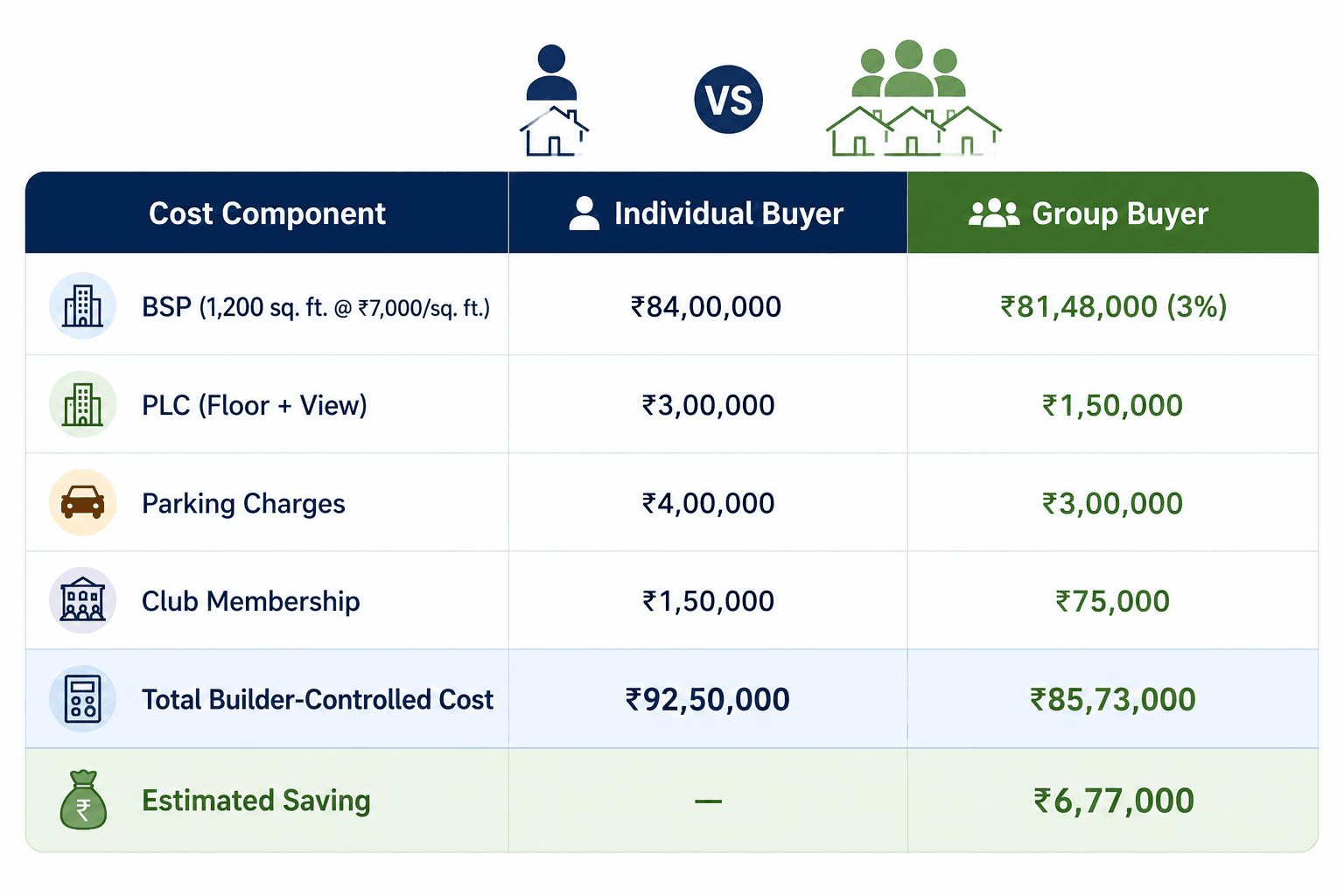
Note: Statutory charges (GST, Stamp Duty, Registration, TDS) are identical for both buyers and are not shown here.
Choosing a project is more consequential than choosing a discount.
Yes. Group buying in real estate is a form of collective negotiation. It is fully legal under Indian law.
Each buyer in a group buying arrangement maintains complete independence. You sign your own Builder Buyer Agreement with the developer. Your name goes on the property title. You apply for and service your own home loan. You are not entering into any shared ownership arrangement with other group members.
Group buying is not fractional ownership, which involves multiple parties holding shares in a single property. It is not a real estate investment trust (REIT). It is not a chit fund or investment scheme.
The group's role ends at the point of negotiation. After that, the transaction between each buyer and the builder is entirely individual. There is no pooled fund, no shared liability, and no common agreement between buyers.
TogetherBuying connects individual property buyers and facilitates collective negotiations with developers on their behalf. The platform focuses specifically on builder-controlled cost components including BSP, PLC, parking, and club charges where negotiation outcomes are possible.
Discounts and commercial terms vary by project, group size, and builder participation. TogetherBuying does not guarantee a fixed discount percentage or specific outcome for any individual transaction. Statutory charges GST, Stamp Duty, Registration, and TDS remain unchanged for all buyers, regardless of platform. TogetherBuying does not claim to reduce or alter these charges.
Each buyer who proceeds to book through a TogetherBuying-facilitated deal signs their own BBA directly with the developer. Ownership is individual. Financing is individual. Legal due diligence remains the buyer's own responsibility, and TogetherBuying recommends independent legal review before any booking is completed.
The platform shortlists projects based on RERA registration status, builder track record, and alignment with buyer profiles. However, buyers should independently verify all project details on the UP-RERA portal and conduct their own due diligence before committing funds.
Noida's real estate market offers genuine opportunities for both end-users and investors. The infrastructure is real, the demand drivers are verifiable, and the pricing flexibility that exists in the market can be accessed if you know how.
Group buying is one structured way to access that flexibility. It works best when buyers enter the process informed about what is negotiable, what is not, and what due diligence they must complete regardless of the group's involvement.
Before you join any group buying arrangement, verify the project on UP-RERA, review the full cost sheet independently, and have your BBA examined by a legal advisor. The savings matter. The asset you are buying matters more.
Group buying in real estate is a process where multiple individual buyers pool their collective purchasing intent to negotiate better commercial terms such as lower BSP, reduced PLC, or waived charges from a developer. Each buyer transacts independently, with their own BBA and ownership.
Yes. Group buying is collective negotiation and is fully legal. Buyers sign individual Builder Buyer Agreements, hold individual property titles, and arrange independent financing. It is not fractional ownership or a shared investment scheme.
Yes. Your home loan eligibility and application are entirely independent of the group. Banks and NBFCs assess your individual income, credit history, and property documents. Group participation does not affect your loan eligibility.
No buyer funds are pooled in a legitimate group buying arrangement. You pay the developer directly after signing your BBA. Ensure the developer is RERA-registered and that your BBA is reviewed by an independent legal advisor before any payment is made.
Discounts depend on the project, builder, group size, and negotiation outcome. There is no fixed or guaranteed discount range. Some buyers receive waivers on PLC or parking; others may receive a percentage reduction on BSP. Statutory charges are never discounted.
This depends on the terms of the group buying platform or coordinator. Most arrangements allow buyers to exit before the BBA is signed and the booking amount is paid. After booking, you are bound by the developer's cancellation and refund policy.
Builder-controlled charges can be negotiated: BSP, PLC, floor rise, parking, club membership, and payment plan terms. Statutory charges - GST, Stamp Duty, Registration, and TDS are fixed by law and cannot be negotiated.
For FY 2026–27, stamp duty in Noida is 8% for male buyers (7% + 1% surcharge), 7% for female buyers (6% + 1% surcharge), and 7.5% for joint registrations (6.5% + 1% surcharge). Registration charges are approximately 1% of the property value.
Yes. NRI buyers can participate in group buying. However, NRIs must ensure compliance with FEMA regulations, applicable TDS provisions (typically 20% for NRI seller transactions under Section 195 of the Income Tax Act), and repatriation rules. Independent legal and tax advice is strongly recommended.
Yes. Group buying can be particularly effective for luxury apartments because the absolute savings on high-value transactions are more significant. However, premium developers with strong sales pipelines may have less incentive to offer substantial discounts.
Group formation and negotiation timelines vary by platform and project. The process typically takes two to six weeks from initial registration to a confirmed builder offer. If your purchase timeline is urgent, factor this into your planning.
BSP stands for Basic Sale Price. It is the base price per square foot charged by the builder, calculated on the super built-up area. BSP does not include PLC, floor rise, parking, club membership, or statutory charges. The total cost of a property is always significantly higher than BSP alone.
PLC stands for Preferential Location Charges. It is an additional amount the builder charges for units with a perceived advantage such as a higher floor, a park-facing view, or a corner unit. PLC is a builder-controlled charge and can be negotiated.
Check the project's RERA registration number, registered developer name, project area, approved number of units, sanctioned plans, and registered possession date. Cross-check this against what the builder's sales team has told you. If there are discrepancies, seek clarification before booking.
The carpet area is the actual usable floor space inside the apartment walls. Super built-up area includes carpet area plus proportionate share of common areas lobbies, staircases, lifts, and amenity spaces. Under RERA, builders must disclose and price properties on carpet areas, but many still quote super built-up areas informally. Always confirm the carpet area before comparing prices across projects.
It depends on your priorities. Ready-to-move units eliminate construction risk and GST (which applies only to under-construction properties). Under-construction units typically offer lower entry prices but carry possession risk and require careful evaluation of builder track record. Neither is universally better the right choice depends on your budget, timeline, and risk tolerance.
A BBA is the legal contract between a property buyer and the developer. It outlines the unit details, agreed price, payment schedule, possession date, penalty clauses, and other rights and obligations. Under UP-RERA and Noida Authority rules, BBA registration is required upon payment of 10% of the total property price. Have the BBA reviewed by an independent lawyer before signing.
Contact Us
Fill out this form
& we'll get back
to you
Recommended for you