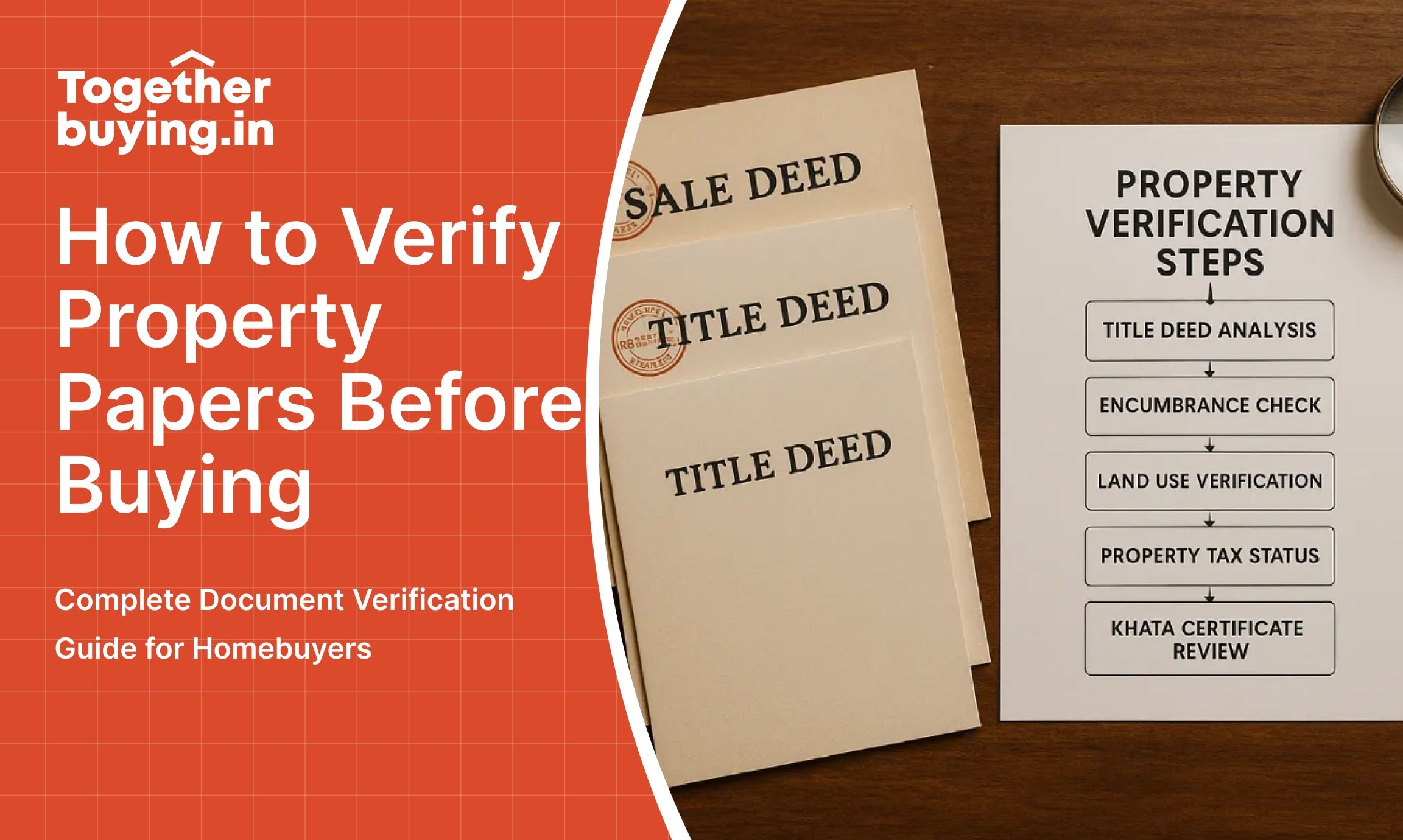
Property document verification stands as the most critical step in the home buying process, protecting buyers from fraud, legal disputes, and financial losses. According to NITI Aayog, nearly two-thirds of civil cases in Indian courts are related to property disputes. This comprehensive guide provides homebuyers with essential knowledge to verify property papers systematically and avoid costly mistakes.
Understanding Property Document Verification
Document verification confirms that the seller has legal rights to transfer ownership and ensures the property is legally transferable, compliant with local laws, and financially secure. This process protects buyers from ownership disputes, illegal construction, hidden loans, or demolition orders.
Property document verification involves checking legal ownership, title clarity, regulatory approvals, financial liabilities, and usage permissions through official documents. The verification process requires systematic examination of multiple documents to ensure complete legal and financial transparency.
Essential Property Documents to Verify
1. Title Deed (Sale Deed)
The title deed represents the most important property document, providing legal proof of ownership. This document legally proves who owns the property and establishes the foundation for all property transactions.
Key verification points:
- Seller's name matches the title deed exactly
- Property description includes accurate size, survey number, boundaries, and address
- Deed is properly registered at the Sub Registrar's office
- Chain of ownership remains clear and unbroken for at least 30 years
- No discrepancies in property measurements or boundaries
2. Encumbrance Certificate (EC)
The Encumbrance Certificate is essential for confirming that the property is free from legal claims, mortgages, or disputes. The EC shows whether the property has any financial or legal liabilities during a selected time period.
Verification process:
- Obtain EC from Sub Registrar's office for at least 13 to 30 years
- Check for any loans, mortgages, or legal disputes
- Verify all transactions match the ownership chain
- Ensure no pending litigation or court cases
- Confirm property taxes are current
An Encumbrance Certificate helps buyers make sure the property is free from loans, legal issues, or unpaid dues. Banks usually ask for an EC before approving home loans because it proves the property can be used as security.
3. Khata Certificate and Extract
The Khata certificate shows the property is recorded in municipal records and property tax is being paid. E-Khata is mandatory for official and financial transactions including property tax payment, home loans, resale transactions, and legal verification.
Verification requirements:
- Property is listed in municipal tax records
- Owner's name matches other documents
- Property tax payments are current
- Assessment details are accurate
- No pending dues or violations
4. Approved Building Plan
Thousands of residential constructions proceed without proper building plan approval, leading to penalties, demolition orders, or the inability to get a completion certificate. Building plan approval is formal permission from your local municipal authority confirming construction compliance.
Essential checks:
- Building plan approved by relevant local authority
- Construction matches approved plans
- Floor Area Ratio (FAR) compliance
- Setback norms adherence
- Height restrictions compliance
5. Completion Certificate (CC) and Occupancy Certificate (OC)
The Certificate of Occupancy is the final regulatory document issued by a local building authority confirming that a structure meets all applicable codes and is legally approved for its intended use.
Verification points:
- Completion certificate issued by local authority
- Occupancy certificate for intended use
- All safety and structural inspections passed
- Utility connections approved
- Fire safety clearances obtained
6. Property Tax Receipts
Keeping accurate property tax records helps you avoid unnecessary penalties and ensures compliance with local regulations. Property tax receipts demonstrate ongoing compliance with municipal requirements.
Required verifications:
- Current year property tax paid
- No outstanding dues
- Assessment matches property details
- Receipt from authorized municipal body
- Tax calculation accuracy
7. No Objection Certificates (NOCs)
Various NOCs ensure regulatory compliance across different government departments and authorities.
Environmental Clearance:
- Pollution Control Board approval
- Environmental impact assessment
- Waste management compliance
Fire Department NOC:
- Fire safety measures compliance
- Emergency exit provisions
- Fire fighting equipment installation
Airport Authority NOC:
- Height clearance for properties near airports
- Aviation safety compliance
Electricity Board NOC:
- Power connection approval
- Load sanction certificate
- Safety compliance
Property Title Verification Process
Property title search emphasizes the importance of checking the ownership chain and conducting litigation search for property disputes. Comprehensive title verification protects against future ownership conflicts.
Chain of Title Verification
30 Year Title Search:
- Trace ownership history for minimum 30 years
- Verify each transfer was legal and properly documented
- Check for any gaps in ownership chain
- Ensure all previous owners had clear title
- Identify any potential claims or disputes
Document Authentication:
- Verify registration stamps and seals
- Check document serial numbers
- Confirm registration dates and offices
- Validate witness signatures
- Ensure proper stamp duty payment
Litigation and Dispute Check
Court Records Search:
- Check civil court records for pending cases
- Verify criminal court records
- Search revenue court proceedings
- Check consumer court complaints
- Review arbitration proceedings
Government Records:
- Land acquisition proceedings
- Revenue department disputes
- Municipal violation cases
- Environmental compliance issues
- Tax evasion proceedings
Financial Verification and Due Diligence
Bank and Financial Institution Checks
Loan Verification:
- Check for existing home loans
- Verify personal loans against property
- Confirm business loans secured by property
- Check for any mortgage arrangements
- Verify loan clearance certificates
Financial Institution Records:
- Bank statements of seller
- Income tax returns verification
- Source of funds documentation
- Foreign exchange compliance (for NRI sellers)
- Anti money laundering compliance
Tax Compliance Verification
Income Tax Verification:
- Seller's PAN card verification
- Income tax return filing status
- Capital gains tax compliance
- TDS certificates for property transactions
- Form 26AS verification
Property Tax Compliance:
- Current year tax payment
- Previous years' tax history
- Assessment value verification
- Penalty or interest calculations
- Municipal compliance status
RERA Registration Verification
For under construction projects, RERA registration verification becomes mandatory. Under the Real Estate Regulation and Development Act, 2016, almost all new residential projects above a small threshold must be registered with the state RERA authority.
RERA Verification Steps:
- Check project registration on state RERA website
- Verify developer registration status
- Review project timeline and completion dates
- Check escrow account compliance
- Verify approved project plans
Developer Due Diligence:
- Previous project completion record
- Financial stability assessment
- Compliance history with RERA
- Customer complaint records
- Legal proceedings against developer
Online Verification Tools and Portals
State Government Portals
Karnataka (BBMP):
- E Aasthi portal for Khata verification
- Property tax payment portal
- Building plan approval status
Maharashtra:
- Property card verification
- Stamp duty calculator
- Registration document search
Tamil Nadu:
- TNREGINET for encumbrance certificates
- Property tax online portal
- Survey settlement records
Delhi:
- Property tax online portal
- Building plan approval system
- Land records verification
Central Government Portals
National Government Services Portal:
The portal provides access to various property related services including encumbrance certificate applications across different states.
Digital India Land Records:
- Land ownership verification
- Survey number confirmation
- Revenue records access
- Mutation status check
Common Red Flags and Warning Signs
Document Related Red Flags
Title Issues:
- Gaps in ownership chain
- Multiple claimants to same property
- Disputed boundaries or measurements
- Unregistered sale agreements
- Forged or tampered documents
Financial Red Flags:
- Outstanding loans or mortgages
- Unpaid property taxes
- Pending utility bills
- Court ordered attachments
- Benami property transactions
Legal and Regulatory Issues
Approval Related Problems:
- Construction without approved plans
- Violations of building codes
- Environmental clearance issues
- Unauthorized additions or modifications
- Non compliance with zoning regulations
Ownership Disputes:
- Family property disputes
- Partnership disagreements
- Inheritance related conflicts
- Tenant rights issues
- Government acquisition proceedings
Step by Step Verification Process
Phase 1: Initial Document Collection
From Seller:
- Original title deed and copies
- Latest property tax receipts
- Encumbrance certificate
- Building plan approvals
- Completion and occupancy certificates
From Official Sources:
- Sub registrar office records
- Municipal corporation records
- Revenue department documents
- Court records search
- RERA portal verification
Phase 2: Professional Verification
Legal Expert Consultation:
- Property lawyer review
- Title opinion preparation
- Legal due diligence report
- Risk assessment analysis
- Compliance verification
Technical Verification:
- Property survey and measurement
- Building plan compliance check
- Structural safety assessment
- Utility connections verification
- Environmental compliance review
Phase 3: Final Clearance
Bank and Financial Verification:
- Loan clearance certificates
- No dues certificates
- Tax compliance verification
- Source of funds documentation
- Anti money laundering clearance
Government Clearances:
- Revenue department clearance
- Municipal no objection
- Pollution control board clearance
- Fire department approval
- Other statutory clearances
Technology and Digital Verification
Blockchain and Digital Records
Modern property verification increasingly relies on digital technologies for enhanced security and efficiency.
Digital Document Verification:
- QR code based authentication
- Blockchain based property records
- Digital signature verification
- Online document tracking
- Automated compliance checking
AI Powered Due Diligence:
- Automated document analysis
- Risk assessment algorithms
- Fraud detection systems
- Compliance monitoring tools
- Predictive analytics for disputes
Mobile Applications and Tools
Government Apps:
- State specific property apps
- Tax payment applications
- Document verification tools
- Complaint registration systems
- Status tracking platforms
Digital Verification Tools:
- Property verification services
- Legal tech solutions
- Due diligence automation
- Document management systems
- Risk assessment tools
Cost and Timeline Considerations
Verification Costs
Professional Fees:
- Legal consultation: ₹10,000 to ₹50,000
- Property survey: ₹5,000 to ₹15,000
- Document verification: ₹5,000 to ₹20,000
- Technical inspection: ₹10,000 to ₹25,000
- Total verification cost: ₹30,000 to ₹1,10,000
Government Fees:
- Encumbrance certificate: ₹100 to ₹500
- Property tax verification: ₹50 to ₹200
- Court records search: ₹100 to ₹300
- Registration document copies: ₹50 to ₹100
- NOC applications: ₹500 to ₹2,000
Timeline for Verification
Standard Timeline:
- Document collection: 7 to 15 days
- Legal verification: 15 to 30 days
- Technical inspection: 5 to 10 days
- Government clearances: 15 to 45 days
- Total verification time: 45 to 90 days
Expedited Process:
- Priority legal review: 7 to 15 days
- Fast track inspections: 3 to 7 days
- Express government services: 7 to 15 days
- Total expedited time: 20 to 40 days
State Specific Considerations
Karnataka Property Verification
E-Khata has become an essential document for property owners in Karnataka, with guidance available for checking Draft E-Khata status online through official government portals.
Karnataka Specific Documents:
- E Khata certificate
- BBMP property tax receipts
- BDA/BMRDA approvals
- Karnataka Land Revenue Act compliance
- Stamp duty and registration verification
Maharashtra Property Verification
Maharashtra Specific Requirements:
- Property card verification
- Maharashtra Stamp Act compliance
- RERA registration (MahaRERA)
- Municipal corporation approvals
- Ready reckoner rate verification
Tamil Nadu Property Verification
Tamil Nadu provides specific guidance for property verification, noting that encumbrance certificates are called Villangam Certificate in Tamil and can be obtained through the TNREGINET portal.
Tamil Nadu Specific Documents:
- Patta and Chitta documents
- Village revenue records
- Tamil Nadu Land Reforms Act compliance
- Guideline value verification
- Local body tax compliance
Common Mistakes to Avoid
Documentation Mistakes
Incomplete Verification:
- Skipping encumbrance certificate check
- Not verifying building plan approvals
- Ignoring property tax compliance
- Missing NOC requirements
- Inadequate title chain verification
Timing Errors:
- Starting verification too late
- Not allowing sufficient time
- Rushing through critical checks
- Missing deadline dependencies
- Poor coordination with stakeholders
Legal and Financial Oversights
Legal Mistakes:
- Not consulting property lawyers
- Ignoring pending litigation
- Missing compliance requirements
- Inadequate due diligence
- Poor risk assessment
Financial Errors:
- Not checking loan liabilities
- Missing tax compliance
- Ignoring hidden costs
- Inadequate fund verification
- Poor financial planning
Future Trends in Property Verification
Digital Transformation
Emerging Technologies:
- Artificial intelligence for document analysis
- Blockchain for secure record keeping
- IoT for property monitoring
- Machine learning for fraud detection
- Automated compliance checking
Government Initiatives:
- Digital India land records
- One nation one registration
- Integrated property databases
- Online dispute resolution
- Paperless transactions
Regulatory Evolution
Enhanced Consumer Protection:
- Stricter disclosure requirements
- Faster dispute resolution
- Better regulatory oversight
- Improved transparency standards
- Stronger penalty frameworks
Technology Integration:
- Mandatory digital records
- Automated verification systems
- Real time compliance monitoring
- Integrated government databases
- Enhanced security protocols
Conclusion
Property document verification represents the foundation of secure real estate investment in India. With nearly two thirds of civil cases in Indian courts related to property disputes, thorough verification protects buyers from fraud, legal complications, and financial losses.
The verification process requires systematic checking of multiple documents including title deeds, encumbrance certificates, building approvals, tax receipts, and various clearances. Modern technology has simplified many verification processes through online portals and digital records, though professional legal assistance remains valuable for complex transactions.
Successful property verification demands adequate time allocation, typically 45 to 90 days, and professional investment of ₹30,000 to ₹1,10,000. This investment prevents much larger potential losses from legal disputes, ownership conflicts, or regulatory violations.
The evolving regulatory landscape, enhanced by RERA implementation and digital transformation initiatives, continues to improve transparency and consumer protection in real estate transactions. However, buyer vigilance and thorough due diligence remain essential for secure property ownership.
Frequently Asked Questions
1. What is the most important document to verify when buying property?
The title deed is the most critical document as it provides legal proof of ownership. However, comprehensive verification requires checking multiple documents including the encumbrance certificate, approved building plans, property tax receipts, and various NOCs. The encumbrance certificate is equally important as it reveals any financial liabilities, loans, or legal disputes associated with the property. Never rely on a single document for verification.
2. How long does the complete property document verification process take?
The standard verification process typically takes 45 to 90 days, depending on the complexity of the property and the efficiency of local authorities. Document collection takes 7 to 15 days, legal verification requires 15 to 30 days, technical inspection needs 5 to 10 days, and government clearances can take 15 to 45 days. For expedited processing with professional help, the timeline can be reduced to 20 to 40 days, though this may involve additional costs.
3. Can I verify property documents online without visiting government offices?
Yes, many states now offer online verification services. You can check encumbrance certificates, property tax status, RERA registration, and building approvals through state government portals. Karnataka offers E Khata verification through BBMP portals, Tamil Nadu provides TNREGINET for encumbrance certificates, and most states have online property tax portals. However, some verifications may still require physical visits or professional assistance for complex cases.
4. What are the typical costs involved in property document verification?
Professional verification costs range from ₹30,000 to ₹1,10,000 depending on property value and complexity. This includes legal consultation (₹10,000 to ₹50,000), property survey (₹5,000 to ₹15,000), document verification (₹5,000 to ₹20,000), and technical inspection (₹10,000 to ₹25,000). Government fees are minimal, typically ₹100 to ₹500 for encumbrance certificates and ₹500 to ₹2,000 for various NOCs. The investment in proper verification prevents much larger losses from legal disputes or fraud.
5. What should I do if I discover discrepancies during document verification?
If you find discrepancies, immediately halt the purchase process and consult a property lawyer. Common issues include ownership disputes, pending litigation, unpaid taxes, or construction violations. Depending on the severity, you may need to negotiate with the seller for resolution, seek legal remedies, or consider withdrawing from the transaction. Never proceed with a purchase when significant discrepancies exist, as they can lead to legal complications, financial losses, or ownership disputes later.