Investments
Kalindi Kunj Gets 2 New Flyovers: How Delhi, Noida & Faridabad Traffic Will Change
15 Jul 2026
Investments
15 Jul 2026
Content
No Blogs content found
It looks like there haven’t been any blogs yet!
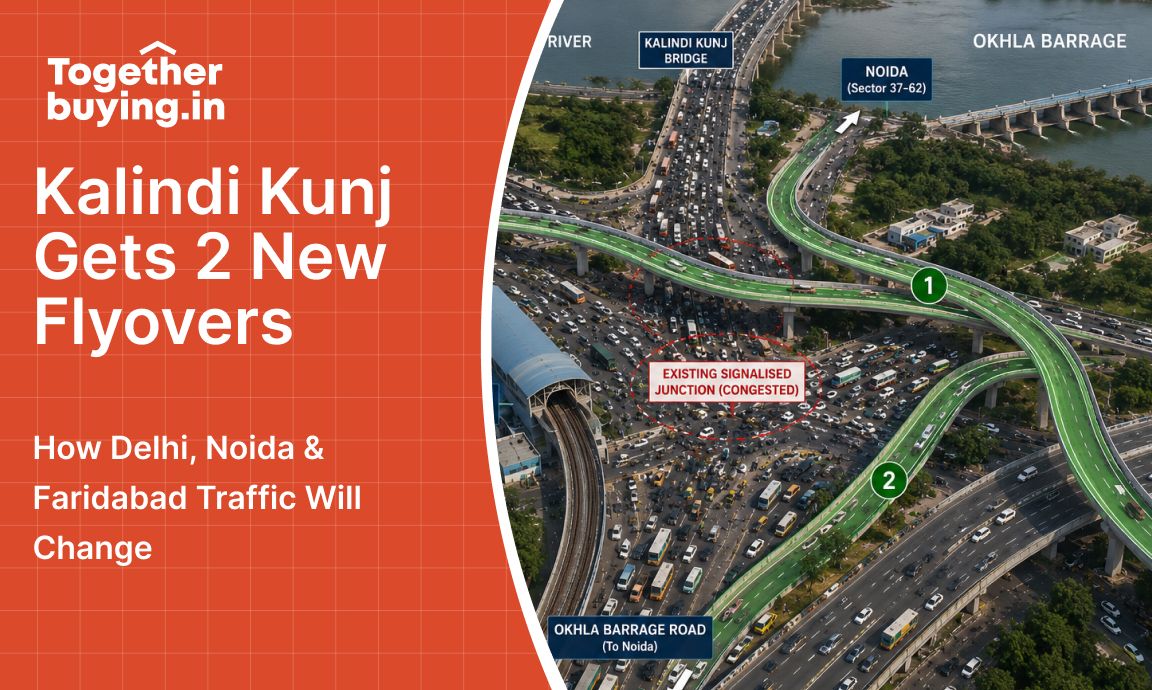
Every day, thousands of vehicles from Noida, Delhi and Faridabad converge at one of NCR's busiest intersections Kalindi Kunj. What should be a two-minute crossing often turns into multiple signal cycles during peak hours. To solve this long-standing bottleneck, the National Highways Authority of India (NHAI) has approved two new flyovers designed to transform the junction into a signal-free interchange.
Here's the complete, verified breakdown of what's being built, what stage the project is at, and what still isn't confirmed.
| Project | Two loop flyovers + junction widening, Kalindi Kunj |
| Implementing Authority | NHAI (National Highways Authority of India) |
| Estimated Cost | ~₹500 crore (sanctioned by Union Minister Nitin Gadkari) |
| Number of Flyovers | 2 loop flyovers + 1 related Madanpur Khadar–Noida link, per DPR |
| DPR Status | Completed and approved (April 8, 2026) |
| Construction Start Date | Not officially announced |
| Completion Timeline | Not officially announced |
| Key Beneficiaries | Noida, Faridabad, Jasola, Sarita Vihar, Shaheen Bagh, Okhla, Delhi–Mumbai Expressway commuters |
To understand why this particular junction jams up so badly, it helps to look at a map rather than a traffic report.
Kalindi Kunj sits on the Yamuna's western bank, right where the Delhi–Noida border meets the road network heading toward Faridabad. According to Union Minister of State for Road Transport and Highways Harsh Malhotra, six roads physically intersect at this one junction a scale of convergence he compared to Delhi's Dhaula Kuan interchange.
Here is what actually merges here:
Did You Know? Kalindi Kunj isn't just a local red light, it's the point where inter-state commuter traffic (Delhi↔Noida), inter-city expressway traffic (Faridabad↔Mumbai corridor), and seasonal religious traffic (this is also a major Kanwar Yatra route) all fight for the same at-grade intersection at once.Kalindi Kunj isn't just a local red light — it's the point where inter-state commuter traffic (Delhi↔Noida), inter-city expressway traffic (Faridabad↔Mumbai corridor), and seasonal religious traffic (this is also a major Kanwar Yatra route) all fight for the same at-grade intersection at once.
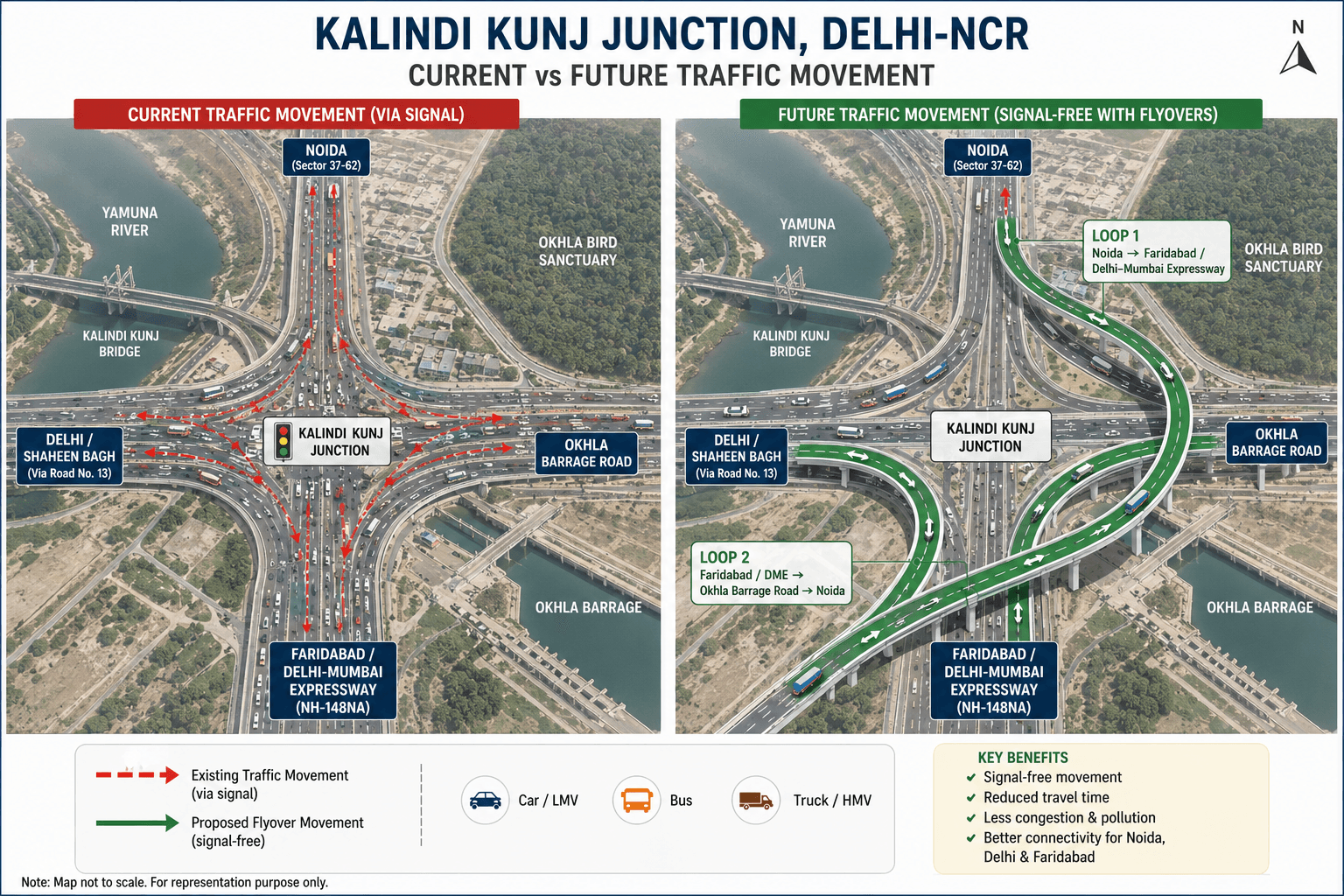
The easiest way to understand this project is visually. The diagram below shows how traffic currently funnels through the single signalised junction (red, dashed) versus how the two new loop flyovers will let vehicles bypass the signal entirely (green).
It's worth being precise here, because most coverage of this project cites general "chronic congestion" without hard numbers.
What is officially documented:
What is not officially available: NHAI, MoRTH, and Delhi/Noida Traffic Police have not published a formal, quantified peak-hour vehicle count (PCU/hour) or average wait-time study specifically for the Kalindi Kunj junction in the public domain. Where news reports mention travel-time figures (for example, "one to one-and-a-half hours" cited by Minister Malhotra), that figure referred specifically to the separate Ashram–Badarpur corridor, not Kalindi Kunj itself — we have kept these two figures distinct rather than conflating them.
The core engineering problem at Kalindi Kunj is that turning traffic and through traffic currently share the same at-grade signal. Left-turning and right-turning vehicles from four different approach roads all have to take their turn at a red light, which is why the signal cycle runs so long.
The proposed fix follows a well-established road engineering principle: separate the turning movements from the through movements using dedicated loop ramps (also called "loop roads"), so vehicles that only need to turn never have to stop at the main signal at all. This is broadly the same design logic used at Delhi's Dhaula Kuan interchange and the Modi Mill flyover both cited by officials as reference points for the Kalindi Kunj plan.
Route: Noida → (via Kalindi Kunj Bridge) → left-turn loop → Faridabad / Delhi–Mumbai Expressway
According to officials involved in the DPR review, this loop is built for commuters travelling from Noida across the Kalindi Kunj Bridge who want to continue toward Faridabad or join the Delhi–Mumbai Expressway (the DND–Faridabad–KMP spur). Instead of merging into the main signalised junction and waiting for a green light to turn, these vehicles will peel off onto a dedicated left-turning loop ramp that bypasses the intersection entirely.
Purpose: Removes one of the heaviest conflicting movements — Noida-to-Faridabad/Expressway traffic from the main signal cycle, which is also one of the flows that has grown the most since Delhi–Mumbai Expressway sections opened.
Route: Faridabad / Delhi–Mumbai Expressway → loop → Okhla Barrage Road → Noida
The second loop serves traffic moving in the opposite direction — commuters and freight coming from Faridabad and the Expressway side who are headed toward Noida. This loop connects directly into Okhla Barrage Road, again allowing vehicles to avoid stopping at the main Kalindi Kunj signal.
The DPR also describes a related link: a flyover connecting the Madanpur Khadar police intersection (referred to as Khadar Puliya in some official communication) directly to Noida, with a return link from Noida back to Khadar Puliya — effectively giving this movement a two-way grade-separated connection independent of the main junction.
Purpose: Removes the Faridabad/Expressway-to-Noida movement — the flow officials say has increased most sharply since the Delhi–Mumbai Expressway's Faridabad sections opened from the signalised intersection.
This is one of the most misunderstood parts of the project, so it's worth stating plainly based on official statements:
| Aspect | Existing Movement | Proposed Movement (Post-Project) |
|---|---|---|
| Noida → Faridabad/Expressway | Left turn at signalised junction, waits for green phase | Dedicated Loop 1 ramp, bypasses signal entirely |
| Faridabad/Expressway → Noida | Crosses/merges at signalised junction | Dedicated Loop 2 ramp, connects to Okhla Barrage Road, bypasses signal |
| Madanpur Khadar ↔ Noida | Routed through main junction | Direct flyover link with return connection, per DPR |
| Remaining through-traffic | Multi-phase signal, long cycle times | Widened, signal-free at-grade crossing |
| Area | Benefit |
|---|---|
| Noida (Sectors 37–62 corridor) | Faster, signal-free access to South Delhi and onward to the Delhi–Mumbai Expressway toward Faridabad |
| Faridabad / Ballabhgarh | Smoother connection into Noida without queuing at the main signal, once the DND–Faridabad link of the Expressway is fully operational |
| Jasola, Sarita Vihar | Reduced spillback congestion on approach roads that currently back up due to the signal at Kalindi Kunj |
| Shaheen Bagh, Jamia Nagar | Less cross-traffic conflict on Road No. 13/13A during peak hours |
| Okhla, Madanpur Khadar | Direct flyover access to Noida per DPR, bypassing local congestion |
| Delhi–Mumbai Expressway users | Cleaner entry/exit at the Kalindi Kunj metro station access point of the DND–Faridabad–KMP spur |
To make this concrete, here are the kinds of everyday commutes this project is aimed at — based on the movements the DPR is designed around, not an official route-by-route list:

| Stage | Current Status |
|---|---|
| Feasibility study | Completed by UP Public Works Department (2022), later followed by a CRRI traffic-pattern analysis |
| Consultant appointment for DPR | NHAI invited consultant bids in June 2025 (submissions due June 23, 2025) |
| Delhi Traffic Police formal request | Sent to NHAI in August 2025 |
| DPR preparation update to Parliament | MoS MoRTH Harsh Malhotra told the Lok Sabha (February 6, 2026) that DPRs were being prepared |
| DPR completion & NHAI approval | DPR finalised and presented to Delhi Traffic Police, Noida Traffic Police, and NHAI on April 8, 2026; project approved |
| Budget sanction | Approximately ₹500 crore sanctioned by Union Minister Nitin Gadkari |
| Implementing agency | National Highways Authority of India (NHAI) |
| Construction start date | Not officially announced |
| Completion timeline | Not officially announced |
NHAI has not published a start date, contractor award, or expected completion year for the two loop flyovers as of July 2026. Any date you see mentioned elsewhere for "when the flyover opens" should be treated as speculation unless it cites a specific NHAI or MoRTH statement, we have not found one.
| Flyover | Route | Purpose | Major Benefit |
|---|---|---|---|
| Loop 1 | Noida (via Kalindi Kunj Bridge) → Faridabad / Delhi–Mumbai Expressway | Bypass main signal for left-turning traffic | Removes Noida-to-Faridabad conflict from junction |
| Loop 2 | Faridabad / Delhi–Mumbai Expressway → Okhla Barrage Road → Noida | Bypass main signal for opposite-direction traffic | Removes Faridabad-to-Noida conflict, the fastest-growing flow post-Expressway |
For the daily commuter, the practical change (once built) is straightforward: if your trip only involves a turning movement covered by one of the two loops, you will no longer need to stop at the Kalindi Kunj signal at all. If your trip crosses straight through the junction, you will still use the at-grade road, but with fewer competing turning movements sharing the signal phases and some stretches widened.
What is confirmed is the structural change: turning movements are being physically separated from through movements, which is the standard engineering method for reducing signal-cycle length and queue buildup at high-conflict junctions.
The Kalindi Kunj project does not exist in isolation - it sits inside a cluster of ongoing NCR infrastructure upgrades that are relevant context for anyone tracking this corridor:
DND–Faridabad–KMP Expressway (NH-148NA): This 59-km, six-lane spur of the Delhi–Mumbai Expressway connects the DND Flyway/Maharani Bagh interchange in Delhi to the KMP Expressway at Khalilpur near Sohna, passing through the Faridabad bypass. The Kalindi Kunj metro station area is one of only two Delhi-side entry/exit points for this spur (the other being the DND/Maharani Bagh interchange). The Sector 65–Sohna stretch opened in 2023, and the Jaitpur/Mithapur–Sector 65 stretch opened on November 12, 2024. The final 9-km Mithapur–DND stretch was, per Minister Gadkari's written Lok Sabha reply, 94.23% complete as of December 2025, with completion expected around June 2026 though this has already faced earlier delays linked to canal-crossing drawing approvals.
Ashram–Badarpur corridor: A separate, parallel signal-free upgrade (three flyovers) is planned for this stretch, also under NHAI, with DPRs being prepared alongside the Kalindi Kunj project.
Faridabad–Sohna spur to Jewar Airport: A further 31-km link is planned from the Sector-65 Faridabad bypass to Noida International Airport at Jewar, extending the long-term relevance of this corridor for airport-bound traffic.
Tughlakabad–Kalindi Kunj Metro corridor: Approved by the Union Cabinet in December 2025 as part of Delhi Metro's Phase V(A) project (total cost ₹12,014.91 crore for 16.076 km across three corridors). This specific 3.9-km extension will connect the under-construction Golden Line (Aerocity–Tughlakabad) to the existing Magenta Line at Kalindi Kunj, with three new stations: Sarita Vihar Depot, Madanpur Khadar, and Kalindi Kunj. Per Delhi Metro's own project tracking, this extension is expected to be completed by 2028 - a separate timeline from the road flyovers, and commuters should not conflate the two projects' completion dates.
Together, these projects point toward Kalindi Kunj becoming a genuine multi-modal interchange zone - road, expressway, and metro - over the next few years, even though each component is on its own independent approval and construction track.
Confirmed infrastructure facts:
Possible real estate impact clearly labelled as speculation:
Real estate advisory reports (not government sources) point to strong recent price appreciation in several Noida localities often discussed in connection with this corridor including Sector 37, Sector 44, Sector 94, and Sector 150 with industry data from portals like 99acres citing appreciation ranging roughly from 10% to over 100% over three-to-five-year periods in specific micro-markets.
However, these figures are tied to a broader basket of drivers the Noida-Greater Noida Expressway, the Aqua Line metro, and the under-construction Noida International Airport at Jewar and no official report or independent study currently isolates the specific price effect of the Kalindi Kunj flyover project on these or any other locality.
Several practical challenges are worth flagging, based on what officials and technical experts have said publicly:
If completed as planned, the Kalindi Kunj Flyover Project could eliminate one of NCR's biggest traffic bottlenecks by separating conflicting traffic movements instead of forcing every vehicle through a single signalised junction. The engineering logic is sound and well-tested, this is essentially the same fix used at Dhaula Kuan and the project has now cleared its DPR and approval stage after tracing back to a 2022 feasibility study. But while funding and approvals are now in place, commuters will have to wait for NHAI to announce the construction schedule before this long-awaited transformation becomes reality.
It is an NHAI-approved plan to build two loop flyovers and widen parts of the existing Kalindi Kunj intersection, converting the Delhi-Noida-Faridabad junction into a signal-free interchange.
Yes. The DPR was completed and presented to Delhi Traffic Police, Noida Traffic Police, and NHAI officials on April 8, 2026, and the project received NHAI approval at that meeting. Construction has not yet started.
The National Highways Authority of India (NHAI) is the implementing agency. No construction contractor has been publicly announced yet.
No official construction start date has been announced. The DPR has been completed and the project approved (April 2026), but tendering and construction timelines are not yet public.
Loop 1 runs from the Noida side of the Kalindi Kunj Bridge toward Faridabad/the Delhi–Mumbai Expressway. Loop 2 runs from the Faridabad/Expressway side to Noida via Okhla Barrage Road. A related flyover link connects the Madanpur Khadar police intersection to Noida with a return connection. Exact alignment drawings have not been made public.
Because six roads converge at one signalised junction Noida, South Delhi/Shaheen Bagh, Faridabad, and the Delhi–Mumbai Expressway all merge here forcing turning and through traffic to share the same long, multi-phase signal cycle.
Yes, officials from Delhi Traffic Police and NHAI have confirmed the goal is to make the junction signal-free once the two loop flyovers are operational, though the existing at-grade crossing will remain in use for some through-movements.
Noida-bound and Noida-originating traffic headed to/from Faridabad and the Delhi–Mumbai Expressway will be able to use dedicated loop ramps instead of waiting at the main signal.
The project specifically targets Faridabad/Expressway-to-Noida traffic, which officials say has increased since Delhi–Mumbai Expressway sections opened, by giving it a dedicated loop (Loop 2) via Okhla Barrage Road.
The Kalindi Kunj metro station area is one of two Delhi-side access points to the DND–Faridabad–KMP spur (NH-148NA) of the Delhi–Mumbai Expressway. Removing signal delays at this junction should smooth entry/exit for Expressway-bound traffic, though no official time-saving figure has been published.
This has not been confirmed by any government or independent study. Noida-area property appreciation reported by real estate portals is linked to multiple factors (metro expansion, Jewar Airport, expressway growth) and cannot be attributed specifically to this flyover project. Treat any price-appreciation claims tied solely to this project with caution.
Yes. The DPR was completed and presented to Delhi Traffic Police, Noida Traffic Police, and NHAI officials on April 8, 2026, and the project received NHAI approval at that meeting.
Two loop flyovers (referred to as Loop 1 and Loop 2), plus a related flyover link connecting the Madanpur Khadar police intersection to Noida with a return connection, as per the DPR.
Approximately ₹500 crore, sanctioned by Union Minister Nitin Gadkari, though a final itemised cost breakup has not been publicly released.
No. The Tughlakabad–Kalindi Kunj Metro corridor (3.9 km, part of Delhi Metro Phase V(A), approved by the Union Cabinet in December 2025) is a separate project with its own timeline (expected by 2028). The flyover project is a road-based NHAI initiative with no published completion date.
No. Officials have confirmed the existing intersection will remain functional; it will be widened at some stretches and made signal-free once the loop flyovers are complete.
Areas most directly affected include Noida (Sectors 37–62 corridor), Jasola, Sarita Vihar, Shaheen Bagh, Madanpur Khadar, Okhla, and Faridabad/Ballabhgarh though specific relief levels have not been officially quantified.
They are separate but related projects. Both are being developed by NHAI as part of a broader push to make key Delhi corridors signal-free, and DPRs for both were referenced together in MoRTH's February 2026 Lok Sabha update.
As of July 2026, the DPR is complete and NHAI has approved the project with an estimated ₹500 crore budget sanctioned by Minister Gadkari. No construction start date or contractor has been announced yet this remains the single biggest open question on the project.
Exact flyover lengths have not been published in the approved DPR summary available publicly. An earlier mid-2025 proposal referenced a roughly 500-metre interchange concept, but this figure predates the final DPR and should not be treated as confirmed.
Contact Us
Fill out this form
& we'll get back
to you
Recommended for you