Market Trends
Noida 8 Lane Expressway: Complete Route, Status, Cost and Real Estate Impact
26 Jun 2026
Market Trends
26 Jun 2026
Content
No Blogs content found
It looks like there haven’t been any blogs yet!
The Noida 8 Lane Expressway is a proposed elevated road corridor running along the Yamuna river embankment, connecting Sector 94 in Noida to the Yamuna Expressway near Greater Noida, close to Gautam Buddha University. It is meant to give Noida and Greater Noida a second high speed spine running parallel to the congested Noida Greater Noida Expressway, cutting travel time toward the newly operational Noida International Airport at Jewar. In June 2026, NHAI submitted a draft alignment for the project, marking its most concrete progress yet, though the road is still in the planning stage and has not been approved for construction.
| Item | Details |
|---|---|
| Status | Draft alignment submitted by NHAI; Detailed Project Report (DPR) is under preparation. |
| Length | Approximately 31 kilometres. |
| Type | Proposed 8-lane elevated expressway. |
| Start | Sector 94, Noida, near Okhla Barrage. |
| End | Chi I, Greater Noida, near Gautam Buddha University. |
| Purpose | Reduce congestion on the Noida Expressway and improve connectivity to Noida International Airport. |
| Lead Agencies | NHAI, Noida Authority, Greater Noida Authority, Yamuna Expressway Industrial Development Authority (YEIDA), and Uttar Pradesh Expressways Industrial Development Authority (UPEIDA). |
| Cost | Not yet finalised; expected to run into several thousand crore rupees. |
| Construction Start | Not yet announced. |
| Estimated Build Time | Approximately two years after construction begins, based on early official estimates. |
The expressway is locally known by several names, including the Yamuna Pushta Elevated Expressway, the Noida Greater Noida Bundh Expressway, or simply Noida's second expressway, since it does not yet have one single, officially notified name.
The core purpose is straightforward. The existing Noida Greater Noida Expressway is already overloaded with corporate, residential and through traffic, and authorities expect traffic to climb further now that commercial flight operations have begun at Noida International Airport. A parallel, signal free corridor along the river embankment is meant to absorb a large share of that future traffic, particularly trips headed toward the airport and Greater Noida's institutional belt, without requiring authorities to acquire large amounts of expensive land in already built up sectors.
Across more than two years of discussion, officials have floated an 8 lane ground level expressway, a 6 lane elevated road, and even a 10 lane widened Pushta corridor. NHAI's June 2026 draft alignment, which describes an 8 lane, 31 kilometre elevated expressway, is the version this article uses as the current working plan, since it is the most recent and most authoritative description available.
According to the draft alignment NHAI submitted to Noida Authority in June 2026, the expressway is proposed to begin near the Okhla Barrage in Sector 94, Noida, close to the Delhi border, and extend along the Yamuna embankment to the Chi I area of Greater Noida, near Gharbara village, where it is planned to merge with the Yamuna Expressway opposite Gautam Buddha University. The total length under this alignment is approximately 31 kilometres.
NHAI's consultant has indicated that a full detailed project report (DPR) is being prepared and was expected within roughly three months of the June 2026 submission. Once the DPR is finalised, the exact land parcels that need to be acquired will be identified, after which the project can move toward formal cost approval, tendering and construction. Noida Authority officials have estimated that construction, once it begins, could be completed within about two years, though this is an early estimate rather than a contractually binding timeline.
It is worth knowing how the project got here, because the timeline tells you a lot about how much can still change.
There is no single, confirmed total project cost as of June 2026. Earlier reporting on the Noida Greater Noida Bundh Expressway concept cited a much smaller figure of around 400 crore rupees for a shorter, 24 to 25 kilometre stretch, but that figure relates to an older and more limited version of the idea, not the current 31 kilometre elevated alignment. More recent reporting from early 2026 has noted that officials themselves acknowledged the present project would require an investment running into several thousand crore rupees, which is far beyond what Noida Authority can fund on its own, hence the discussion of NHAI involvement, a public private partnership structure, or a joint special purpose vehicle between the Noida, Greater Noida and Yamuna Expressway authorities. A precise, board approved cost figure is expected to emerge only once the DPR is finalised.
The most recent and most official description, from NHAI's June 2026 draft alignment, is an 8 lane elevated corridor. Earlier in the project's life, planners compared an 8 lane ground level expressway against a 6 lane elevated alternative, and Noida Authority separately discussed widening the existing Pushta Road into a 10 lane surface corridor as a related but distinct initiative. Detailed engineering parameters such as exact right of way, carriageway width, service road provision, cycle tracks, green belt allocation, and intelligent traffic systems have not yet been published, and will likely only be confirmed once the DPR is released. This article will be updated once those specifications are made public.
Based on the alignment described by NHAI and corroborated across multiple feasibility study reports from 2024 to 2026, the corridor is planned to run as follows. A route map is recommended alongside this section so readers can see the embankment path relative to the Noida sector grid at a glance, since a sector by sector text description is harder to visualise on a corridor that runs along a river edge rather than through a standard grid layout.
| Route Section | Key Areas | Expected Benefit |
|---|---|---|
| Sector 94 | Okhla Barrage, Delhi Border | Improves connectivity with Delhi and serves as the proposed starting point of the elevated expressway. |
| Sector 95–124 Belt | Expressway Embankment Frontage | Provides an alternate corridor to reduce traffic on the existing Noida Expressway. |
| Sectors 125–127 | Amity University Belt | Enhances access to educational institutions and nearby commercial developments. |
| Sectors 128–135 | JP Wish Town, IT Corridor | Improves commuting for residents and office-goers in this major residential and IT corridor. |
| Sector 137 | Metro-Connected Area | Receives indirect benefits through reduced congestion on the existing expressway. |
| Sectors 143–149 | Areas Away from the Confirmed Alignment | Expected to benefit indirectly from overall traffic decongestion. |
| Sector 150 | Premium Residential Hub, Proposed Interchange | Strengthens connectivity for airport-bound traffic and long-distance travel. |
| Sectors 151–153 | Adjacent to the Sector 150 Belt | Likely to receive secondary benefits through improved regional connectivity. |
| Chi I & Knowledge Park | Gharbara Village, Gautam Buddha University (GBU) | Provides the proposed connection to the Yamuna Expressway and Greater Noida. |
The paragraphs below explain each of these sections in more detail, including where the benefit is direct frontage and where it is closer to neighbourhood proximity.
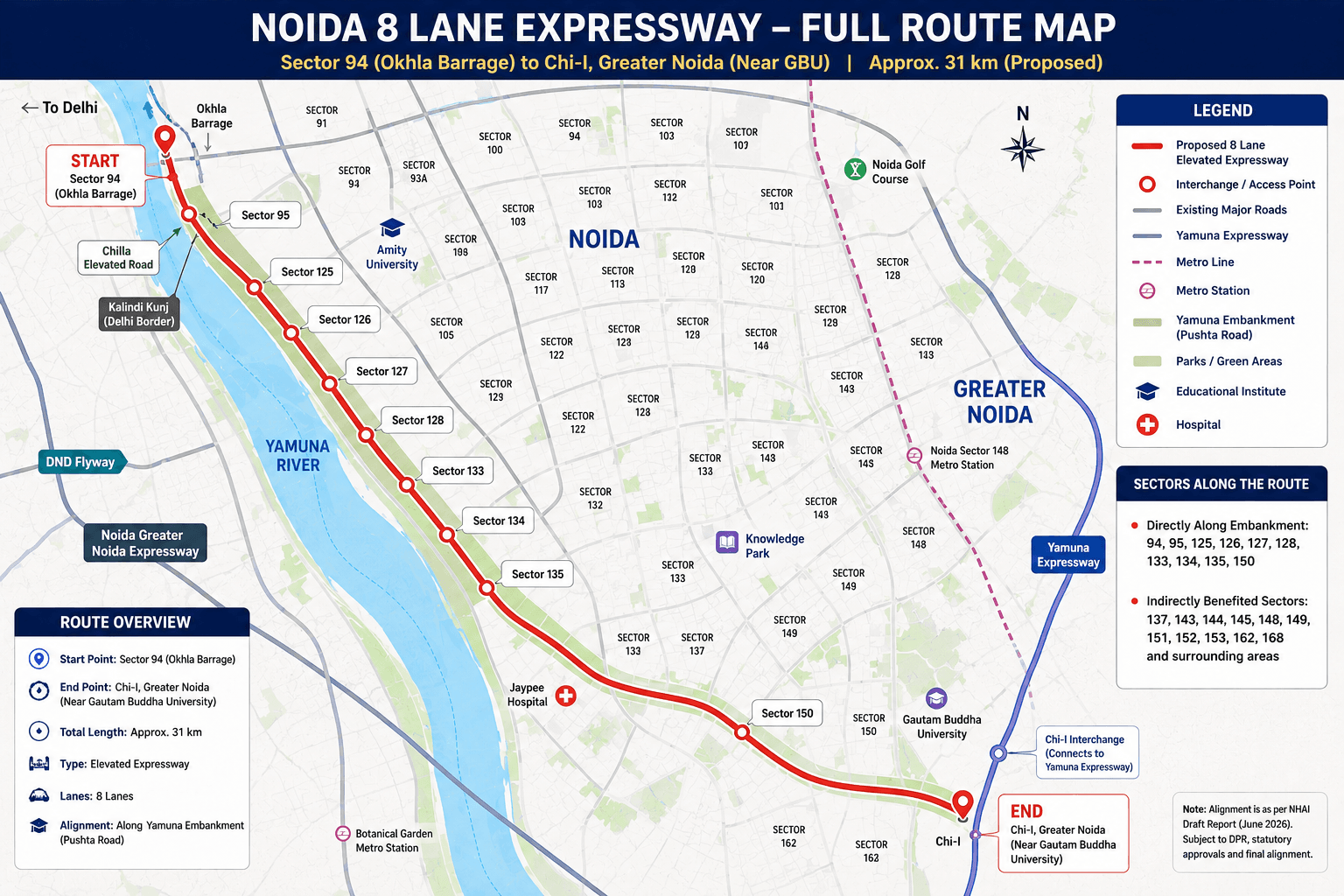
Starting point, Sector 94 and Okhla Barrage. The expressway begins near the Okhla Barrage, adjacent to Sector 94, Noida, right at the Delhi border. This is also close to the Okhla Bird Sanctuary, and the alignment has reportedly been planned to avoid disturbing this ecologically sensitive zone by following the river embankment rather than cutting through it.
Sector 95 and Sectors 125 to 135. Multiple reports describe the corridor running along the Yamuna embankment through this stretch, adjacent to a cluster of established and developing residential and institutional sectors including 125, 126, 127, 128, 129, 130, 131, 132, 133, 134 and 135. The expressway runs alongside these sectors rather than cutting directly through their internal road networks, since it follows the embankment on the river facing edge.
Sector 128, JP Wish Town. Sector 128, home to the well known Jaypee Wish Town township, sits along this general corridor. The expressway is expected to improve this sector's access toward Delhi and toward the airport corridor, in addition to the connectivity it already has via the main Noida Greater Noida Expressway.
Sector 137. Sector 137 lies near this broader expressway corridor and benefits indirectly through the area's overall improved arterial network, though it is not a sector the embankment alignment runs directly alongside in the way Sectors 125 to 135 are.
Sectors 143 to 149. These sectors are not part of the confirmed embankment alignment based on current reporting. Their connectivity benefit from this specific project would be indirect, mainly through reduced pressure on the main Noida Greater Noida Expressway rather than direct frontage on the new corridor.
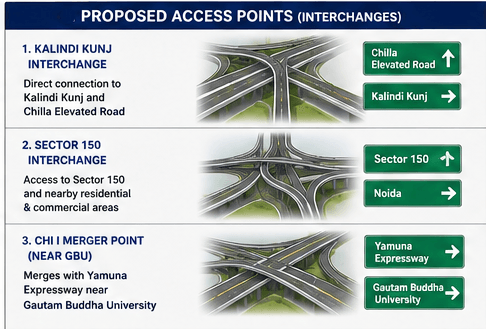
Sector 150. Sector 150 is one of the most consistently mentioned endpoints across the project's various iterations. Several reports describe the Pushta Road corridor running specifically from Sector 94 to Sector 150, with a rotary or interchange planned near Sector 150 to provide access onward to the Yamuna Expressway. Even in the latest NHAI alignment, which is described as ending closer to Chi I, Sector 150 sits along the same general corridor and is expected to gain a meaningful access point.
Sectors 151, 152 and 153. These sectors are adjacent to the broader Pushta Road and Sector 150 corridor area and would likely see secondary connectivity benefits, though they are not consistently named as direct touch points in the alignment reporting reviewed for this article.
Knowledge Park and CHI. The expressway's Greater Noida end is planned to connect near Chi I, close to Gharbara village, linking onward to the Yamuna Expressway. This brings it close to the Knowledge Park institutional and educational belt, and to the broader CHI sector cluster, though the road itself terminates at the Chi I interchange point rather than running through the interior of Knowledge Park.
Gautam Buddha University. The planned merger point with the Yamuna Expressway is described as being opposite Gautam Buddha University, near Gharbara village. This makes GBU one of the most directly benefited institutions, since the new corridor's endpoint sits right across from the campus.
Amity University and Sector 125 to 126 belt. Amity University's Noida campus sits in the broader Sector 125 to 126 zone that the embankment corridor runs alongside, so it stands to gain improved alternate access, again as an adjacent rather than a through connection.
Chilla Elevated Road connection. The Chilla Elevated Road, a separate 5.5 to 5.6 kilometre project connecting Chilla in Delhi to the Mahamaya Flyover in Noida, is being developed alongside this expressway as part of a wider, linked connectivity push. Officials have described these projects as parts of the same broader plan to create a more seamless, signal free travel network between Delhi, Noida, Greater Noida and the airport zone, though they are technically separate projects with separate timelines.
Yamuna Expressway connectivity. The corridor's Greater Noida end is designed specifically to connect into the Yamuna Expressway, which is what gives this project its airport relevance. Once merged, traffic can continue toward Jewar without rejoining the main Noida Greater Noida Expressway.
If completed broadly as currently planned, the expressway would improve access between several major points in the region.
It would give Delhi commuters, particularly those entering from the Kalindi Kunj and Okhla Barrage side, an alternate route into Noida and onward to Greater Noida that does not pass through the most congested stretches of the existing Noida Greater Noida Expressway. It would offer a second route running broadly parallel to that expressway, giving traffic planners a way to split load between the two corridors. It connects, indirectly through shared planning, with the Chilla Elevated Road project linking Delhi and Noida. At its eastern end, it is designed to feed directly into the Yamuna Expressway, which is what gives it a meaningful link to Noida International Airport. It also runs close to the broader Greater Noida IT and institutional corridor anchored around Knowledge Park and Gautam Buddha University. The project does not currently have a confirmed direct link to DND Flyway, FNG Expressway or the Eastern Peripheral Expressway, though all of these sit within the same wider NCR road network and benefit indirectly from reduced congestion on shared arterial roads.
This project will matter more to some readers than others. Based on the route and purpose described above, the clearest beneficiaries are:
Based on the route described above, the institutions most plausibly benefited, assuming the project proceeds roughly as planned, fall into a few clear groups.
Educational institutions. Gautam Buddha University sits closest to the actual benefit, given its direct proximity to the proposed Greater Noida merger point opposite Gharbara village. Amity University, whose Noida campus sits in the broader Sector 125 to 126 belt the embankment corridor runs alongside, would gain an alternate route in addition to its existing access via the main expressway. Schools located within the Sector 125 to 135 and Sector 150 belt, such as those serving the Jaypee Wish Town and Sector 150 catchments, would see the same general improvement in alternate access, though no specific school has been named in any official document reviewed for this article, so naming individual schools such as Genesis Global School here would be speculative rather than confirmed.
Healthcare. Jaypee Hospital, located in Sector 128, sits within the same general corridor and could see improved approach routes, particularly for traffic coming from the Delhi side, since the new road would offer an alternate path that bypasses the busiest stretches of the existing expressway.
Corporate and IT clusters. The expressway itself does not run directly through Noida's established commercial belt in sectors such as 132, 135 and 142, where corporate parks including Advant Navis Business Park in Sector 142 are located. The benefit to these clusters is indirect: by pulling through traffic and airport bound trips onto the new corridor, the existing Noida Greater Noida Expressway should carry comparatively less load, which would ease the daily commute for employees working in these office parks. No official document reviewed for this article names specific corporate tenants or IT campuses as being directly connected to the new alignment, so this article avoids claiming a direct link between named companies and the new road. Readers should treat any such claim seen elsewhere with caution until the DPR confirms interchange locations.
Real estate marketing material on this project has, in places, run well ahead of its actual approval status, so the framing below is based on a clear, stated logic rather than a prediction. Each sector is assessed on two things: how close it sits to the proposed embankment alignment, and how developed or active that sector's market already is. Closer proximity plus an already active market generally points to a faster, more visible reaction once construction becomes real. The table is a reading of relative positioning, not a forecast of guaranteed returns.
| Sector | Proximity to Alignment | Likely Timing of Impact | Primary Character |
|---|---|---|---|
| Sector 94 | Direct; proposed starting point of the alignment. | Near term, once land acquisition and project execution begin. | Commercial and Institutional. |
| Sector 95 | Direct; along the embankment frontage. | Near term to medium term. | Mixed Residential. |
| Sectors 125–127 | Direct; adjacent to the embankment. | Medium term. | Institutional and Residential. |
| Sector 128 (JP Wish Town) | Adjacent to the broader corridor. | Medium term. | Residential Township. |
| Sectors 129–134 | Direct; adjacent to the embankment. | Medium term. | Residential and IT-Adjacent. |
| Sector 135 | Direct; adjacent to the embankment. | Medium term. | IT and Commercial. |
| Sector 137 | Indirect; located near the proposed corridor. | Long term, dependent on overall traffic decongestion. | Residential and Metro-Linked. |
| Sectors 143–149 | Not on the confirmed alignment. | Long term; expected to benefit indirectly. | Residential and Developing. |
| Sector 150 | Direct; proposed key interchange location. | Near term to medium term. | Premium Residential. |
| Sectors 151–153 | Indirect; adjacent to the Sector 150 corridor. | Long term; primarily indirect benefits. | Residential and Developing. |
| Chi I & Knowledge Park | Direct; proposed endpoint and adjoining areas. | Medium term. | Educational and Institutional. |
A near term reading reflects sectors closest to the starting point and to the Sector 150 interchange area, where land acquisition and early construction activity, once they begin, are likely to be most visible first. A medium term reading reflects sectors that sit along the embankment but further from these two anchor points, where benefit would build gradually as the corridor is constructed in stages. A long term or indirect reading reflects sectors that are not on the confirmed alignment at all, where any benefit would come mainly from reduced pressure on the existing Noida Greater Noida Expressway rather than from direct frontage on the new road.
Sectors that already show strong appreciation and sit along or near the proposed corridor include Sector 150 and Sector 128. Sector 150 has recorded substantial price growth over the past several years, with various industry sources placing five year appreciation in the range of roughly 120 to 145 percent depending on the project and data source, and current average rates in the broad range of 11,000 to 16,500 rupees per square foot. Sector 128, anchored by the Jaypee Wish Town township and newer entrants such as Max Estates, L&T Realty, M3M and Kalpataru, has also shown strong appreciation, with some sources citing roughly 106 to 128 percent growth over five years and current average rates that vary widely by project, from around 12,000 rupees per square foot in older inventory to over 20,000 rupees per square foot in newer premium launches.
It would be inaccurate to attribute this past appreciation to the proposed expressway, since these sectors have already been rising in value due to the existing Noida Greater Noida Expressway, the Yamuna Expressway, metro connectivity and the broader pull of the Noida International Airport. What the new expressway could plausibly add, if it proceeds, is a secondary connectivity premium, the kind of incremental demand and sentiment boost that typically follows visible construction progress on a planned corridor, distinct from speculative buying based on announcements alone.
Property appreciation depends on a wide range of factors including overall market conditions, interest rates, the pace of actual construction, and broader economic trends, and past performance in any sector is not a reliable predictor of future returns. This article is not investment advice, and anyone making a buying decision based partly on this project should track official construction milestones rather than news of approvals or alignments alone.
The expressway's central purpose is decongestion. The existing Noida Greater Noida Expressway already carries heavy daily commuter and freight traffic, and officials have expressed concern that congestion levels could approach those seen on the Delhi Gurugram Expressway as residential, commercial and institutional development continues and as airport related traffic grows. A parallel, access controlled, elevated corridor is intended to offer a faster, more predictable alternative for through traffic, particularly trips headed toward the airport, without forcing all of that volume through the same junctions and signals used by local sector traffic. Because the corridor is planned with limited entry and exit points along the embankment rather than dense local access, it would function more as a bypass route for longer trips than as a service road for sector level circulation. Specific projected traffic volumes have not been published in any document available for this article, and will likely emerge as part of the DPR.
To summarise where things stand using clear, distinct categories:
Approved: No final cabinet or board approval for construction has been issued. The project has not been formally sanctioned as a national highway, which is part of what NHAI's involvement is meant to help achieve.
Proposed: The overall concept of a second expressway along the Yamuna Pushta corridor, in various lane configurations, has been under proposal and discussion since November 2023.
Planned: A feasibility study has been completed by RITES and a separate consultant, Almondz Global Infra, with NHAI now leading alignment work.
Tendered: No construction tender has been issued as of the most recent available reporting.
Under construction: No construction has begun.
Land acquisition assessment is underway based on the draft alignment, but exact parcels will only be confirmed once the DPR is finalised, expected roughly three months after the June 2026 submission. Environmental and irrigation department clearances remain a known sensitivity given the embankment's location in a floodplain zone, and earlier delays in the project's history were directly tied to these clearance requirements. Funding has not been finalised, with officials openly acknowledging that the cost is likely to exceed what Noida Authority can bear alone.
| Aspect | Existing Noida–Greater Noida Expressway | Proposed New 8-Lane Expressway |
|---|---|---|
| Status | Operational since 2002; 6-lane expressway. | Draft alignment submitted; project not yet approved or constructed. |
| Length | Approximately 24.5 kilometres. | Approximately 31 kilometres (proposed). |
| Route | Mahamaya Flyover to Pari Chowk, passing through central commercial sectors of Noida. | Sector 94 along the Yamuna embankment to Chi I, Greater Noida. |
| Primary Purpose | Main arterial corridor connecting Noida and Greater Noida. | Parallel bypass intended to reduce traffic on the existing expressway. |
| Traffic Type | Mixed local, commercial, and through traffic. | Primarily intended for through traffic and airport-bound trips. |
| Connectivity | Connects with the DND Flyway, FNG corridor area, and Yamuna Expressway. | Designed to connect directly with the Yamuna Expressway near Gautam Buddha University (GBU). |
| Primary Beneficiaries | Commercial sectors such as 132, 135, 142, and 150, along with general commuters. | Sector 94, the Sector 125–135 corridor, Sector 150, Gautam Buddha University, and airport-bound traffic. |
| Stage | Status |
|---|---|
| Initial Proposal | November 2023 – Noida Authority formally approached NHAI to examine the feasibility of a parallel expressway. |
| Feasibility Study | 2024 to early 2025 – A joint feasibility study was undertaken by RITES and the Noida Authority. |
| Design Options Compared | March 2025 – Authorities evaluated an 8-lane at-grade corridor against a 6-lane elevated alternative. |
| Project Stalled and Revived | Late 2025 to January 2026 – The proposal was reviewed and revived during a high-level meeting in Lucknow. |
| Fresh Feasibility Study | March to April 2026 – Almondz Global Infra was appointed to carry out an updated feasibility assessment. |
| Draft Alignment Submitted | June 2026 – NHAI submitted a draft alignment for a proposed 31-kilometre, 8-lane elevated expressway. |
| DPR Finalisation | Expected within approximately three months of the June 2026 draft alignment submission. |
| Land Acquisition | To be initiated and finalised after completion and approval of the DPR. |
| Construction Start | Not yet announced by the project authorities. |
| Expected Completion | Estimated at around two years from the commencement of construction, based on early official estimates. |
It is a proposed elevated road corridor running largely along the Yamuna river embankment, intended to connect Sector 94 in Noida to the Yamuna Expressway near Greater Noida, offering an alternate route to the existing Noida Greater Noida Expressway.
The most recent draft alignment places the starting point near the Okhla Barrage in Sector 94, Noida, close to the Delhi border.
It is planned to end near the Chi I area of Greater Noida, close to Gharbara village, merging into the Yamuna Expressway opposite Gautam Buddha University.
Approximately 31 kilometres, according to the draft alignment NHAI submitted in June 2026. Earlier proposals cited shorter lengths of around 24 to 25 kilometres for an earlier, more limited version of the concept.
The current and most recent description from NHAI is an 8 lane elevated expressway. Earlier in the project's history, a 6 lane elevated option and a 10 lane surface widening were also discussed, so the final specification could still be adjusted once the DPR is complete.
Sectors closest to the embankment alignment, including 94, 95, and the 125 to 135 belt, along with Sector 150 near the Greater Noida end, appear best positioned for direct benefit. Sectors further from the river, such as 143 to 153, would likely see a smaller, more indirect benefit.
Sector 128 sits along the broader corridor and could see improved alternate access toward Delhi and the airport side, in addition to its existing connectivity via the main expressway.
Yes. The eastern end of the proposed alignment is specifically designed to merge into the Yamuna Expressway near Greater Noida, which is what gives the project its relevance to Noida International Airport traffic.
That is the project's stated purpose, since it would offer a more direct, less congested route from Delhi and central Noida toward the Yamuna Expressway, which leads to the airport at Jewar. Actual travel time savings have not been officially quantified yet.
No. Land acquisition assessment is underway based on the draft alignment, but the exact parcels to be acquired will only be confirmed once the detailed project report is finalised.
No construction start date has been announced. The DPR was expected within roughly three months of the June 2026 alignment submission, after which approvals, funding and tendering would need to follow.
Noida Authority officials have estimated a construction period of roughly two years once work begins, but since construction has not started, no firm completion date exists yet.
No confirmed total cost has been published for the current 31 kilometre alignment. Earlier, smaller versions of the concept cited figures around 400 crore rupees, while more recent official acknowledgement suggests the present project could run into several thousand crore rupees. A confirmed figure is expected after the DPR.
NHAI is currently leading the alignment and DPR work, in coordination with Noida Authority, Greater Noida Authority, Yamuna Authority, UPEIDA and the irrigation department. A final decision on the executing and funding agency, potentially involving a joint special purpose vehicle, is still pending.
Some sectors along the proposed corridor, particularly Sector 150 and Sector 128, have already seen strong appreciation over the past several years, largely due to existing infrastructure and the airport's opening. Any additional impact from this specific expressway would likely depend on visible construction progress rather than announcements alone, and should not be treated as a guaranteed outcome. This is general information, not investment advice.
It runs close to the Chi I and Knowledge Park belt at its Greater Noida end rather than through the interior of Knowledge Park itself.
No. The Chilla Elevated Road is a separate, shorter project connecting Chilla in Delhi to the Mahamaya Flyover in Noida. The two projects are often discussed together as part of a wider connectivity push, but they have separate alignments, budgets and timelines.
That is its core intended function, by giving through traffic, especially airport bound traffic, an alternate route that does not pass through the busiest commercial stretches of the existing expressway. The actual reduction in congestion will depend on how much traffic shifts to the new corridor once it opens.
The most reliable sources are Noida Authority's official board meeting minutes and press releases, NHAI announcements, and UPEIDA updates, supplemented by established regional news coverage.
The Noida 8 Lane Expressway, more formally tracked across official channels as the Yamuna Pushta Elevated Expressway or Noida Greater Noida Bundh Expressway, is one of the more significant pieces of planned infrastructure in the NCR right now, but it is still firmly in the planning and alignment stage rather than the construction stage. NHAI's June 2026 draft alignment, running 31 kilometres from Sector 94 to Chi I in Greater Noida as an 8 lane elevated corridor, represents the most concrete progress this project has made since it was first proposed in November 2023. A detailed project report, land acquisition finalisation, funding decisions, environmental clearances and a construction tender all still need to happen before ground work can begin.
The sectors best positioned to benefit directly are those sitting closest to the embankment alignment, particularly Sector 94, the 125 to 135 belt, and Sector 150 toward the Greater Noida end, along with institutions such as Gautam Buddha University and Amity University that sit near the corridor. Sectors further from the river, including much of the 143 to 153 range, would see a more indirect benefit tied to overall traffic decongestion rather than direct frontage.
For homebuyers and investors, the most useful approach is to treat this as an early stage infrastructure story rather than a delivery stage one. Track the DPR release, watch for formal cabinet or board approval, and look for visible land acquisition and construction activity before factoring this expressway heavily into a buying decision. Announcements and alignment submissions are meaningful signals of intent, but they are not the same as a road that is being built. This article will be updated as the DPR, funding structure and construction timeline become clearer.
Contact Us
Fill out this form
& we'll get back
to you
Recommended for you