Market Trends
SBI MaxGain Home Loan: Can You Really Reduce Your Home Loan Interest from 8% to 2%?

07 Jul 2026
Market Trends
07 Jul 2026
Content
No Blogs content found
It looks like there haven’t been any blogs yet!
If you have searched for SBI MaxGain Home Loan, you have probably come across a bold claim: that this product can bring your effective interest rate down from something like 8% to 2%. It sounds almost too good to be true, and in the way it is often marketed, it is a bit misleading.
The confusion happens because SBI MaxGain does not change your contracted interest rate at all. What it changes is how much of your outstanding balance actually earns interest on any given day, because surplus money you park in a linked overdraft account is temporarily offset against your loan principal. For some borrowers this genuinely produces a very low effective interest cost. For others, especially those who never build up surplus funds, it changes almost nothing.
This guide explains, in plain language and with verified information, exactly what SBI MaxGain is, how the overdraft mechanism works, when the "8% to 2%" claim is realistic and when it is not, what it costs, who benefits from it, who should avoid it, and how it compares with both a regular SBI home loan and simple prepayment. By the end, you should be able to decide with confidence whether it suits your financial habits, without needing to check another page.
Quick definition: SBI MaxGain Home Loan is an overdraft based home loan offered by State Bank of India where surplus funds deposited in a linked account reduce the outstanding balance used for daily interest calculation. This lowers the total interest paid over the loan tenure while still allowing borrowers to withdraw their surplus whenever they need it.
| Aspect | Summary |
|---|---|
| Loan Type | A home loan sanctioned as an overdraft facility rather than a conventional term loan. |
| Overdraft Facility | The linked overdraft account functions like a savings or current account and typically includes features such as a cheque book, debit card, and net banking. |
| Interest Calculation Method | Interest is calculated on a daily reducing balance based on the outstanding loan amount minus any surplus maintained in the overdraft account. |
| Withdrawal Flexibility | Surplus funds can generally be withdrawn whenever required, subject to the lender's terms and certain restrictions during the under-construction stage of the property. |
| Interest Saving Mechanism | Every rupee parked in the overdraft account reduces the loan balance used for daily interest calculation. It lowers the interest payable without changing the contracted interest rate. |
| Tax Benefits | Generally similar to a standard home loan, with deductions available under Section 24(b) and Section 80C of the Income Tax Act, subject to eligibility conditions. |
| Best Suited For | Borrowers who regularly receive surplus funds, such as business owners, professionals with variable income, or individuals receiving bonuses while maintaining an emergency corpus. |
| Major Limitations | Typically available only for ready-to-move-in properties, requires a minimum loan sanction amount, and delivers the greatest benefit only to disciplined savers who consistently maintain surplus balances. |
SBI MaxGain is State Bank of India's home loan overdraft product. Instead of disbursing your loan as a simple term loan with a fixed amortization schedule, SBI sanctions it as an overdraft account with a defined overdraft limit. According to SBI's own home loan product page, under this scheme home loans are sanctioned as an overdraft, and while you continue to pay your EMI exactly as you would on a regular home loan, the drawing power on the overdraft is reduced every month to the extent of the principal component of that EMI, so that the account is fully liquidated by the end of the tenure.
In practice, this means you get two things layered into one account: a housing loan and a flexible, overdraft style account where you can park money, withdraw it, use a debit card, get a cheque book, and access net banking, much like a savings account.
The purpose of the scheme is straightforward. Most borrowers occasionally have idle money sitting around, a bonus, a maturing fixed deposit, seasonal business income, or simply a growing emergency corpus. In a normal loan, that money either sits in a low yield savings account or gets used for principal repayment through formal prepayment, which permanently reduces liquidity. MaxGain lets you keep the money fully accessible while still getting most of the benefit of prepaying it, because the balance offsets your outstanding balance for the purpose of daily interest calculation.
Feature snapshot:
| Feature | Details |
|---|---|
| Loan Type | Overdraft-linked home loan. |
| Minimum Loan Amount | Commonly reported as around ₹20 lakh. Confirm the latest eligibility criteria with SBI before applying. |
| Maximum Tenure | Aligned with SBI's standard home loan tenure, typically up to around 30 years, subject to the borrower's age, repayment capacity, and eligibility. |
| Property Type | Ready-to-move residential properties. |
| Interest Type | Floating interest rate linked to SBI's External Benchmark Lending Rate (EBLR). |
| Prepayment | Surplus funds parked in the overdraft account effectively reduce the outstanding balance. No separate foreclosure charge applies to floating-rate home loans, as per prevailing RBI guidelines. |
| Withdrawal | Yes, subject to the loan disbursement status and the terms applicable to the property. |
| Linked Overdraft Account | Yes. The overdraft account functions similarly to a savings or current account and can be used for everyday banking transactions. |
| EMI Frequency | Monthly. |
This is fundamentally different from a standard home loan, where your EMI, principal outstanding, and interest are calculated purely on a fixed amortization schedule regardless of how much surplus cash you are holding elsewhere.
Short answer: not in the way the headline sounds. Your loan's contracted interest rate does not drop from 8% to 2%. SBI does not reprice your loan based on your account balance.
What actually happens is that your effective interest cost, meaning the real rupee amount of interest you end up paying relative to your original sanction amount, can fall dramatically if you consistently maintain a large surplus balance. Here is the distinction that most competing articles gloss over:
If your sanctioned loan is 8% and you consistently keep a surplus equal to 75% of your outstanding balance, you are only paying interest on the remaining 25%. Mathematically, your effective interest cost on the original loan amount could work out close to 2%, purely because you are paying interest on a much smaller base, not because the rate itself changed.
This is only realistic under specific conditions:
The claim does not apply if:
So the honest way to describe SBI MaxGain is this: it is a tool that can produce a very low effective interest cost for disciplined savers with meaningful surplus funds, but it cannot and does not lower your bank's contracted lending rate.
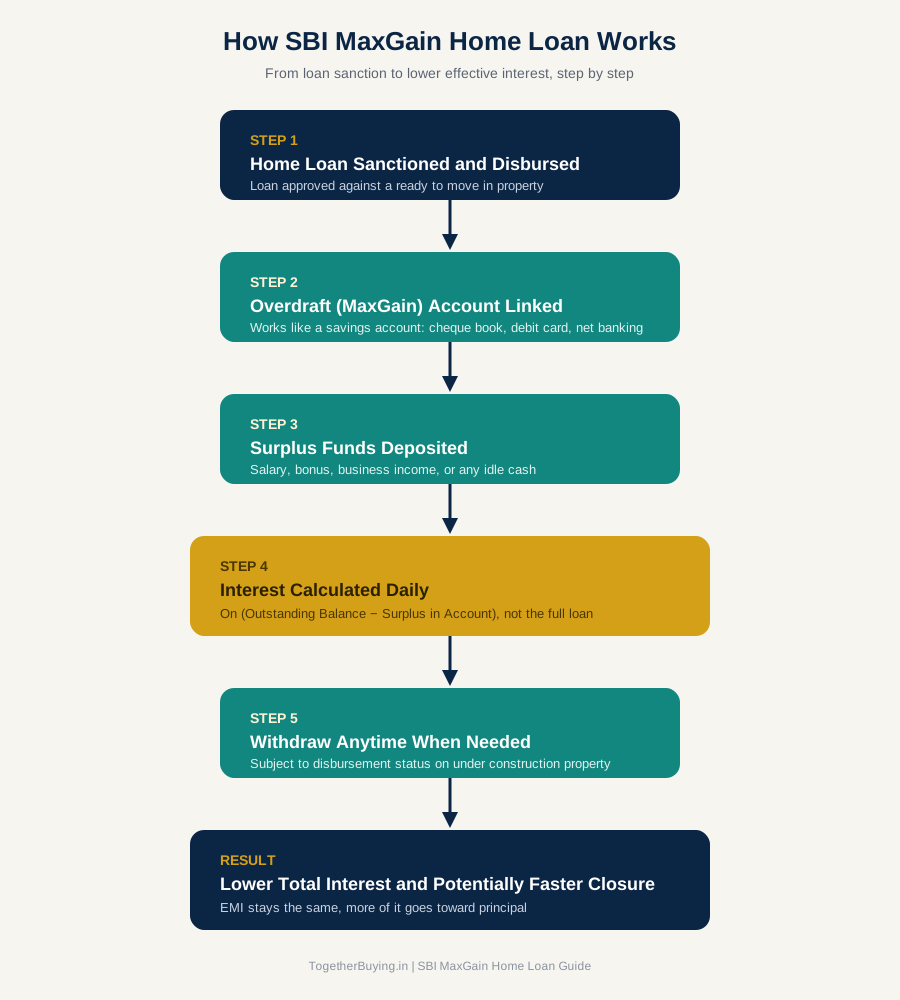
Understanding the mechanics helps clear up the confusion completely. Here is the flow from sanction to closure:
Loan Sanctioned and Disbursed
       ↓
Overdraft (OD) Account Created, Linked to the Loan
       ↓
Salary or Surplus Funds Deposited into the OD Account
       ↓
Interest Calculated Daily on Outstanding Balance minus Surplus
       ↓
Surplus Reduces the Interest Bearing Balance
       ↓
Withdrawal Possible Anytime (subject to disbursement status)
       ↓
Lower Overall Interest Paid and Potentially Faster Closure
Step by step, this is what happens:
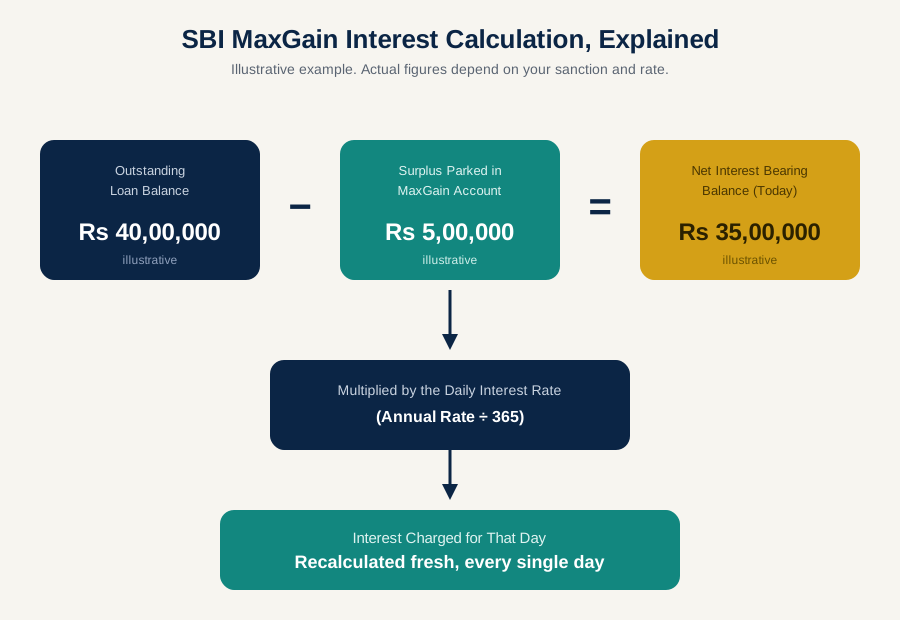
The core formula behind SBI MaxGain interest is simple:
Interest for the day = (Outstanding balance minus surplus balance in the overdraft account) multiplied by the daily interest rate.
Let us walk through a few real world scenarios to see how this plays out differently depending on a borrower's cash flow pattern.
Scenario 1: Salaried employee depositing monthly salary A salaried borrower routes their monthly salary into the MaxGain account and spends gradually across the month for expenses. Even though the balance depletes as the month progresses, the average daily balance still reduces the interest calculated for those days, producing a modest but real saving every month.
Scenario 2: Annual bonus deposited A borrower deposits a large annual bonus into the account and does not touch it for several months. During that period, a substantial chunk of the outstanding balance is effectively offset, generating a meaningful interest saving concentrated in those months.
Scenario 3: Self employed borrower with irregular cash flow A business owner deposits surplus revenue whenever cash flow allows, sometimes leaving large sums parked for weeks, sometimes withdrawing heavily during lean periods. Savings fluctuate month to month but average out to a useful reduction over the year, especially if the surplus tends to be maintained more often than it is drawn down.
Scenario 4: Partial withdrawal for emergencies A borrower withdraws part of the parked surplus for a medical emergency. Interest for the following days rises back toward the level it would have been without the surplus, since the offsetting balance has shrunk. This illustrates that the saving is dynamic, not locked in.
Scenario 5: Large lump sum deposit A borrower sells an asset and parks a large lump sum in the account rather than formally prepaying the loan outright. This produces one of the biggest interest reductions possible under the scheme while preserving full access to that lump sum if a better use for it arises later.
Compared with a normal home loan, where interest is calculated purely on a fixed amortization schedule regardless of your bank balance elsewhere, SBI MaxGain rewards you for keeping money in this specific account rather than in an external savings account or fixed deposit. Over time, savings accumulate in proportion to how consistently and how heavily you maintain a surplus, not simply because time has passed. Note also that during the construction period on an under construction purchase, borrowers typically service only pre EMI interest on the amount disbursed so far, and the full MaxGain offsetting benefit becomes most useful once regular EMIs and full disbursement begin.
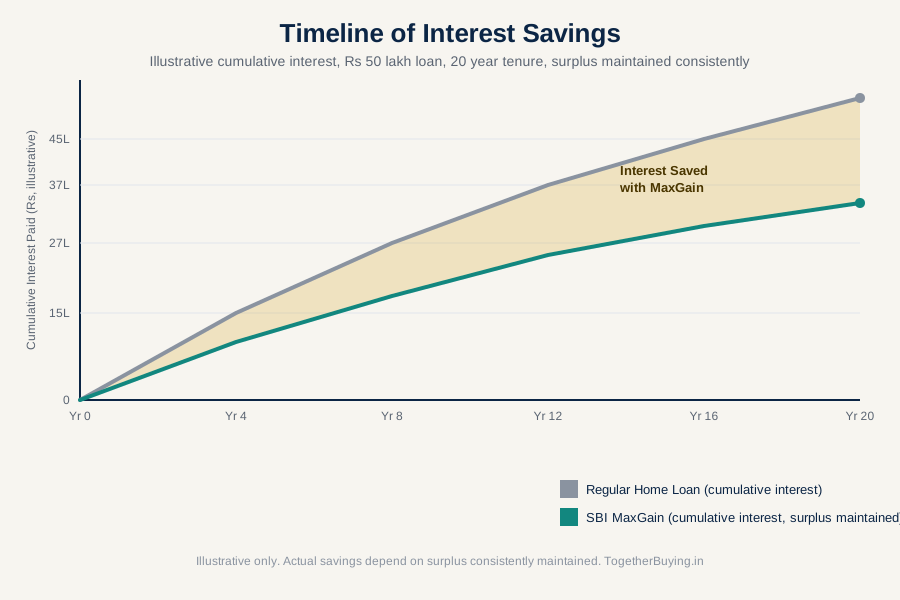
The chart above shows why the gap between a regular home loan and SBI MaxGain widens over time rather than staying constant. Since interest is recalculated daily on the reduced balance, a surplus maintained early in the loan compounds its benefit year after year, which is also why parking money as early as possible in the tenure tends to produce a larger cumulative saving than parking the same amount later.
SBI MaxGain, like SBI's other home loan products, is offered on a floating rate basis linked to SBI's external benchmark lending rate, or EBLR, which itself is tied to the Reserve Bank of India's repo rate. This means:
The following is a general summary of the type of charges commonly associated with SBI home loans, including MaxGain. Exact figures change periodically, so treat this as a guide and confirm current charges with SBI before proceeding.
| Charge Type | Typical Structure Reported |
|---|---|
| Processing Fee | Typically charged as a percentage of the sanctioned loan amount, subject to minimum and maximum limits, plus applicable GST. |
| Legal Charges | A fixed fee for legal verification of the property's title and supporting documents. |
| Technical Valuation Charges | A flat fee for the bank's technical inspection and valuation of the property. |
| Documentation Charges | Nominal administrative charges associated with processing and maintaining loan documentation. |
| Foreclosure / Prepayment | SBI has generally not levied foreclosure or prepayment charges on floating-rate home loans, in line with RBI guidelines. Borrowers should confirm the applicable terms in their individual loan sanction letter. |
| Other Charges | Additional charges may apply for cash withdrawals made using the MaxGain debit card at another bank's ATM, as transactions are drawn from an overdraft account rather than a standard savings account. |
Because processing fees, legal fees, and technical charges are revised from time to time and can also vary by circle or region, always request a written, updated fee schedule from SBI at the time of your application.
Reported eligibility norms for SBI MaxGain generally track SBI's standard home loan eligibility criteria, with some scheme specific conditions:
SBI MaxGain broadly follows the same tax treatment as a standard home loan, since it is still a housing loan for tax purposes, just structured as an overdraft.
An important clarification specific to MaxGain: money you simply park as surplus in the overdraft account is not treated as prepayment of principal for the purpose of Section 80C, since you retain the right to withdraw it. Only your scheduled EMI principal component and any amount you formally choose to use as prepayment count toward the relevant deductions. Since tax rules and the choice between old and new tax regimes affect eligibility for these deductions, it is worth confirming your position with a tax advisor based on your specific return.
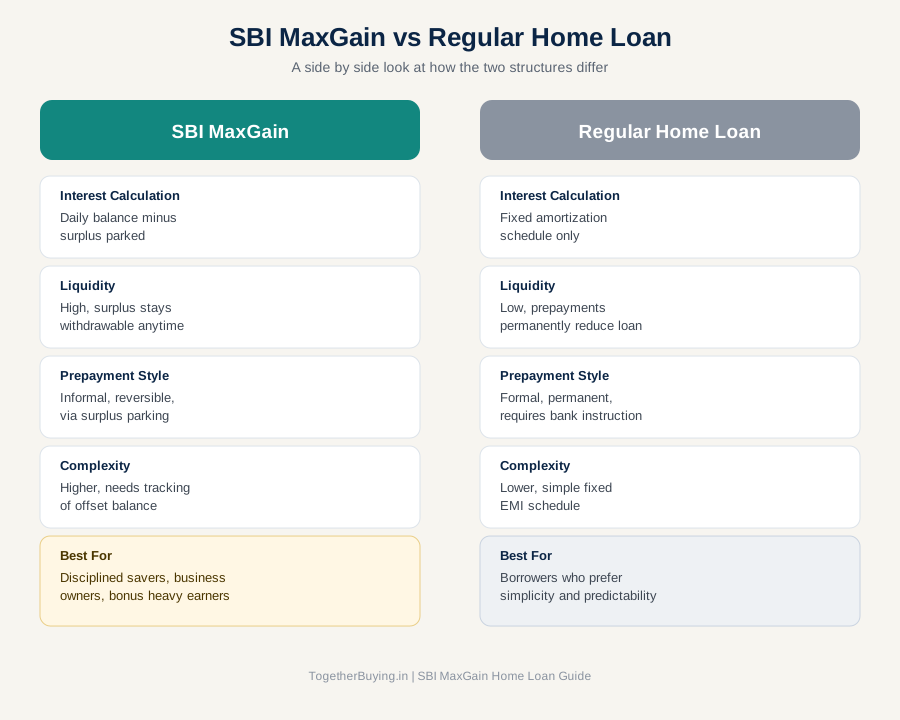
| Factor | SBI MaxGain | Regular SBI Home Loan |
|---|---|---|
| Interest Calculation | Calculated daily on the outstanding loan balance after deducting any surplus parked in the linked overdraft account. | Calculated daily on the outstanding loan balance as per the standard amortisation schedule. |
| EMI | Fixed, similar to a regular home loan. | Fixed. |
| Liquidity | High. Surplus funds remain accessible and can generally be withdrawn when required. | Low. Extra repayments permanently reduce the outstanding loan principal. |
| Withdrawal Facility | Available through the linked overdraft account, which functions similarly to a savings or current account. | Not available. |
| Flexibility | High. Well suited to borrowers with irregular income, bonuses, or fluctuating cash flow. | Lower. Best suited to borrowers with stable monthly income and predictable budgets. |
| Prepayment | Effectively achieved by parking surplus funds in the overdraft account without making a formal prepayment. | Requires a formal prepayment, which permanently reduces the outstanding principal. |
| Cash Flow Management | Strong. The overdraft account can also function as an operating account for day-to-day banking. | Limited to servicing the home loan. |
| Best Borrower Type | Disciplined savers, business owners, professionals with variable income, and borrowers who regularly receive bonuses. | Borrowers who prefer a simple repayment structure with predictable EMIs. |
| Complexity | Higher. Requires understanding of overdraft balances, drawing power, and interest offset calculations. | Lower. Follows a straightforward amortisation schedule. |
| Long-Term Savings Potential | Can be substantial if meaningful surplus funds are consistently maintained in the linked account. | Savings depend entirely on the frequency and amount of formal prepayments made during the loan tenure. |
A question many borrowers ask is whether it makes more sense to simply prepay their home loan whenever they have surplus funds, rather than opting for MaxGain at all. Both approaches reduce interest by lowering the balance on which it is calculated, but they differ in one crucial way: reversibility.
If your surplus is genuinely permanent and you have no realistic scenario where you would need it back, a straightforward home loan with periodic formal prepayment can be simpler to manage and avoids the added complexity of tracking a daily offset balance.
| Pros | Cons |
|---|---|
| Lower effective interest cost by offsetting the outstanding loan balance with surplus funds parked in the linked overdraft account. | Requires consistent financial discipline to maintain surplus balances and maximise interest savings. |
| Full liquidity on surplus funds, allowing withdrawals whenever needed, subject to applicable terms. | More complex than a conventional home loan due to the overdraft structure and interest offset mechanism. |
| Functions as both a home loan account and an operating or emergency fund account. | Interest savings depend entirely on the amount of surplus consistently maintained in the linked account. |
| No separate foreclosure or prepayment charge on floating-rate loans, in line with prevailing RBI guidelines. | Frequent withdrawals from the linked account reduce the interest-saving benefit. |
| Can help borrowers repay the loan faster without making formal prepayments, provided surplus funds are maintained. | Generally available only for ready-to-move residential properties. |
Myth: The interest rate becomes 2%. Fact: The contracted rate never changes. Only the effective interest cost on the reduced balance can approach a much lower figure under specific, sustained surplus conditions.
Myth: Deposited money is locked in. Fact: Surplus funds are generally withdrawable at any time, though funds deposited before full disbursement on an under construction property may be restricted until disbursement is complete.
Myth: The EMI automatically reduces. Fact: The EMI typically stays the same. What changes is the proportion of each EMI going toward interest versus principal repayment, and potentially the total tenure if surplus is maintained consistently.
Myth: Any borrower will save lakhs of rupees. Fact: Savings scale directly with how much surplus is maintained and for how long. A borrower who rarely holds surplus funds will see only a marginal benefit.
Myth: MaxGain is the same as a regular overdraft account. Fact: While it operates like an overdraft in terms of usability, it is specifically structured as a housing loan product with drawing power tied to your home loan schedule, not a general purpose credit line.
SBI MaxGain Home Loan is a genuinely useful product, but it is not the interest rate miracle the "8% to 2%" framing suggests. Your bank never changes your contracted rate. What changes, if you use the account the way it is designed to be used, is how much of your loan actually accrues interest on any given day, because your own surplus funds are quietly working against your outstanding balance while remaining fully accessible to you.
If you consistently maintain surplus funds, SBI MaxGain can be one of the most effective home loan products in India for reducing your overall interest cost while preserving liquidity. However, borrowers without regular surplus cash may achieve similar outcomes with a conventional floating rate home loan and periodic formal prepayments.
Before choosing between the two, use SBI's official MaxGain calculator with your actual numbers, confirm current rates, charges, and eligibility with an SBI branch, and be honest with yourself about how consistently you are likely to maintain a surplus. That, more than any marketing claim, is what will determine how much you actually save.
It is a home loan sanctioned as an overdraft, where any surplus money you park in the linked account temporarily reduces the balance on which interest is calculated, while remaining withdrawable whenever you need it.
No. Your contracted interest rate does not change. What can fall dramatically, under the right conditions, is your effective interest cost, because you end up paying interest on a much smaller net balance.
Interest is calculated daily on your outstanding balance minus whatever surplus balance sits in the linked overdraft account that day, using a daily reducing balance method.
Generally yes, though funds deposited before full loan disbursement for an under construction property may not be withdrawable until disbursement is complete.
No. It does not earn a separate rate of interest. Its benefit comes purely from reducing the interest charged on your loan.
It is primarily positioned for ready to move in properties. Confirm current eligibility for your specific property type with SBI before applying.
MaxGain is generally structured around ready to move in residential property purchase rather than standalone plot purchase. Ask SBI whether a different scheme applies if you specifically need financing for a plot.
Aggregator sources commonly cite a minimum around Rs 20 lakh, but you should verify the current minimum directly with SBI, since such figures are periodically revised.
Some comparison platforms suggest a marginal rate difference may apply to overdraft linked products, though this is not confirmed on SBI's official product page. Confirm the exact rate offered to you at the time of sanction.
No. Simply parking withdrawable surplus is not treated as prepayment for Section 80C purposes. Only your scheduled EMI principal and any formal prepayment qualify.
You can still claim Section 24(b) on the actual interest paid, but since MaxGain often results in lower interest paid, your absolute deduction amount may also be lower, alongside lower interest outgo overall.
Borrowers who consistently maintain meaningful surplus funds, such as business owners with seasonal income, bonus earners, or salaried professionals with strong savings habits.
Borrowers who rarely have surplus funds, live paycheck to paycheck, prefer simplicity, or plan to invest surplus elsewhere may find a regular home loan easier to manage with comparable outcomes.
Some sources indicate conversion may be possible subject to SBI's process and applicable charges. Confirm feasibility and cost directly with your home loan branch.
Yes. Every withdrawal increases the balance on which interest is calculated from that point onward, reducing the savings you were previously accumulating.
Floating rate home loans in India, including SBI's, generally do not carry foreclosure charges in line with RBI guidelines, but confirm this for your specific loan sanction.
Once the loan is fully repaid, whether through the regular schedule or early closure, the overdraft account linked to it is closed along with the loan, and any remaining surplus balance should be withdrawn before closure, since it will no longer function as a standalone bank account afterward.
Home loan eligibility generally depends on verifiable income and repayment capacity up to a maximum age at loan maturity, so a pensioner with a qualifying pension income and adequate residual repayment tenure may be considered, subject to SBI's specific policy at the time of application.
SBI offers home loan products for NRIs, but availability of the MaxGain overdraft structure specifically for NRI applicants should be confirmed with SBI, since documentation and eligibility norms for NRIs differ from resident applicants.
Yes, the MaxGain overdraft account is typically issued with a cheque book and a debit card, along with net banking access, so it can be operated much like a regular savings or current account.
For financially disciplined borrowers who will genuinely maintain surplus balances, it remains a useful way to reduce effective interest cost while keeping full liquidity. For borrowers without that discipline, a regular home loan with periodic formal prepayment may be equally effective and simpler to manage.
Contact Us
Fill out this form
& we'll get back
to you
Recommended for you