Market Trends
Shiv Murti to Nelson Mandela Marg Tunnel: Route, Cost, Timeline, Benefits & Impact on Delhi Gurugram Travel
18 Jun 2026
Market Trends
18 Jun 2026
Content
No Blogs content found
It looks like there haven’t been any blogs yet!
Current Status: The DPR has been prepared and multiple approvals have been obtained. However, government statements and approval documents released through 2025 to 2026 indicate that investment, implementation, and statutory clearance processes are still progressing before construction begins.
Every weekday morning, very heavy daily traffic moves between Gurugram, South Delhi and Indira Gandhi International Airport through the Mahipalpur corridor. The road cannot be widened further. Dense settlements line both sides. Traffic from three directions — the airport, Dwarka Expressway and Gurugram — converges at the same point, causing extended peak hour jams.
The Delhi government and the Union Ministry of Road Transport and Highways (MoRTH) have responded with a direct solution: a 4.9 to 5 kilometre underground tunnel connecting Shiv Murti interchange at Mahipalpur to Nelson Mandela Marg in Vasant Kunj. The tunnel will run entirely underground, bypassing the congested surface road network and creating a signal free route between NH 48 at Shiv Murti and Vasant Kunj.
This article covers the tunnel's route, confirmed project details, clearance status, expected benefits, environmental concerns, and its potential impact on South Delhi real estate and Delhi to Gurugram commuters.
| Parameter | Status |
|---|---|
| DPR | Completed |
| Forest Related Approvals | Obtained |
| Supreme Court Clearance | Obtained |
| Public Hearings | Completed |
| Environmental Clearance | Pending |
| Construction Contract | Not Announced Publicly |
| Construction Start | Yet to Be Officially Confirmed |
The project is a proposed six lane underground road tunnel forming part of National Highway 148AE (NH 148AE). It will connect the Shiv Murti interchange on NH 48 at Mahipalpur (where the Dwarka Expressway begins) to Nelson Mandela Marg in Vasant Kunj.
Delhi Chief Minister Rekha Gupta announced the project in June 2025 after a meeting with Union Minister for Road Transport and Highways Nitin Gadkari. The project is one of six major infrastructure works for Delhi approved by the central government under a broader Rs 24,000 crore road decongestion package for the National Capital Region.
| Particular | Details |
|---|---|
| Project Name | Shiv Murti (Mahipalpur) to Nelson Mandela Marg Underground Road Tunnel |
| Highway Designation | NH 148AE |
| Tunnel Length | Approximately 4.9 km underground section; total project length approximately 5 km |
| Estimated Project Cost | Rs 3,500 crore |
| Executing Agency | National Highways Authority of India (NHAI) |
| Start Point | Shiv Murti Interchange, Mahipalpur, NH 48 / Dwarka Expressway Junction |
| End Point | Nelson Mandela Marg, Vasant Kunj |
| Configuration | Twin Tube Tunnel with Three Lanes per Tube (Six Lanes Total) |
| Finished Tunnel Diameter | 13.8 Metres per Tube |
| Construction Method | Tunnel Boring Machine (TBM) |
| DPR Status | DPR Completed (MoRTH Confirmation, August 2024) |
| Environmental Clearance | Public Hearings Completed (September 2024); Environmental Clearance Remained a Key Pending Requirement in the Latest Publicly Reported Updates |
| Forest Clearance | Ridge Management Board (November 2022), Central Empowered Committee (June 2023), and Supreme Court (October 2023) Approvals Obtained |
| Expected Construction Start | Construction Timeline Remains Subject to Environmental Clearance, Investment Approval, Tendering, and Implementation Decisions |
| Broader Package | Part of the Rs 24,000 Crore Delhi NCR Road Infrastructure Package |
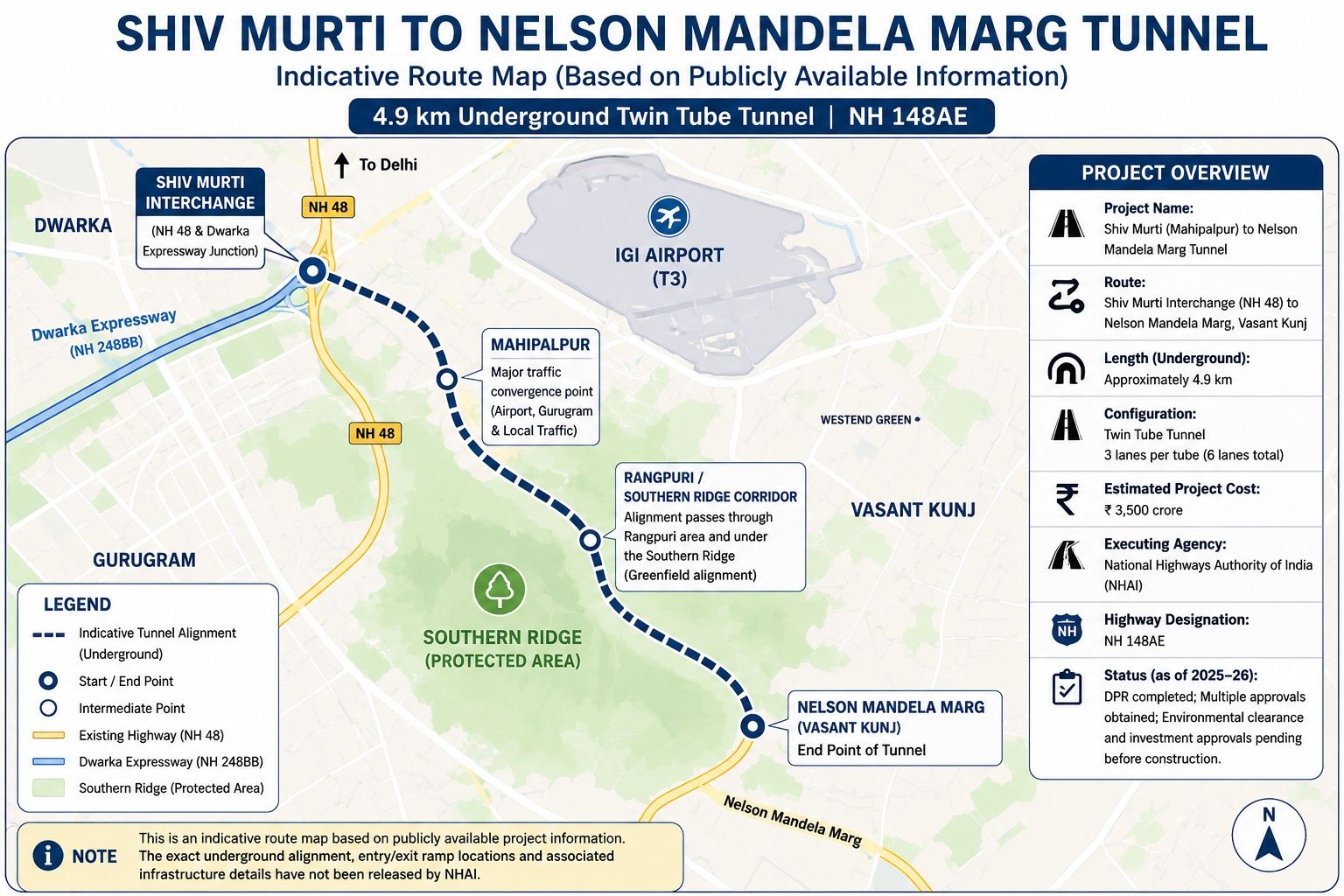
The tunnel runs south west to south, connecting the NH 48 corridor near the airport with the residential and commercial zones of South Delhi. It passes through greenfield alignment, agricultural land and the Southern Ridge. No surface road widening is involved along the underground stretch.
Shiv Murti is the gateway between Delhi, Gurugram and IGI Airport. It marks the point where NH 48 (the Delhi Jaipur Expressway, formerly NH 8) meets the Dwarka Expressway (NH 248BB). The Dwarka Expressway became fully operational in August 2025 and now carries significant traffic from north Delhi, Dwarka and Gurugram. All this traffic currently funnels onto the surface NH 48 to reach Vasant Kunj and South Delhi, creating the bottleneck the tunnel is designed to resolve. The tunnel's interchange at Shiv Murti will connect it to both NH 48 and Dwarka Expressway.
Mahipalpur is the primary traffic bottleneck on this corridor. NH 48 runs through dense, built up urban settlement here. Airport traffic, Gurugram commuters and local traffic merge at this point. Surface road widening is not feasible. The Delhi to Gurugram Expressway section between Rajiv Chowk and Mahipalpur regularly records multi kilometre queues during both morning and evening peak hours. The NHAI's DPR for the tunnel specifically cites Mahipalpur's narrow city roads and heavy mixed traffic as the main reason an underground bypass was chosen over surface widening.
The tunnel alignment passes through the Rangpuri area, which connects Mahipalpur to Vasant Kunj on the surface. Rangpuri sits adjacent to the southern boundary of IGI Airport and carries airport bound traffic from NH 48. The tunnel will allow vehicles to bypass the Rangpuri surface road, reducing load on this stretch. The tunnel passes through what the DPR describes as greenfield alignment across the Rangpuri Ridge, a section of the Southern Ridge.
Nelson Mandela Marg is a major arterial road in Vasant Kunj, one of South Delhi's most established residential and commercial localities. It connects to Mehrauli, Vasant Vihar and parts of the diplomatic area. By terminating here, the tunnel brings Dwarka, Gurugram and airport area traffic directly into South Delhi without touching the congested surface network at Mahipalpur or Rangpuri.
| Location | Role in the Corridor |
|---|---|
| Shiv Murti Interchange | Primary entry and exit node connecting the tunnel to NH 48 and the Dwarka Expressway (NH 248BB). |
| Mahipalpur | Major surface traffic bottleneck that the tunnel is designed to bypass completely, reducing congestion on the existing road network. |
| Rangpuri | Section where the tunnel alignment passes beneath the Southern Ridge through a greenfield underground corridor. |
| Westend Green (En Route) | Premium residential locality situated close to the proposed tunnel alignment. |
| Nelson Mandela Marg, Vasant Kunj | Tunnel exit point providing direct connectivity to South Delhi's arterial road network and key destinations in Vasant Kunj. |
The NHAI's project documentation and MoRTH's Lok Sabha reply from August 2024 confirm that widening the existing surface road was ruled out at the planning stage. The corridor at Mahipalpur and Rangpuri has no available land for expansion, and the combination of environmental and urban constraints made a tunnel the only viable grade separated solution.
| Challenge | Impact |
|---|---|
| Dense Urban Settlement | Limited land acquisition opportunities on both sides of NH 48 near Mahipalpur make conventional road widening difficult and expensive. |
| Airport Influence Zone | Infrastructure and height restrictions around the IGI Airport boundary constrain surface-level expansion options. |
| Existing Traffic Volume | Surface construction activities would severely disrupt one of Delhi NCR's busiest traffic corridors, affecting daily commuters and freight movement. |
| Southern Ridge Ecology | Environmental protections and ecological sensitivities within the Southern Ridge limit road widening and greenfield surface infrastructure development. |
The NHAI's project documentation and MoRTH's Lok Sabha reply from August 2024 give the clearest official explanation:
"As NH 48 carries very heavy traffic to Chhatarpur or Vasant Kunj from Gurgaon, it creates heavy congestion at Mahipalpur due to very narrow city roads, traffic to and from Delhi airport and Mahipalpur or Rangpuri market. Since the road bears heavy traffic and has very heavy settlements en route, heavy congestion along this route occurs during peak hours. Widening along this route is almost difficult due to heavy settlement, and therefore, it was proposed to connect NH 248BB with NH 148AE at Nelson Mandela Marg to avoid this congestion." — NHAI, from DPCC public hearing report, September 2024
The specific pressure points the tunnel is designed to address:
| Problem | Current Impact |
|---|---|
| Mahipalpur Bottleneck | Multi-kilometre traffic queues regularly form on NH 48 during peak hours. Road widening is constrained by dense urban development and limited right of way. |
| Airport Traffic Merger | Traffic from IGI Airport and Gurugram converges at Mahipalpur, significantly increasing congestion and travel delays. |
| Dhaula Kuan Overload | When NH 48 becomes congested, traffic diverts onto Rao Tula Ram Marg and Dhaula Kuan, placing additional pressure on already busy corridors. |
| No Signal Free Alternate | Commuters travelling from Gurugram toward Vasant Kunj and South Delhi currently lack a grade-separated bypass route. |
| Distance Penalty | Without the tunnel, vehicles from the Dwarka Expressway must travel approximately 13 km extra via surface roads to access NH 148AE. |
| Pollution | Slow-moving and idling traffic in congested sections increases fuel consumption and local emissions. A signal-free corridor could help reduce idle time and improve traffic flow. |
Data note: The Delhi government's broader Rs 24,000 crore road package aims at decongesting the Dhaula Kuan to IGI Airport to Gurugram section of NH 48, of which this tunnel is the centrepiece. Source: MoRTH Lok Sabha reply, August 2024; Business Standard, June 2025.
| Feature | Details |
|---|---|
| Tunnel Type | Underground road tunnel (fully subterranean) |
| Number of Tubes | Two (Twin Tube Configuration) |
| Lanes per Tube | Three |
| Total Lanes | Six |
| Finished Tube Diameter | 13.8 Metres |
| Cross Passages | Provided Every 500 Metres for Emergency Evacuation and Inter-Tube Access |
| Lay-bys | Emergency Lay-bys Planned at Approximately 750-Metre Intervals |
| Construction Method | Tunnel Boring Machine (TBM) Technology Designed to Minimise Surface Disruption |
| Ventilation | Advanced Electromechanical Ventilation Systems for Air Quality Management |
| Fire Safety | Dedicated Fire Detection, Suppression, and Emergency Response Systems |
| CCTV | Continuous Surveillance Coverage Throughout the Tunnel Length |
| Emergency Exits | Cross Passages Every 500 Metres and Emergency Lay-bys Every 750 Metres |
| Signal Control | Fully Signal-Free Route with No Traffic Signals Inside the Tunnel |
| Highway Connections | Integrated Interchange at Shiv Murti Connecting NH 48 and Dwarka Expressway (NH 248BB) |
Source: NHAI officials quoted in Outlook India; DPCC public hearing report, September 2024; Construction World, January 2025.
The tunnel's primary benefit is a signal free underground corridor between Shiv Murti and Nelson Mandela Marg. Vehicles will not encounter any traffic signals, level crossings or grade level intersections along the 4.9 km underground stretch. This is a structural improvement, not a conditional one — it is a direct function of being underground.
Commuters travelling from Gurugram to South Delhi or vice versa currently have limited options. NH 48 through Mahipalpur is the primary route and is chronically congested. Dwarka Expressway offers a partial bypass but still converges at Shiv Murti on the surface. The tunnel creates a new route: Gurugram via NH 48 or Dwarka Expressway to Shiv Murti, then underground to Vasant Kunj, without touching the Mahipalpur surface bottleneck.
The tunnel sits adjacent to the IGI Airport access network. Vehicles heading from Vasant Kunj and South Delhi to Terminal 3 will benefit from a faster, signal free approach route via the tunnel to Shiv Murti and onward to the airport. The NHAI's original project description specifically mentioned providing an alternate route to IGI Airport.
By diverting a portion of through traffic underground, the tunnel is expected to reduce vehicle load on Mahipalpur, Rangpuri, Dhaula Kuan, Rao Tula Ram Marg and the NH 48 surface corridor. The relief will be proportional to the volume of through traffic that opts for the tunnel, which will depend on travel time savings and any toll structure applied.
According to NHAI data, vehicles from Dwarka Expressway currently have to cover approximately 13 km to reach NH 148AE (Nelson Mandela Marg) via the surface road. The tunnel reduces this to approximately 5 km.
Important: No official travel time reduction figures (such as "Delhi to Gurugram in 20 minutes") have been confirmed by NHAI or MoRTH for this specific tunnel. The commonly cited "20 minute" figure refers to the broader vision for Delhi NCR corridor improvements, not to this tunnel in isolation. This article does not project specific travel times beyond what official sources have stated.
| Area | Expected Benefit |
|---|---|
| Vasant Kunj | Direct tunnel terminus offering faster connectivity to Dwarka, Gurugram, and IGI Airport while avoiding surface road congestion. |
| Mahipalpur | Reduction in through traffic on the NH 48 surface corridor, easing pressure on local roads, intersections, and commercial areas. |
| Rangpuri | Improved travel times through bypassing congested surface roads and providing quicker access to the airport corridor. |
| Westend Green | Enhanced connectivity to South Delhi's arterial road network through proximity to the tunnel alignment. |
| Dwarka | The Dwarka Expressway connects directly to Shiv Murti, creating a continuous grade-separated corridor toward South Delhi. |
| Gurugram (North and East) | Commuters travelling to Vasant Kunj, Chhatarpur, and Mehrauli can bypass the Mahipalpur bottleneck entirely. |
| IGI Airport Zone | Faster access from South Delhi to NH 48 through the tunnel, with direct connectivity near the airport precinct. |
| Dhaula Kuan and Rao Tula Ram Marg | Potential reduction in congestion spillover from NH 48, particularly during peak travel periods. |
Infrastructure improvements that reduce commute time and increase connectivity have a documented effect on residential demand in affected localities. This relationship is well established in Delhi NCR — the Dwarka Expressway corridor saw significant residential activity in anticipation of its completion.
As the tunnel's exit point, Vasant Kunj stands to benefit most directly. The locality already commands premium pricing, with average flat rates at approximately Rs 22,150 per sq ft (99acres, 2026). A direct, signal free link to Gurugram and Dwarka would further reinforce Vasant Kunj's appeal to professionals commuting to the Cyber City and Golf Course Road corridors. DDA has also recently initiated a tender for 118 residential plots in Vasant Kunj Sector D 6, reflecting continued demand in this micro market.
A reduction in through traffic on surface roads could improve liveability perception in nearby residential pockets around Mahipalpur. Rangpuri, which serves as a support zone for airport area services, could attract more residential investment from buyers seeking proximity to both the airport and South Delhi's social infrastructure.
Dwarka's residential market, which has been strengthening since the Dwarka Expressway became operational in 2025, connects directly to the tunnel's Shiv Murti entry point. For Dwarka residents working in South Delhi, Vasant Kunj or Chhatarpur, the tunnel removes the Mahipalpur surface bottleneck from their daily route.
Note: The above discusses historical patterns and connectivity logic. This article does not project or recommend specific property price movements. Real estate investment decisions should be made with independent advice and current market data.
The tunnel does not function in isolation. Its strategic value comes from the network of roads and expressways it links:
| Area | Expected Benefit |
|---|---|
| Vasant Kunj | Direct tunnel terminus offering faster connectivity to Dwarka, Gurugram, and IGI Airport while avoiding surface road congestion. |
| Mahipalpur | Reduction in through traffic on the NH 48 surface corridor, easing pressure on local roads, intersections, and commercial areas. |
| Rangpuri | Improved travel times through bypassing congested surface roads and providing quicker access to the airport corridor. |
| Westend Green | Enhanced connectivity to South Delhi's arterial road network through proximity to the tunnel alignment. |
| Dwarka | The Dwarka Expressway connects directly to Shiv Murti, creating a continuous grade-separated corridor toward South Delhi. |
| Gurugram (North and East) | Commuters travelling to Vasant Kunj, Chhatarpur, and Mehrauli can bypass the Mahipalpur bottleneck entirely. |
| IGI Airport Zone | Faster access from South Delhi to NH 48 through the tunnel, with direct connectivity near the airport precinct. |
| Dhaula Kuan and Rao Tula Ram Marg | Potential reduction in congestion spillover from NH 48, particularly during peak travel periods. |
Source: MoRTH Lok Sabha reply, August 2024; Business Standard, June 2025; Swarajya Mag, August 2025.
| Year / Period | Milestone |
|---|---|
| Earlier (Pre-2022) | Project conceptualised to decongest the NH 48 corridor between Dhaula Kuan, IGI Airport, and Gurugram. |
| November 2022 | Ridge Management Board approved the project during the forest and ridge clearance stage. |
| June 2023 | Central Empowered Committee granted clearance for the proposed tunnel project. |
| August 2023 | NHAI was reported to be inviting tenders from construction agencies for project execution. |
| October 2023 | Supreme Court clearance was granted, removing a major regulatory hurdle. |
| August 2024 | MoRTH confirmed DPR preparation in a written Lok Sabha reply by Union Minister Nitin Gadkari. |
| September 2024 | DPCC conducted two public hearings for environmental clearance and forwarded stakeholder feedback to MoEF&CC. |
| January 2025 | Media reports indicated that the environmental clearance decision remained pending with MoEF&CC. |
| June 2025 | Delhi Chief Minister Rekha Gupta announced MoRTH approval for six Delhi infrastructure projects, including this tunnel, with the project cost confirmed at Rs 3,500 crore. |
| 2026 | The project continued through approval, investment, tendering, and implementation evaluation stages. |
| Construction Period (Estimated) | Approximately four years after construction commencement, based on timelines observed for comparable NHAI tunnel projects. |
Important: As of the date of this article, the environmental clearance from MoEF&CC is the key pending step before construction can formally begin. Project timelines are subject to clearance decisions and tendering outcomes. Only officially reported milestones are included above.
The tunnel alignment passes through approximately 4.9 km of underground terrain, a section of which crosses the Southern Ridge — a protected urban forest area in Delhi. The project requires clearance under the Forest Conservation Act (FCA) as it affects 5.825 hectares of Southern Ridge land and 1.68 hectares of deemed forest. Following two public hearings conducted by the Delhi Pollution Control Committee (DPCC) in September 2024, environmental clearance from the Union Ministry of Environment, Forest and Climate Change (MoEF&CC) remained a key pending requirement in the latest publicly reported project updates. The clearance status should be verified against the latest MoEF&CC records before construction begins.
The project requires the felling and transplantation of approximately 417 trees in the Southern Ridge. NHAI has committed to planting over 4,000 saplings as compensatory afforestation. Environmental groups and local residents raised this concern formally during the DPCC public hearings.
At the DPCC public hearings, Mahipalpur residents raised concerns about potential structural damage to houses above the tunnel route. The project proponent addressed these concerns in writing, stating that the use of a Tunnel Boring Machine (TBM) ensures construction remains well below the surface and that proper monitoring and safety design checks would be implemented to avoid damage to existing structures. The DPCC's report noted this assurance but forwarded all concerns to the environment ministry for consideration.
This will be one of the widest road tunnels in India, with a finished diameter of 13.8 metres per tube. Constructing twin large diameter TBM tunnels through the Delhi Ridge and below a dense urban settlement is technically complex. Construction timelines for similar projects in India have run to four or more years after ground breaking.
The project has moved through multiple approval stages since at least 2022. The gap between the DPR and formal construction start reflects the layered clearance process for projects affecting ridge land, forest and urban settlements. Each stage (Ridge Management Board, Central Empowered Committee, Supreme Court, environmental public hearings, MoEF&CC) is sequential and cannot be shortened.
| Project | Length | Type | Status (as of 2025–26) |
|---|---|---|---|
| Shiv Murti to Nelson Mandela Marg Tunnel | ~4.9 km | Underground Twin-Tube Road Tunnel | DPR completed; multiple approvals obtained; implementation remains subject to further statutory, financial, and investment clearances. |
| Dwarka Expressway (NH 248BB) | 27.6 km | Elevated Expressway with a 3.6 km Tunnel Section | Fully Operational (August 2025) |
| Urban Extension Road II (UER II) | ~75 km | Ring Road / Expressway | Under Construction |
| Delhi–Mumbai Expressway (Delhi Link) | ~50 km | Greenfield Expressway | Partially Operational |
| Delhi–Dehradun Expressway | ~210 km | Greenfield Expressway with Wildlife Tunnel | Operational (2024) |
| Delhi–Amritsar–Katra Expressway | ~670 km | Greenfield Expressway | Under Construction |
The project has received several important approvals, including Ridge Management Board, Central Empowered Committee and Supreme Court clearances. However, environmental and implementation related processes are still progressing according to the latest publicly available information.
Construction has not yet been officially scheduled. While government announcements in 2025 indicated a target of starting work in 2026, subsequent project documents and government statements show that implementation remains subject to environmental clearance, investment approvals, tendering, and execution decisions. No confirmed contract award date has been announced as of the time of writing.
Rs 3,500 crore, confirmed by Delhi Chief Minister Rekha Gupta in June 2025 and corroborated by Business Standard, Daily Pioneer and India TV News. This is part of a larger Rs 24,000 crore Delhi road decongestion package.
The tunnel will eliminate the Mahipalpur surface bottleneck for vehicles travelling between Shiv Murti and Vasant Kunj, which is expected to improve travel times on this specific segment. No official figure for end to end Delhi to Gurugram travel time reduction has been stated for this tunnel. Overall travel time will depend on traffic conditions before and after the tunnel and on any toll structure.
The most directly benefited areas are Vasant Kunj, Mahipalpur, Rangpuri, Dwarka and the Gurugram to Delhi commuter corridor. Residents near Dhaula Kuan and Rao Tula Ram Marg will also benefit from reduced spillover traffic.
Yes. The National Highways Authority of India (NHAI) is the executing agency, confirmed by both the MoRTH Lok Sabha reply (August 2024) and the Chief Minister's June 2025 announcement.
Yes. The tunnel's interchange at Shiv Murti connects directly to both NH 48 and Dwarka Expressway (NH 248BB), which became fully operational in August 2025.
Infrastructure improvements have historically correlated with increased residential demand in South Delhi, and Vasant Kunj in particular has seen strong appreciation in recent years. However, property price movements depend on many factors beyond a single infrastructure project. This article does not make price predictions.
The DPR has been prepared and several approvals have been obtained. However, project implementation remains subject to environmental, investment, and execution related clearances. The latest publicly available government information indicates that the project is still progressing through approval and implementation stages.
Yes. The 4.9 km tunnel section is entirely underground, bored using a Tunnel Boring Machine. There is no elevated or at grade section within the tunnel itself. Approach ramps and interchanges at Shiv Murti and Vasant Kunj will be at or near ground level.
A twin tube tunnel consists of two parallel underground bores, each carrying traffic in one direction. Each tube in this project will have three lanes, giving a total capacity of six lanes. Cross passages between the tubes every 500 metres serve as emergency evacuation routes. This is the standard configuration for major urban road tunnels in India.
Contact Us
Fill out this form
& we'll get back
to you
Recommended for you