Market Trends
Stamp Duty and Registration Charges in Delhi
16 Apr 2026
Market Trends
16 Apr 2026
Content
No Blogs content found
It looks like there haven’t been any blogs yet!
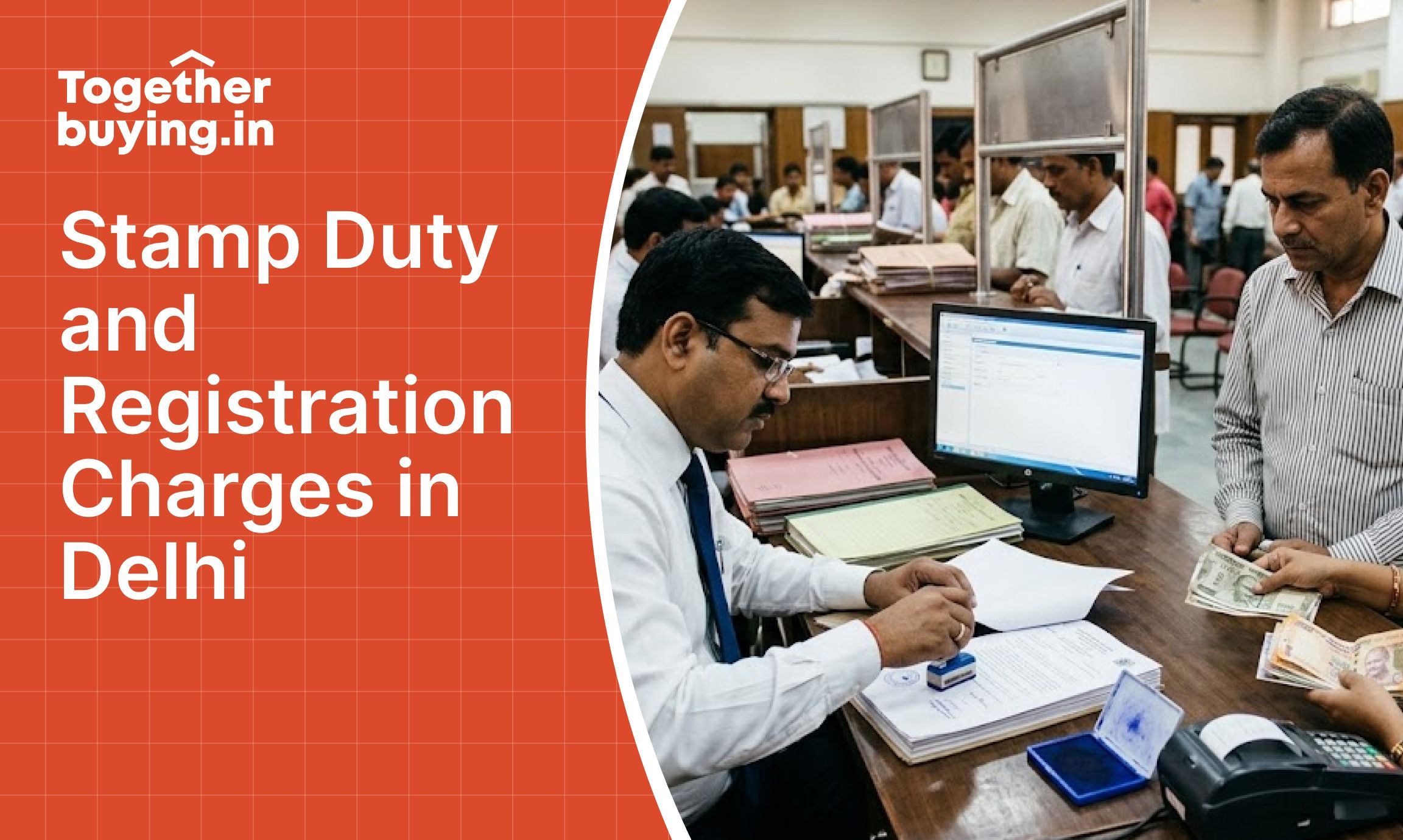
Property transactions in Delhi require mandatory payment of stamp duty and registration charges to the Delhi government. These charges represent legal fees necessary to transfer property ownership and register the transaction in official government records.
Stamp duty serves as a state tax on property transfers, while registration charges cover the administrative cost of recording the transaction. Both payments are essential for establishing legal ownership and protecting buyer rights under Indian property law.
Delhi follows a simplified gender based stamp duty structure with flat rates for all property values. According to Delhi Revenue Department rates apply to the higher value between the transaction amount and circle rate.
All properties purchased by male buyers attract 6% stamp duty regardless of property value.
Female buyers pay 4% stamp duty on all property transactions, providing a 2% concession compared to male buyers.
Properties purchased jointly by male and female buyers attract 5% stamp duty as a fixed rate, regardless of ownership percentage distribution between the parties.
ClearTax confirms that Delhi follows a straightforward registration charge structure:
The registration charge applies to the higher value between the sale consideration and circle rate, similar to stamp duty calculation.
Property value: ₹80 lakh Circle rate: ₹85 lakh (higher value considered) Stamp duty: ₹85 lakh × 6% = ₹5.1 lakh Registration charges: ₹85 lakh × 1% = ₹85,000 Pasting fee: ₹100 Total charges: ₹5.95 lakh
Property value: ₹50 lakh Circle rate: ₹45 lakh (property value is higher) Stamp duty: ₹50 lakh × 4% = ₹2 lakh Registration charges: ₹50 lakh × 1% = ₹50,000 Pasting fee: ₹100 Total charges: ₹2.5 lakh
Property value: ₹1 crore Circle rate: ₹95 lakh (property value is higher) Stamp duty: ₹1 crore × 5% = ₹5 lakh Registration charges: ₹1 crore × 1% = ₹1 lakh Pasting fee: ₹100 Total charges: ₹6 lakh
Residential and commercial properties follow identical stamp duty rates in Delhi. The property type does not influence the calculation method or applicable rates.
Circle rates vary significantly across Delhi locations. Premium areas like Lutyens Delhi, Greater Kailash, and Vasant Vihar have higher circle rates compared to peripheral areas like Dwarka or Rohini.
The gender composition of buyers directly impacts stamp duty rates. Female ownership provides the maximum savings, while joint ownership offers moderate benefits compared to male ownership.
Stamp duty calculation always uses the higher value between the declared property price and the government prescribed circle rate for that locality.
Circle rates represent minimum property values set by the Delhi government for different localities. These rates serve as the base for calculating stamp duty and registration charges, preventing undervaluation of properties.
The Delhi Revenue Department updates circle rates periodically based on market conditions and infrastructure development. Current circle rates are available on the official Delhi government revenue portal.
Delhi circle rates are categorized by:
Gather required documents including sale deed, identity proofs, address proofs, property documents, NOC certificates, and clearance papers from relevant authorities.
Access the Delhi Revenue Department portal and create an account. Fill the property registration application with accurate property and buyer details.
Calculate stamp duty using the online calculator available on the revenue portal. Pay stamp duty through the online system using net banking or card payment.
Book an appointment at the designated Sub Registrar office through the online appointment system. Select a convenient date and time slot.
Visit the Sub Registrar office with all original documents. Complete document verification and biometric authentication of all parties involved.
Execute the sale deed in the presence of the Sub Registrar and required witnesses. Pay registration charges and obtain the official receipt.
Collect registered documents with an official seal and unique registration number. Obtain certified copies for future legal and financial requirements.
Declaring property value below the prescribed circle rate attracts penalties and legal consequences. The registration department can reject such transactions or demand additional stamp duty payment with penalties.
Properties without proper stamp duty payment face legal challenges in ownership transfer proceedings. Courts may not recognize such transactions as legally valid.
Delayed registration beyond the prescribed time limit attracts progressive penalty charges. Extended delays may result in transaction complications and additional legal requirements.
Improper registration creates title disputes and affects property marketability. Financial institutions may refuse loans against properties with registration defects.
Stamp duty and registration charges qualify for tax deduction under Section 80C up to ₹1.5 lakh annually. This benefit applies specifically to self occupied residential properties.
Stamp duty and registration charges form part of the property acquisition cost for capital gains calculation. These expenses reduce taxable capital gains during future property sales.
Properties with proper stamp duty payment qualify for home loan interest deduction under Section 24(b) up to ₹2 lakh annually for self occupied properties.
Stamp duty and registration charges in Delhi follow a straightforward gender based structure with rates of 6% for male buyers, 4% for female buyers, and 5% for joint ownership. The absence of property value slabs makes calculation simple and predictable.
Female buyers receive substantial savings of 2% compared to male buyers, while joint ownership provides moderate benefits. Understanding circle rates and maintaining proper documentation ensures smooth property registration and legal compliance.
These charges typically add 5% to 7% to the total property cost, requiring careful budget planning by buyers. Professional consultation may be beneficial for complex transactions involving commercial properties or multiple ownership structures.
Male buyers pay 6% stamp duty on all property transactions in Delhi, calculated on the higher value between property price and circle rate.
Yes, female buyers pay only 4% stamp duty compared to 6% for male buyers, providing a significant 2% saving on property transactions.
Joint ownership between male and female buyers attracts a fixed 5% stamp duty rate, regardless of the ownership percentage distribution.
No, Delhi follows a simple 1% registration charge on property value with no minimum or maximum limits, plus a ₹100 pasting fee.
Stamp duty and registration charges are calculated on circle rate when it exceeds the declared property value, preventing undervaluation.
Stamp duty rates applicable on the date of document execution apply to the transaction, regardless of any subsequent rate changes.
Stamp duty is generally non refundable. However, specific circumstances may allow refund under Delhi government guidelines with proper documentation.
Property registration typically takes 10 to 15 working days from online application submission to final document collection.
Contact Us
Fill out this form
& we'll get back
to you
Recommended for you