Investments

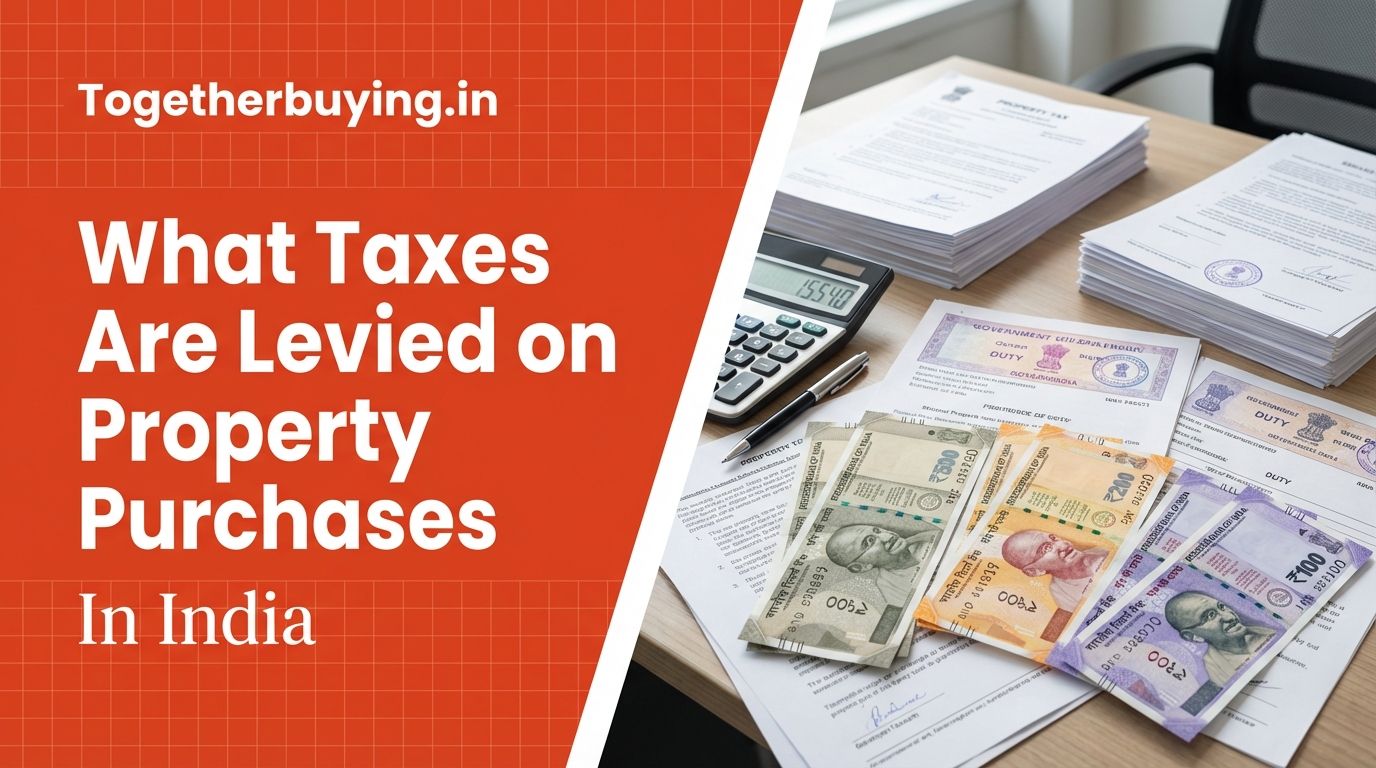
What Taxes Are Levied on Property Purchases in India?
What Taxes Are Levied on Property Purchases in India?

12 Jan 2026

Content

No Blogs content found

It looks like there haven’t been any blogs yet!

Get answer to all your queries

We're here to help

Talk to Expert

Purchasing property in India isn't just about paying the price you negotiate with the seller. There are multiple government taxes and charges that add to your final bill. Some of these you pay immediately during purchase, while others come up later. Knowing what these charges are helps you budget properly, stay on the right side of the law, and figure out how much you're actually spending on the property.

1. Stamp Duty: Primary Transfer Tax

Stamp duty is a tax imposed by the State Government on the transfer of immovable property. It effectively legalizes the sale transaction and confirms the transfer of ownership rights from seller to buyer.

Key features:

  • Calculated as a percentage of the property’s market value (often the higher of agreement value or circle/ready-reckoner rate).
  • Typical range: approximately 5% to 7% or even 8–10% in some states.
  • Rates vary significantly by state, location (urban/rural), and sometimes buyer profile (e.g., female owners may receive rebates in certain states).

Why it matters

Stamp duty is usually the single largest direct tax cost in buying a property. Without payment and stamping of the sale deed, ownership transfer lacks legal protection.

2. Registration Charges: Legal Recording Fee

Separate from stamp duty, this is the fee for registering the property sale deed with the government under the Registration Act.

Key points:

  • Uniformly levied around 1% of property value (varies by state/market norms).
  • Ensures the transaction is recorded in the public registry, preventing disputes.
  • Registration is mandatory for all property transfers above a nominal value.

Implication

Registration fees plus stamp duty often together constitute a significant upfront statutory cost in property acquisition.

3. Goods and Services Tax (GST)

  • GST is levied only on under-construction properties (i.e., not “completed” or “ready-to-move-in” properties).
  • Residential under-construction: Typically 5% GST.

Affordable housing

Lower rate of 1% GST may apply when certain conditions are met (e.g., property price under a specified limit).

Commercial properties

Standard GST rates may apply, often higher than residential.

Important: GST does not apply on stamp duty or registration charges because these are statutory state levies, not supply of goods/services.

Why it matters

GST paid on purchase cannot be offset against stamp/registration and increases the total upfront payment for new construction properties.

4. Tax Deducted at Source (TDS) on Property Purchase

When the sale value of a property exceeds ₹50 lakh, the buyer must deduct TDS at 1% of total sale value under Section 194-IA of the Income Tax Act.

Mechanism

  • Deduct 1% from the payment to the seller.
  • Deposit it with the government within specified timelines.
  • Furnish Form 16B (TDS certificate) to the seller.

Special cases: Higher TDS (e.g., 20%) applies when the seller is a Non-Resident Indian (NRI) under Section 195, with additional surcharge/cess.

Why this matters

TDS is not a “cost” per se, but buyers must comply or face penalties. Sellers can claim credit in their tax returns.

5. Capital Gains Tax (Long-Term/Short-Term)

Although not levied at the time of purchase, capital gains tax becomes relevant if you sell the property later.

Key points:

  • Profit from sale (sale price minus cost of acquisition and indexed improvements) is subject to capital gains tax.
  • Tax classification depends on the holding period (short-term vs long-term).
  • Expenses like stamp duty and registration costs are included in cost of acquisition calculations when computing gains.

Note: Buyers should plan this cost at the time of exit from the investment, particularly in markets with high appreciation.

6. Other Local or Recurring Taxes


### Property Tax Once you own and occupy / rent the property, municipal authorities levy annual property tax based on assessed value. This tax funds local civic services and is not a purchase tax, but part of ongoing ownership cost.

Transfer Fees in Special Cases

Some municipal bodies or state laws may impose nominal transfer or documentation charges beyond standard duties for specific deed types or delayed registration (varies by location).

How These Taxes Impact Your Purchase Cost

A simplified illustration for a property worth ₹1 crore might look like:

ComponentTypical RateApprox. Amount
Stamp Duty~6%₹6,00,000
Registration~1%₹1,00,000
GST (if applicable)5% (under-construction)₹5,00,000
TDS1% (if > ₹50 lakh)₹1,00,000
Total (approx.)₹13,00,000+

Note: Actual figures vary by state, property type, and eligibility for rebates.

Practical Tips for Buyers

Plan early for these taxes

Upfront stamp, registration, GST, and TDS can constitute 10–15% or more of the base property price.

Review state rules

Stamp duty rates, rebates for female buyers, and circle rates differ across states.

Document properly

Under-reporting sale price can trigger penalties; official rates based on market/ready reckoner values are legally required.

Factor into home loans

Many banks do not finance stamp duty and registration, so buyers must arrange separate funds.

Conclusion

Property acquisition in India carries multiple statutory taxes beyond the negotiated sale price. The principal ones are stamp duty and registration charges, followed by GST (on under-construction units), TDS (if applicable), and future capital gains tax on resale. Advanced planning, understanding of state-specific rates, and compliance with tax provisions are critical to avoid surprises and maximize the value of your investment.

Frequently Asked Questions (FAQs)

1. What are the main taxes payable when buying a property in India?

When purchasing a property in India, buyers typically pay stamp duty, registration charges, GST (only on under-construction properties), and TDS (if the property value exceeds ₹50 lakh). Apart from these, municipal property tax becomes applicable after ownership.

2. Is stamp duty the same across all states in India?

No. Stamp duty is a state government tax, and rates vary by state, city, and sometimes even by locality. Some states also offer concessions for women buyers or first-time homebuyers.

3. Do I have to pay GST on all property purchases?

  • GST is applicable only on under-construction properties.
  • Under-construction residential property: 5% GST
  • Affordable housing (eligible): 1% GST
  • Ready-to-move-in properties with completion certificate are exempt from GST.

4. Is GST charged on stamp duty or registration charges?

No. GST is not applicable on stamp duty and registration charges. These are statutory levies imposed by state governments and are outside the GST framework.

5. What is TDS on property purchase and when does it apply?

If the property value is ₹50 lakh or more, the buyer must deduct 1% TDS on the total sale value under Section 194-IA and deposit it with the Income Tax Department. This applies even if the buyer is purchasing a residential property for self-use.

6. Who is responsible for paying TDS on property purchase?

The buyer is legally responsible for deducting and depositing TDS. The deducted amount is adjusted against the seller’s income tax liability.

7. Is TDS applicable on stamp duty and GST amounts?

No. TDS is calculated only on the agreement value of the property, excluding stamp duty, registration charges, and GST.

8. Are registration charges mandatory even after paying stamp duty?

Yes. Stamp duty and registration charges are two separate payments. Registration legally records the transaction in government records and is mandatory to establish ownership.

9. Can stamp duty and registration charges be claimed as tax deductions?

Stamp duty and registration charges can be claimed under Section 80C, subject to the overall limit of ₹1.5 lakh, only in the year of purchase and only for self-occupied residential property.

10. Do I need to pay property tax immediately after purchase?

Property tax is usually payable after possession or once the property is registered in your name. It is an annual municipal tax, not a purchase-time tax.

11. Are taxes different for under-construction vs ready-to-move properties?

Yes, Under-construction: Stamp duty + registration + GST + TDS (if applicable) Ready-to-move: Stamp duty + registration + TDS (if applicable) No GST is charged on completed properties.

12. Are taxes higher for buying property from a builder compared to resale?

Usually yes. New or under-construction properties attract GST, whereas resale properties do not. Stamp duty and registration charges apply in both cases.

13. What happens if I do not pay stamp duty or register the property?

An unregistered or insufficiently stamped property agreement is legally invalid, cannot be enforced in court, and may attract penalties and fines.

14. Do home loans cover stamp duty and registration charges?

Most banks and housing finance companies do not finance stamp duty and registration charges. Buyers must arrange these funds separately.


Share with

Contact Us

Fill out this form
& we'll get back
to you

Afghanistan
+93
Albania
+355
Algeria
+213
Andorra
+376
Angola
+244
Antigua and Barbuda
+1268
Argentina
+54
Armenia
+374
Aruba
+297
Australia
+61
Austria
+43
Azerbaijan
+994
Bahamas
+1242
Bahrain
+973
Bangladesh
+880
Barbados
+1246
Belarus
+375
Belgium
+32
Belize
+501
Benin
+229
Bhutan
+975
Bolivia
+591
Bosnia and Herzegovina
+387
Botswana
+267
Brazil
+55
British Indian Ocean Territory
+246
Brunei
+673
Bulgaria
+359
Burkina Faso
+226
Burundi
+257
Cambodia
+855
Cameroon
+237
Canada
+1
Cape Verde
+238
Caribbean Netherlands
+599
Cayman Islands
+1
Central African Republic
+236
Chad
+235
Chile
+56
China
+86
Colombia
+57
Comoros
+269
Congo
+243
Congo
+242
Costa Rica
+506
Côte d'Ivoire
+225
Croatia
+385
Cuba
+53
Curaçao
+599
Cyprus
+357
Czech Republic
+420
Denmark
+45
Djibouti
+253
Dominica
+1767
Dominican Republic
+1
Ecuador
+593
Egypt
+20
El Salvador
+503
Equatorial Guinea
+240
Eritrea
+291
Estonia
+372
Ethiopia
+251
Faroe Islands
+298
Fiji
+679
Finland
+358
France
+33
French Guiana
+594
French Polynesia
+689
Gabon
+241
Gambia
+220
Georgia
+995
Germany
+49
Ghana
+233
Greece
+30
Greenland
+299
Grenada
+1473
Guadeloupe
+590
Guam
+1671
Guatemala
+502
Guinea
+224
Guinea-Bissau
+245
Guyana
+592
Haiti
+509
Honduras
+504
Hong Kong
+852
Hungary
+36
Iceland
+354
India
+91
Indonesia
+62
Iran
+98
Iraq
+964
Ireland
+353
Israel
+972
Italy
+39
Jamaica
+1876
Japan
+81
Jordan
+962
Kazakhstan
+7
Kenya
+254
Kiribati
+686
Kosovo
+383
Kuwait
+965
Kyrgyzstan
+996
Laos
+856
Latvia
+371
Lebanon
+961
Lesotho
+266
Liberia
+231
Libya
+218
Liechtenstein
+423
Lithuania
+370
Luxembourg
+352
Macau
+853
Macedonia
+389
Madagascar
+261
Malawi
+265
Malaysia
+60
Maldives
+960
Mali
+223
Malta
+356
Marshall Islands
+692
Martinique
+596
Mauritania
+222
Mauritius
+230
Mayotte
+262
Mexico
+52
Micronesia
+691
Moldova
+373
Monaco
+377
Mongolia
+976
Montenegro
+382
Morocco
+212
Mozambique
+258
Myanmar
+95
Namibia
+264
Nauru
+674
Nepal
+977
Netherlands
+31
New Caledonia
+687
New Zealand
+64
Nicaragua
+505
Niger
+227
Nigeria
+234
North Korea
+850
Norway
+47
Oman
+968
Pakistan
+92
Palau
+680
Palestine
+970
Panama
+507
Papua New Guinea
+675
Paraguay
+595
Peru
+51
Philippines
+63
Poland
+48
Portugal
+351
Puerto Rico
+1
Qatar
+974
Réunion
+262
Romania
+40
Russia
+7
Rwanda
+250
Saint Kitts and Nevis
+1869
Saint Lucia
+1758
Saint Pierre & Miquelon
+508
Saint Vincent and the Grenadines
+1784
Samoa
+685
San Marino
+378
São Tomé and Príncipe
+239
Saudi Arabia
+966
Senegal
+221
Serbia
+381
Seychelles
+248
Sierra Leone
+232
Singapore
+65
Slovakia
+421
Slovenia
+386
Solomon Islands
+677
Somalia
+252
South Africa
+27
South Korea
+82
South Sudan
+211
Spain
+34
Sri Lanka
+94
Sudan
+249
Suriname
+597
Swaziland
+268
Sweden
+46
Switzerland
+41
Syria
+963
Taiwan
+886
Tajikistan
+992
Tanzania
+255
Thailand
+66
Timor-Leste
+670
Togo
+228
Tonga
+676
Trinidad and Tobago
+1868
Tunisia
+216
Turkey
+90
Turkmenistan
+993
Tuvalu
+688
Uganda
+256
Ukraine
+380
United Arab Emirates
+971
United Kingdom
+44
United States
+1
Uruguay
+598
Uzbekistan
+998
Vanuatu
+678
Vatican City
+39
Venezuela
+58
Vietnam
+84
Wallis & Futuna
+681
Yemen
+967
Zambia
+260
Zimbabwe
+263