Market Trends
The Gurugram Noida RRTS Corridor Everything You Need to Know
08 May 2026
Market Trends
08 May 2026
Content
No Blogs content found
It looks like there haven’t been any blogs yet!
The National Capital Region has been waiting for a solution to its most pressing transportation challenge: connecting Gurugram, Faridabad, and Noida without navigating through Delhi. After years of planning and feasibility studies, that solution is finally becoming a reality. The Gurugram Noida RRTS Corridor, officially known as the Gurugram Faridabad Noida Greater Noida Namo Bharat project, represents one of the most ambitious infrastructure initiatives in Northern India. This rapid rail transit system will fundamentally change how millions of people commute between these three key cities, reducing travel times from hours to mere minutes.
What makes this project particularly significant is its scale and strategic importance. At a cost of Rs 15,000 crore, the corridor will connect three major economic hubs that have operated in relative isolation. For decades, the cross city commute between Haryana and Uttar Pradesh has been a nightmare of traffic snarls and unpredictable delays. The Gurugram Noida RRTS Corridor promises a radical shift in how the region's economy functions, enabling seamless movement of workers, goods, and investment across state borders.
This article provides a detailed analysis of the Gurugram Noida RRTS Corridor project. We cover everything from route details and station locations to timeline expectations, real estate implications, and what this means for investors and homebuyers across the National Capital Region.
The term RRTS stands for Regional Rapid Transit System. Unlike metro rail systems that focus on urban commuting with frequent stops and shorter distances between stations, RRTS is designed for intercity travel covering longer distances at higher speeds. Think of RRTS as a middle ground between metro rail and trains like Indian Railways.
Here are the key differences between RRTS and metro systems:
Speed: RRTS trains operate at speeds up to 180 kilometers per hour, while metro trains typically run at 80 kilometers per hour Station Spacing: RRTS stations are spaced 5 to 10 kilometers apart, while metro stations are usually 1 to 3 kilometers apart Travel Purpose: RRTS is meant for longer intercity commutes, whereas metro serves local urban mobility within cities Service Frequency: RRTS trains run less frequently than metro services but carry more passengers per train Cost Efficiency: RRTS projects are generally more cost effective for regional connectivity compared to metro expansion
The Gurugram Noida RRTS Corridor is a proposed rapid rail transit system that will connect three key cities: Gurugram in Haryana, Faridabad in Haryana, and Noida along with Greater Noida in Uttar Pradesh. The corridor is being developed by the National Capital Region Transport Corporation, commonly known as NCRTC, which is the same organization that built the successful Delhi Meerut Namo Bharat corridor.
The primary objective of this corridor is straightforward: bypass the congested roads of Delhi and provide direct, high speed connectivity between three of the NCR's most economically important cities. The corridor will operate as Namo Bharat, which is NCRTC's branding for its RRTS services.
The Gurugram Noida RRTS Corridor spans approximately 61 to 64 kilometers in total length. The alignment has been carefully designed to pass through important commercial and residential zones while also avoiding ecologically sensitive areas. Here is the complete breakdown of the route:
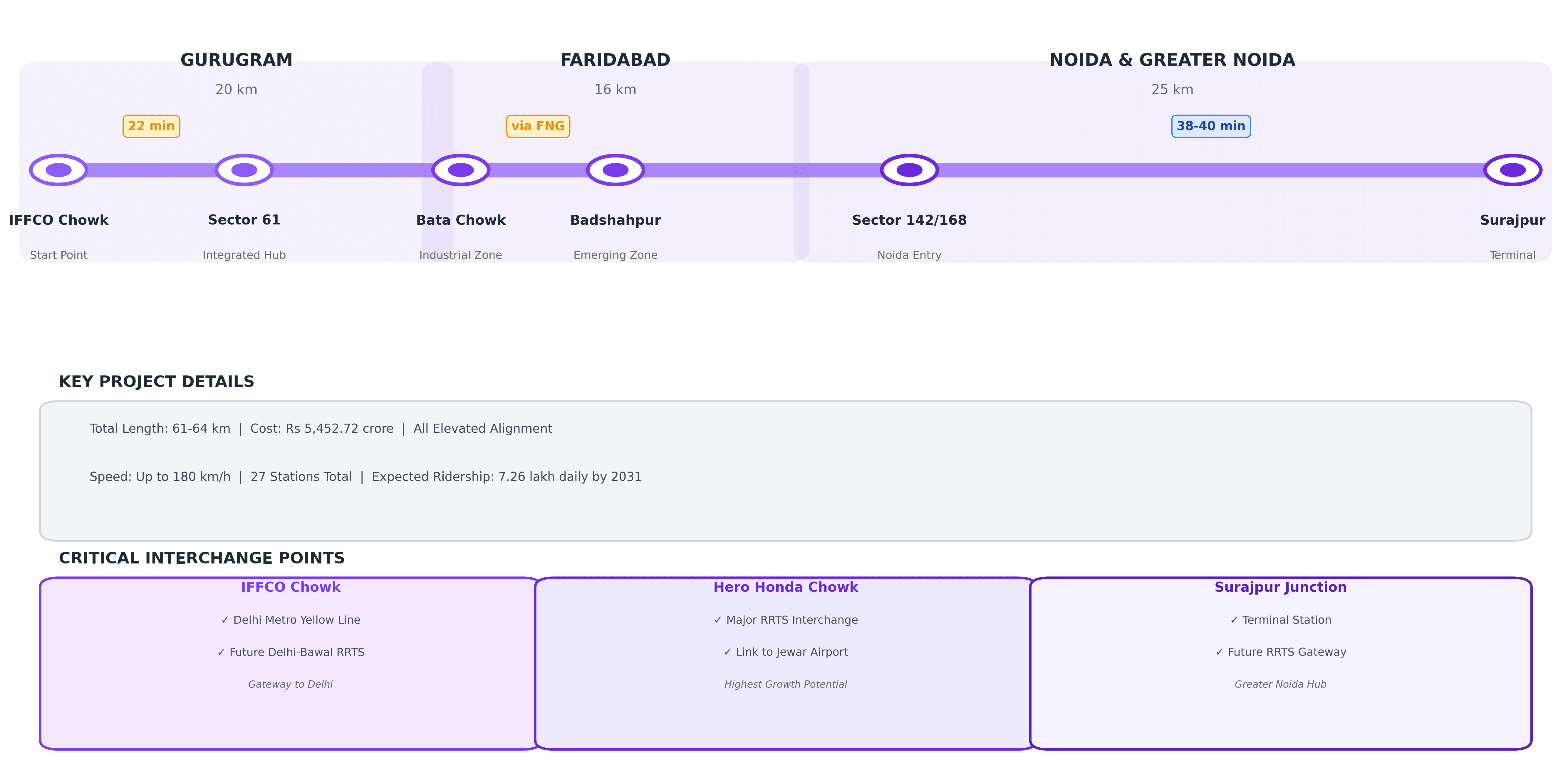
The corridor begins at IFFCO Chowk in Gurugram, which is already established as a major Namo Bharat station for the Delhi Bawal RRTS corridor. This location serves as an important interchange point that will eventually connect the Gurugram Noida corridor with the Delhi Bawal RRTS line, enabling seamless travel from Delhi to Noida via Gurugram.
From IFFCO Chowk, the alignment runs eastward through Gurugram's most developed areas. The route passes through:
The alignment then heads towards Gwal Pahari and moves along Golf Course Road Extension. This routing ensures that the corridor connects Gurugram's major residential developments and employment hubs, making it convenient for thousands of daily commuters.
From Gurugram, the corridor enters Faridabad at Bata Chowk and continues through key areas including:
The Faridabad section is particularly important as it connects the city's industrial zones and provides linkage to the Violet Line of the Delhi Metro network, enabling multi modal connectivity.
From Faridabad, the alignment moves south along the Faridabad Noida Ghaziabad (FNG) Expressway. This is a critical segment that utilizes the recently developed expressway to provide a direct connection between Haryana and Uttar Pradesh without passing through Delhi.
The corridor enters Noida near the Sector 142 and Sector 168 areas, which serve as the main entry point from the FNG Expressway. The alignment then continues eastward through Noida and finally terminates at Surajpur Junction in Greater Noida. The Surajpur terminal will serve as an important interchange point for the proposed Ghaziabad Jewar RRTS corridor, which is being developed to connect Ghaziabad with the new Noida International Airport at Jewar.
According to the detailed project report completed in December 2025, the Gurugram Noida RRTS Corridor will feature six major stations strategically located to serve the communities and employment centers along the route. The station distribution is designed to balance accessibility with the need to maintain RRTS's core advantage of speed for longer distance travel.
IFFCO Chowk Station: This is the flagship station for the corridor in Gurugram, serving as an interchange point with the Delhi Bawal RRTS corridor. It will be designed as an integrated RRTS cum metro hub with enhanced facilities for transferring between different transit modes
Sector 61 Station: Located in Gurugram's premium sector area, this station will serve residential and commercial developments in the region and will also function as an integrated RRTS cum metro hub
Bata Chowk Station: Serving as the main entry point to Faridabad, this station connects to the city's industrial zones and is strategically located for workers traveling from both Haryana and Uttar Pradesh
Badshahpur Station: Located near the city's southern limits, this station serves the newer developments in Faridabad and provides connectivity to the FNG Expressway for onward travel to Noida
Sector 142 168 Station: The first station in Noida, located at the entry point from the FNG Expressway. This station will serve as a key interchange for users traveling to Noida's commercial and residential areas
Surajpur Junction Station: The terminal station in Greater Noida, strategically located to serve as an interchange with the proposed Ghaziabad Jewar RRTS corridor. This is a critical node in the broader NCR rapid transit network
One of the distinguishing features of the Gurugram Noida RRTS Corridor project is the proposal to run metro services alongside RRTS along the same alignment in Gurugram. This dual service model has been successfully implemented in the Delhi Meerut Namo Bharat corridor and is now being replicated for this project.
In Gurugram specifically, the plan includes six metro stations in addition to the two major RRTS cum metro hubs at IFFCO Chowk and Sector 61. These additional metro only stops will be located at:
This dual service approach means that high speed RRTS trains will be used for intercity movement between Gurugram, Faridabad, and Noida, while slower metro services will operate on the same corridor to serve shorter trips within Gurugram itself. This eliminates the need to build separate infrastructure for metro expansion and optimizes the use of the right of way corridor.
Total Corridor Length: 61 to 64 kilometers
The complete corridor stretches across 61 to 64 kilometers, with approximately 52 kilometers passing through Haryana (covering Gurugram and Faridabad) and the remaining 12 to 15 kilometers running through Uttar Pradesh (Noida and Greater Noida). This routing ensures that the project provides balanced benefits across both states.
Estimated Project Cost: Rs 15,000 Crore
The National Capital Region Transport Corporation has estimated the total project cost at approximately Rs 15,000 crore, making it a significant infrastructure investment. This cost is reasonable when compared to other major RRTS projects in the region. For context, the Delhi Bawal RRTS corridor is estimated at Rs 32,000 crore for 93 kilometers, while the Delhi Panipat Karnal corridor is projected at Rs 33,000 crore for 136 kilometers.
The cost breakdown will likely include land acquisition, construction of elevated viaducts or underground tunnels depending on the final alignment decision, station development, electrical and signaling systems, rolling stock procurement, and contingency provisions for cost overruns.
Funding Structure
The funding for the Gurugram Noida RRTS Corridor will come from multiple sources. NCRTC will likely seek funding through government budgetary allocations, multilateral development banks, and international finance institutions. Similar to other NCRTC projects, the corridor may also generate revenue through operational fares, advertising, property development rights, and other value capture mechanisms along the alignment.
May 2025: Initial Approval
In May 2025, the Haryana government officially approved the Gurugram Faridabad Noida RRTS corridor following a proposal from NCRTC. This approval marked the formal commencement of detailed planning work. During the same period, NCRTC conducted geo technical surveys and site investigations to understand ground conditions and geological factors that would influence alignment decisions.
December 2025: DPR Completed and Approved
NCRTC completed the Detailed Project Report (DPR) in December 2025, seven months after the project received initial approval. The DPR is a comprehensive document that outlines the exact route, station locations, cost estimates, implementation timeline, environmental assessments, and technical specifications. The DPR has been submitted to the Haryana and Uttar Pradesh governments for review and approval.
May 2026: Current Status (Pending Approvals)
As of May 2026, the project is awaiting final approvals from both state governments. The main point of discussion among stakeholders is the alignment choice in Gurugram: whether the corridor should be built as an elevated viaduct or an underground tunnel. The Haryana government has advocated for an underground alignment to preserve surface level space for future road upgrades, while NCRTC has suggested an elevated viaduct to reduce costs.
Construction Expected Start: December 2026
The Haryana Chief Minister has directed NCRTC to begin construction by December 2026. This aggressive timeline allows for the project to commence once environmental clearances and final design approvals are secured.
Construction Duration: 4.5 Years The project is expected to take approximately 4.5 years to complete from the start of construction. This means the corridor could be operational by 2031, contingent on timely approvals and no major construction delays.
Operational Target: 2031
The corridor is projected to become operational by 2031, transforming regional connectivity across the NCR. However, this timeline assumes that all approvals are completed promptly and there are no significant delays in land acquisition or construction.
The Gurugram Noida RRTS Corridor will deliver transformative connectivity benefits by dramatically reducing travel times between the three cities. These improvements will ripple across the entire economy of the National Capital Region.
Gurugram to Faridabad: From 1 Hour to 22 Minutes
Currently, traveling between Gurugram and Faridabad requires navigating through congested city roads and often involves going through Delhi. This journey typically takes 1 to 1.5 hours depending on traffic conditions. With the RRTS corridor, the same distance can be covered in approximately 22 minutes. This dramatic reduction opens up employment opportunities, allowing workers to comfortably commute between the two cities for jobs.
Gurugram to Noida: From 1.5 to 2 Hours to 38 to 40 Minutes
The most transformative impact will be on Gurugram Noida connectivity. Currently, this is one of the most challenging commutes in the NCR, typically requiring 1.5 to 2 hours or more by road due to the need to navigate through Delhi's congested streets. With the RRTS corridor, this journey will take just 38 to 40 minutes. This single connectivity improvement will fundamentally reshape the regional economy.
For context, this is equivalent to reducing a commute that currently involves crossing the congested NCR triangle to a straightforward journey in less than an hour. Office workers will be able to commute regularly between Gurugram's financial district and Noida's tech parks. Investors will find it easier to operate businesses across the two cities.
Service Frequency and Operational Characteristics
The RRTS corridor will operate with high frequency service, with trains running every 5 to 7 minutes during peak hours. This frequency is higher than most international rapid transit systems and ensures minimal waiting times for passengers. The trains will operate at speeds up to 180 kilometers per hour, allowing for swift movement between cities.
Airport Connectivity and Jewar Integration
One of the strategic purposes of this corridor is to serve as a link in the larger connectivity network connecting Delhi's IGI Airport with the new Noida International Airport at Jewar. The Gurugram Noida corridor will connect to the Delhi Bawal RRTS line at IFFCO Chowk and to the proposed Ghaziabad Jewar RRTS corridor at Surajpur. This will eventually enable passengers to travel from IGI Airport to Jewar Airport via a fast, efficient rapid transit system, bypassing the congested roads of Delhi entirely.
Major infrastructure projects like the Gurugram Noida RRTS Corridor have historically driven significant appreciation in property values in surrounding areas. The improved connectivity, reduced commute times, and economic stimulus generated by large transport investments create powerful tailwinds for residential and commercial real estate.
Historical data from other major transport infrastructure projects in India shows that properties within 500 to 1000 meters of transit stations experience appreciation rates of 15 to 25 percent over 3 to 5 years following project commissioning. This is significantly higher than broader market appreciation rates, which typically hover between 8 to 12 percent annually.
For the Gurugram Noida RRTS Corridor, the location advantage is particularly pronounced because the corridor addresses a critical connectivity gap that has existed for decades. Properties that benefit from better access to employment centers typically command premium valuations.
The Gurugram section of the corridor will drive appreciation in multiple sectors. Sectors near stations like IFFCO Chowk, Millennium City Centre, Sector 52, Sector 54, Sector 57, and Sector 61 will experience the most significant upside. These are premium sectors with high density development, strong employment centers, and affluent residential communities. Properties in Sector 61, which will be an integrated RRTS cum metro hub, are expected to command premium valuations. This sector already hosts significant commercial and residential development, and the RRTS connectivity will further enhance its attractiveness as a residential destination for professionals working in Noida.
Properties along the Golf Course Road corridor are also well positioned to benefit. This is one of Gurugram's most developed arterial roads connecting several premium residential projects, office spaces, and retail centers. The RRTS alignment will enhance mobility along this corridor significantly.
Faridabad has traditionally been seen as an industrial city with limited residential appeal for Gurugram or Delhi workers. The RRTS corridor will change this perception fundamentally. Areas near Bata Chowk, Badshahpur, and the NIT area will emerge as attractive residential destinations for workers seeking lower property prices while maintaining good connectivity to Gurugram and Noida.
Property prices in Faridabad are currently significantly lower than comparable properties in Gurugram. Once the RRTS connectivity is established, Faridabad will attract spillover demand from Gurugram seekers who want better value. This represents a significant appreciation opportunity for investors willing to bet on Faridabad's transformation.
For Noida, the corridor represents enhanced connectivity to Gurugram's financial services industry and Faridabad's manufacturing base. Noida's existing strengths in IT and technology will be reinforced as the city becomes easier to access for workers from Gurugram.
Greater Noida, particularly areas near Surajpur, will benefit from the terminal station location. Surajpur will eventually serve as an interchange for the Ghaziabad Jewar corridor, making it a critical mobility hub. Properties near Surajpur will become highly valuable as this location will be one of the few spots in the NCR that provides direct connectivity to both Gurugram and Jewar Airport.
Large infrastructure projects like the Gurugram Noida RRTS Corridor drive economic benefits far beyond the immediate transport efficiency gains. The project will create significant employment during construction and operation, boost commercial activity, and catalyze urban expansion across the three cities.
During the construction phase from December 2026 to 2031, the project will create thousands of direct and indirect jobs. These include positions for civil engineers, construction workers, electricians, signaling specialists, and project management professionals. Estimates suggest that large RRTS corridors of this scale create between 10,000 to 15,000 job years of employment during construction.
Once operational, the corridor will require permanent employment for train operators, station staff, security personnel, maintenance engineers, and customer service professionals. NCRTC projects of comparable size typically employ 300 to 500 permanent staff members.
Major transport corridors act as magnets for commercial development. Landowners and developers along the corridor route will seek to capitalize on the increased accessibility by developing office spaces, shopping centers, hotels, and restaurants near RRTS stations. This will create secondary employment in retail, hospitality, and service sectors. NCRTC has also planned property development projects at station areas, including office spaces, commercial centers, and premium residential developments. These value capture projects help fund the operations of the system while generating additional employment.
Improved connectivity typically enables planned urban expansion away from existing congested city centers. Areas near RRTS stations will attract attention from developers seeking to build large integrated residential and commercial complexes. This pattern has been observed in Delhi, Gurugram, and other NCR cities where metro and RRTS projects have catalyzed new development nodes.
For Faridabad and Noida specifically, the RRTS will enable these cities to leverage their lower land costs to offer competitive alternatives to Gurugram while maintaining good connectivity. This will help achieve more balanced and sustainable urban growth across the NCR.
While the Gurugram Noida RRTS Corridor is a strategically important project with strong political backing, several challenges and risks could impact its timeline and cost.
Land acquisition is typically the most time consuming aspect of large infrastructure projects in India. The corridor passes through densely populated areas in Gurugram and Faridabad where landowners are often reluctant to give up property. Additionally, private owners in these premium commercial and residential zones may demand higher compensation, increasing costs.
Right of way challenges along existing roads can also delay construction. The corridor will need to work within existing urban infrastructure, which often complicates construction methodology and extends timelines.
The most significant point of contention currently is the alignment choice through Gurugram. NCRTC has proposed an elevated viaduct design, which is less expensive and faster to construct. However, the Haryana government advocates for an underground tunnel alignment to preserve surface level space for future road infrastructure and to minimize visual impact and noise concerns.
Underground construction costs approximately 1.5 to 2 times more than elevated construction. Additionally, underground sections can take significantly longer to construct due to the complexity of underground work. A final decision on this critical issue could delay project commencement and increase the overall cost.
The corridor involves multiple agencies including NCRTC, the Haryana government, the Uttar Pradesh government, the Ministry of Housing and Urban Affairs, municipal corporations, police departments, and local authorities. Coordinating between all these agencies can be slow, particularly when interests diverge. Environmental and utility clearances from multiple states and central agencies must be obtained, which adds time to the approval process.
The Rs 15,000 crore estimated cost is a substantial investment. Securing funding from government budgets, international financing institutions, and development banks requires navigating complex approval processes. Any delay in securing funding will directly impact the construction timeline.
Large infrastructure projects often experience cost overruns due to labor inflation, material price increases, design changes, and unforeseen ground conditions. The DPR will include contingency provisions, but these may prove insufficient if major issues arise.
The Gurugram Noida RRTS Corridor will operate alongside other transit options in the NCR. Understanding how RRTS differs from metro rail and expressway connectivity helps explain why this project is needed.
While both RRTS and metro serve public transit needs, they are designed for different purposes. Metro systems like the Delhi Metro focus on urban mobility with frequent stops, lower speeds, and shorter distances between stations. RRTS focuses on longer distance intercity travel with fewer stops and higher speeds.
For Gurugram to Noida travel, the metro would require multiple transfers through Delhi, making it impractical for daily commuting. RRTS provides direct service, making it the appropriate choice for this regional connectivity need.
Currently, the primary way to connect Gurugram and Noida is via road. The Delhi Jaipur highway, National Highway 44, and the newer Faridabad Noida Ghaziabad Expressway provide road connections, but these are subject to traffic congestion, accidents, and weather related delays.
The RRTS corridor offers significant advantages over road transport: it operates on a fixed schedule regardless of traffic, carries large numbers of passengers efficiently, produces zero emissions, and provides a more comfortable and reliable travel experience. For daily commuters, RRTS is far superior to cars or buses for long distance intercity travel. That said, road connectivity will continue to play an important complementary role. The RRTS corridor itself depends on feeder connectivity via roads to get passengers to stations.
For investors and homebuyers, the Gurugram Noida RRTS Corridor represents a significant opportunity, but timing and location selection are critical. Here is a strategic guide to the most promising zones.
Prime Gurugram Sectors to Monitor
Faridabad: The Value Play
Faridabad represents the most significant value opportunity for investors. Properties near Bata Chowk and Badshahpur stations are likely to appreciate strongly as the city's connectivity profile improves. Investors seeking higher returns at lower entry costs should monitor Faridabad carefully.
The catch is timing: properties will show appreciation only after the RRTS becomes operational in 2031. Investors should assess whether the city's current prices already reflect expectations of RRTS benefits.
Noida and Greater Noida Opportunities
Noida has already been a strong investment destination due to its IT industry presence and proximity to Delhi. The RRTS corridor will enhance Noida's appeal by providing good connectivity to Gurugram's financial services sector. Greater Noida, particularly Surajpur area near the terminal station, offers emerging value. As this zone becomes a major mobility hub with future Jewar Airport connectivity, properties here could see substantial appreciation.
Infrastructure Led Investment Strategy
Successful infrastructure investors follow a principle: buy undervalued properties 2 to 3 years before major connectivity improvements are completed, and sell after the project becomes operational when appreciation has already been substantial.
However, timing such investments requires careful judgment. Property prices in Gurugram already reflect significant premium valuations. More attractive opportunities exist in Faridabad and Greater Noida, which are less developed but will see significant appreciation once the RRTS becomes operational.
Critical Milestones to Watch
Throughout the National Capital Region, major transport infrastructure projects have consistently driven property appreciation. The Delhi Metro expansion, the completion of ring roads, and the development of expressways have all led to measurable increases in property values in connected areas.
The Gurugram Noida RRTS Corridor will follow this proven pattern. However, the magnitude of the opportunity is particularly large because this project addresses what has been called the most significant connectivity gap in the NCR: the lack of direct, fast linkage between Gurugram and Noida.
For three decades, Gurugram and Noida have functioned as largely separate economic zones because the commute between them has been impractical. This has prevented the kind of integrated labor market and business ecosystem that characterizes mature metropolitan regions. The RRTS corridor will change this in a fundamental way.
Investors who understand this transformation and position themselves early in undervalued but well located areas stand to benefit substantially. The key is to focus on areas that are currently underappreciated because they lack connectivity, but which will become highly valuable once the RRTS becomes operational.
The Gurugram Noida RRTS Corridor is far more than just a transportation project. It represents a fundamental reimagining of how the National Capital Region functions as an integrated economic zone. By connecting Gurugram, Faridabad, and Noida with fast, reliable rail transit that bypasses congested Delhi, the project will unlock decades of pent up economic potential.
For commuters, the corridor will be transformative, reducing what is currently a 1.5 to 2 hour ordeal to a comfortable 40 minute journey. For businesses, it will enable operations across multiple cities without the burden of extreme commute times for employees. For investors, it represents a significant opportunity to benefit from infrastructure led property appreciation.
The project is currently at the DPR stage with final approvals expected in mid 2026. Construction is scheduled to begin in December 2026, with completion targeted for 2031. While challenges related to land acquisition, alignment design, and multi agency coordination exist, the strong political backing from the Haryana government suggests the project will move forward.
The Rs 15,000 crore investment will yield returns far exceeding the direct transit benefits. Property appreciation, job creation, commercial growth, and urban expansion will create a multiplier effect that strengthens the entire NCR economy.
Whether you are a homebuyer seeking a new property, an investor evaluating infrastructure-led development opportunities, or simply someone interested in the future of the National Capital Region, the Gurugram Noida RRTS Corridor is a project worth following closely. The next few years will be critical as the project moves from planning to construction, and the decisions made now will shape the region's trajectory for decades to come.
Contact Us
Fill out this form
& we'll get back
to you
Recommended for you