Investments
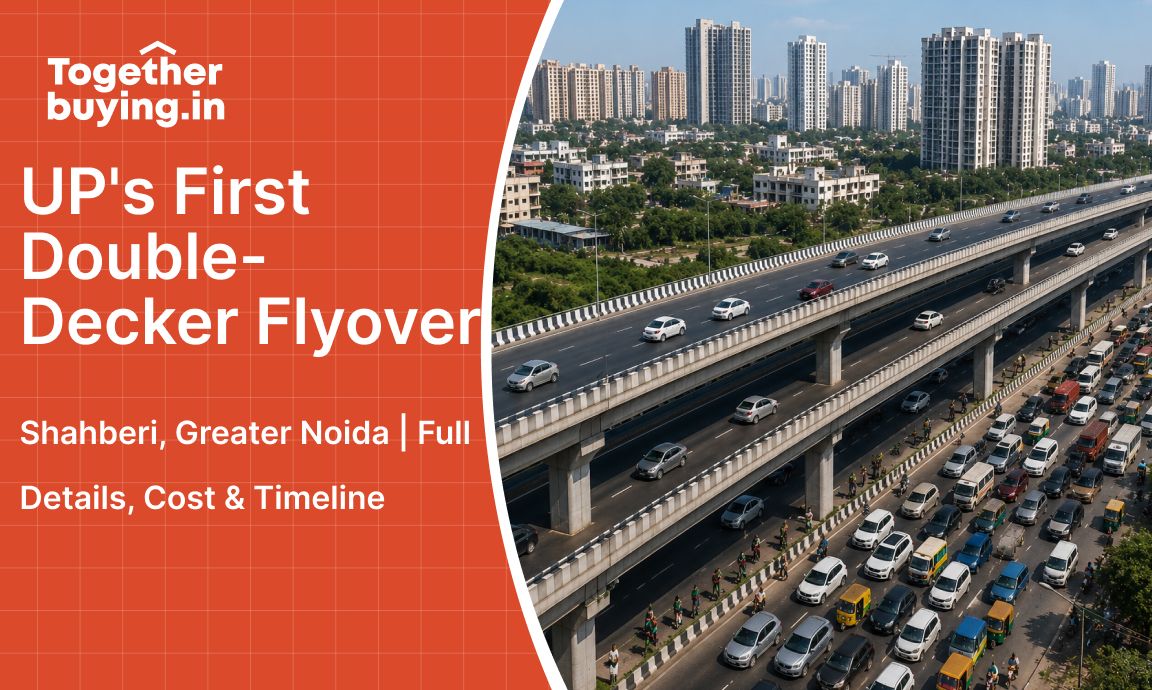
UP's First Double-Decker Flyover: Shahberi, Greater Noida | Full Details, Cost & Timeline
15 Jul 2026
Investments
15 Jul 2026
Content
No Blogs content found
It looks like there haven’t been any blogs yet!
Greater Noida has proposed Uttar Pradesh's first double-decker flyover in Shahberi, a 1.4 km, six-lane structure designed to carry traffic on two stacked levels instead of one. The project is an engineering solution to a major space constraint along one of Greater Noida West's busiest corridors. GNIDA has finalised the concept and presented it to the National Highways Authority of India (NHAI), which has sought a Detailed Project Report (DPR) before granting further approvals. With construction yet to begin, here's everything you need to know about the project and how it compares with similar double-decker corridors across India.
| Project Detail | Status |
|---|---|
| Location | Shahberi, Greater Noida West, connecting Eteda Roundabout with Crossings Republik and providing onward connectivity to NH-9 and the Delhi–Meerut Expressway. |
| Double-Decker Section | Approximately 1.4 km. |
| Total Project Length | Approximately 2.5 km. |
| Design Corridor Width | 12 metres. |
| Configuration | Double-decker elevated corridor with two stacked decks. |
| Lanes | Six lanes in total (three lanes on each deck). |
| Estimated Cost | Around ₹900 crore. |
| Earlier Estimate | Approximately ₹400 crore under the earlier single elevated road proposal. |
| Project Owner | Greater Noida Industrial Development Authority (GNIDA). |
| Proposed Executing Agency | National Highways Authority of India (NHAI). |
| Current Status | The design has been finalised by GNIDA and presented to NHAI. The Detailed Project Report (DPR) is under review/finalisation before statutory approvals, tendering, and construction can begin. |
Greater Noida West has grown into one of the NCR's largest residential belts over the past decade. Big townships including Gaur City, Panchsheel Greens, Nirala Estate, Ace City, Fusion Homes, Gulshan Bellina and Supertech Eco Village all funnel their daily traffic through the same narrow corridor toward Ghaziabad and Delhi.
There's a real number behind the congestion complaints: more than 10,000 vehicles pass through the Republic Crossing junction every single day, according to authority officials cited in early 2025 reporting, and that count was expected to climb further once Noida International Airport at Jewar became operational (it started commercial flights in June 2026). Add school buses, delivery trucks, commercial vehicles and autorickshaws into the mix, and the picture gets worse during monsoon, when standing water on the existing road slows everything to a crawl.
The core structural problem is simple: there's no direct link from Greater Noida West's arterial 130 metre road to the Delhi Meerut Expressway. Everyone gets routed through the same choke point.
This is where the project gets genuinely interesting from an engineering standpoint, and it's worth explaining properly rather than glossing over.
A standard 4 lane flyover needs roughly 15 metres of clear width to accommodate the carriageway, medians and safety margins. When GNIDA's project team, led by GM Project A.K. Singh, surveyed the Shahberi site, they found only 14 metres available. That one metre shortfall would normally force a compromise: either narrower lanes, fewer lanes, or a costly land acquisition fight to widen the corridor.
Instead, the authority worked out a double decker alternative with its consultants. By stacking two 3 lane decks on top of each other, each running one way traffic, the project delivers 6 total lanes inside a 12 metre footprint, less width than even the original 4 lane plan needed. It's essentially trading horizontal space for vertical space.
The structure will rest on U shape piers, a design choice that lets the existing ground level road keep functioning as a service lane throughout construction and after the flyover opens. That matters practically: local shops, societies and residents along Shahberi retain uninterrupted access instead of losing the road to a construction shutdown.
It helps to separate the stages clearly, because "approved" gets used loosely in headlines:
What hasn't happened yet: financial sanction, tender issuance, contractor appointment, and construction itself. None of these have started.
Detailed technical parameters like pier spacing, exact superstructure type, design speed, load class and drainage design typically get finalised only once a DPR clears review, and that review is still underway here. Rather than guess at numbers, it's more useful to state plainly what's public and what isn't:
Confirmed: U shape pier substructure design, 12 metre overall width, 6 lanes across two decks, one way traffic per deck. Not yet released: pier spacing, superstructure type (whether precast segmental, PSC girder, or another method), exact deck height, design speed, load class or IRC design standard, crash barrier specifications, drainage plan.
This gap is normal at this stage of a project, not a sign of neglect. Once NHAI clears the DPR, these specifications typically become public through the tender documents.
This is where deeper research actually changes the picture, because a few widely repeated assumptions about comparable projects don't hold up once you check the primary reporting.
| Project | Length | Cost | Structure | Lanes | Status |
|---|---|---|---|---|---|
| Nagpur LIC Square → Automotive Square | 5.67 km 3.1 km Double Decker Viaduct | ₹573 Crore |
Four-tier corridor
| 4–6 Lanes | Completed & Operational |
| Patna Ashok Rajpath | 2.2 km + 1.5 km Lower Tier | ₹422 Crore |
Three-Level Road Corridor
| 4 Lanes | Completed |
| Hyderabad LB Nagar → Hayathnagar | 5.5 km | ₹940 Crore | Highway + Metro + Service Roads | 6 Lanes | Approval Received |
| Delhi Mehrauli–Badarpur Road | Nearly 5 km | ₹1,471.14 Crore | Metro Corridor + Six-Lane Road | 6 Lanes | Approved (Target: Dec 2027) |
| Greater Noida Shahberi | 1.4 km | ~₹900 Crore | Two-Level Road Corridor | 6 Lanes | DPR Under Review |
The pattern that emerges: Nagpur, Hyderabad's planned corridor, and Delhi's MB Road project all combine road traffic with a metro line on a shared structure. Patna looks similar on paper but is actually road only; its metro line runs on a separate, rerouted alignment nearby rather than stacked on the same flyover. Shahberi follows the Patna pattern rather than the Nagpur or Delhi one: it's a pure traffic capacity fix, with no metro component announced, built double decker purely because the available width couldn't support a standard single deck flyover.
Once operational, the flyover is expected to give Greater Noida West direct access to the Delhi Meerut Expressway without funneling through the current bottleneck at Republic Crossing. The jump from 4 planned lanes to 6 actual lanes, inside a smaller footprint, gives it more headroom for future traffic growth than the original single deck plan would have. And the U shape pier design means the ground level road stays usable throughout, avoiding the kind of prolonged local disruption that flyover projects often cause.
There's a reasonable case for a real estate effect too, though no dedicated study for this specific project has been published. Infrastructure announcements like the Aqua Line metro extension and the long discussed FNG Road corridor have historically shifted buyer interest in nearby NCR pockets well before construction finished. Local real estate voices, including a statement from Karyan Group's director in July 2026 coverage, expect a similar pattern for Shahberi and Crossings Republik.
Two points are worth flagging plainly rather than smoothing over:
Length and completion timeline: One industry report from July 2026 describes the project as 2.5 km with a 2028 completion target under NHAI execution. GNIDA's own project team, in the same period, describes the structure as 1.4 km with no completion date attached. Until GNIDA or NHAI issues a formal notice, treat 1.4 km and no confirmed completion date as the more reliable figures, since they trace directly to an on record GNIDA official rather than a secondary industry account.
Funding split: Some 2025 reports say NHAI will fund the project outright, given its connection to the Delhi Meerut Expressway. A 2026 account suggests GNIDA and GDA will share the cost instead. No official, itemised funding agreement has been published by either authority.
This will be Uttar Pradesh's first double decker flyover, and the reasoning behind it is genuinely sound engineering: fitting 6 lanes into 12 metres where a conventional flyover needed 15 for just 4. Unlike most of its peers around the country, it's a road-only structure with no metro component, closer in spirit to Patna's approach than Nagpur's or Delhi's. The next real milestone to watch for is NHAI clearing the detailed project report. Everything else, financial sanction, tendering, and construction, sits behind that gate.
In Shahberi, Greater Noida West, connecting the 130-metre road to the Delhi-Meerut Expressway via Crossings Republik in Ghaziabad.
The site only had 14 metres of usable width, while a standard 4-lane flyover needs about 15 metres. The double-decker design fits 6 lanes into just 12 metres by stacking two 3-lane decks instead of building one wide deck.
The Greater Noida Industrial Development Authority (GNIDA) is the lead authority. NHAI is currently reviewing the detailed project report and is expected to be involved in execution given the flyover's link to the Delhi-Meerut Expressway.
Around ₹900 crore, up from an earlier ₹400 crore estimate for the original single-deck, 4-lane version.
The switch from a single-level to a two-level structure requires more complex foundations, piers and decking, which pushed the estimate up.
No. The design has been finalised and presented to NHAI, but the DPR review, financial approval, tendering and construction are all still pending.
No official start date has been confirmed by GNIDA or NHAI.
No confirmed completion date exists from GNIDA or NHAI. One industry report cites 2028, but this figure isn't corroborated by GNIDA's own on-record statements.
1.4 km, based on GNIDA's project team. A separate report cites 2.5 km; the two figures haven't been reconciled publicly.
12 metres wide, with 6 total lanes, 3 lanes on each of the two decks.
No. Each deck carries one-way traffic, so one level handles Greater Noida West to Crossings Republik traffic and the other handles the reverse direction.
No. Unlike Nagpur's or Delhi's double-decker projects, this is a road-only structure with no metro component announced.
The flyover uses U-shape piers specifically so the existing ground-level road can keep functioning as a service lane during and after construction, minimising disruption to local shops and residents.
Nagpur's is longer (5.67 km overall), cost less (₹573 crore), and combines a metro line and, in places, a rail track above road traffic. Shahberi is shorter, costs more, and carries road traffic only.
Yes, more so than Nagpur's or Delhi's. Patna's Ashok Rajpath flyover is also road-only. Its nearby metro line was actually rerouted away from the flyover corridor rather than integrated into it.
This is unresolved. Some 2025 reports point to NHAI funding it given the national highway connection; a 2026 report suggests a GNIDA-GDA cost split. No official funding agreement has been published.
Over 10,000 vehicles pass through the Republic Crossing junction daily, according to authority officials cited in early 2025 reporting, a number expected to rise further with Noida International Airport now operational.
Indirectly, yes. It's expected to ease movement for commuters from Ghaziabad and Greater Noida West heading toward the airport via NH-9 and the Delhi-Meerut Expressway corridor.
No dedicated study confirms this for this specific project. Real estate voices point to past NCR infrastructure projects, like the Aqua Line and the FNG Road proposal, that shifted buyer interest before construction even finished, as a reasonable precedent.
GNIDA's public communications and NHAI's project updates are the most reliable channels, since neither authority has issued a dedicated public notice for this project yet.
Contact Us
Fill out this form
& we'll get back
to you
Recommended for you