Group Buying
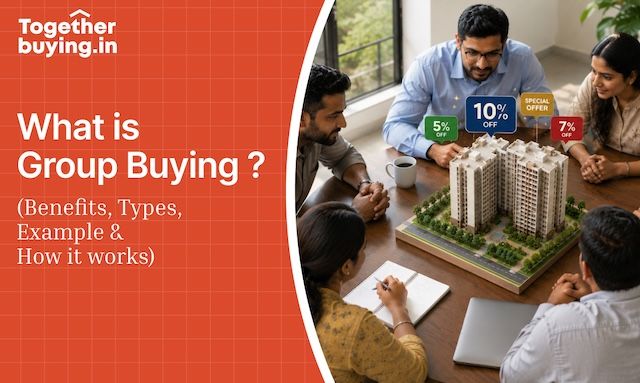
What Is Group Buying? Benefits, Types, Examples and How It Works?
12 Jun 2026
Group Buying
12 Jun 2026
Content
No Blogs content found
It looks like there haven’t been any blogs yet!
Group buying is a purchasing model where multiple buyers come together to negotiate better pricing and terms from a seller. Instead of each buyer approaching the seller individually, the group presents unified demand. The seller, in exchange for the certainty of multiple confirmed sales at once, agrees to a lower price, reduced fees, or added benefits that no individual buyer could have secured alone.
The model has existed in various forms for well over a century, from agricultural cooperatives and consumer buying clubs to professional procurement organisations. What changed with the internet, and more recently with dedicated technology platforms, is the ability to organise buyers who do not know each other, match them with the right sellers, and manage the negotiation professionally at scale.
Group buying is now applied across consumer goods, healthcare procurement, wholesale supply chains, and most significantly, residential real estate. In India specifically, the model is gaining traction as a structured mechanism for homebuyers to access developer pricing that was previously available only to institutional investors and bulk purchasers.
This article covers the definition of group buying, how it works, the main types, market data, the role of technology platforms, its application in real estate, and what buyers should know before participating.
Group buying is a purchasing arrangement in which multiple independent buyers aggregate their demand and approach a seller collectively to negotiate pricing or terms that would not be accessible to each buyer acting alone.
The concept works across sectors wherever three conditions exist: sellers have inventory or capacity they want to move, buyers have similar needs at similar times, and someone or some platform can organise the coordination between them.
| Step | What Happens |
|---|---|
| 1. Identify a Product or Property | A buyer or platform identifies a specific product, project, or service that is suitable for group purchasing. |
| 2. Register Interest | Interested buyers register their demand through a platform, coordinator, or group-buying community. |
| 3. Build a Group | The platform matches interested buyers, validates demand, and may run campaigns to reach the target group size. |
| 4. Negotiate with the Seller | The platform negotiates pricing, payment terms, discounts, or additional benefits on behalf of the group. |
| 5. Seller Confirms the Deal | Once collective demand is confirmed, the seller agrees to the negotiated group pricing and terms. |
| 6. Each Buyer Completes Individually | Every participant completes their own independent purchase and receives their own product, service, or property at the agreed group rate. |
The most important step is four. A platform with confirmed demand from multiple buyers occupies a fundamentally different negotiating position than a single buyer. Sellers know that walking away from the group means forgoing several transactions at once rather than just one.
| Metric | Data |
|---|---|
| Global Group Buying Market Size (2025) | Approximately USD 19.15 Billion |
| Projected Market Size (2034) | Approximately USD 37 Billion |
| Market Growth Rate (CAGR) | Approximately 7.6% Per Year |
| Asia Pacific Market Share | 40% of the Global Market |
| India Internet Subscribers (2024) | 954 Million and Growing |
| India Online Shoppers (2024) | 270 Million, Second Largest Globally |
| Savings Through Real Estate Group Buying | Typically 5% to 30%, Depending on Project and Buying Stage |
| Fastest Growing Country (Group Buying 2025–2033) | India |
| India E-Commerce Market Size (2024) | USD 125 Billion |
| India E-Commerce Projected Size (2030) | USD 345 Billion |
Sources: Business Research Insights, Grand View Research, IBEF, Statista
These numbers establish the scale of the opportunity. Group buying is not a niche model. It is a significant and growing segment of global commerce, with India projected to outpace all other markets in growth rate over the next decade. Real estate is a primary driver of this projection given the size of India's residential property market and the growing awareness of collective negotiation as a strategy.
The roots of group buying predate the internet by more than a century. Agricultural cooperatives in Europe and North America pooled purchasing power to buy seeds, equipment, and supplies at lower cost. The Rochdale Pioneers in England, often credited as the first modern consumer cooperative, established their store in 1844. Their model spread globally and gave rise to the cooperative movement that still operates in grocery retail, credit unions, and housing associations today.
In the twentieth century, employee buying clubs, neighbourhood associations, and community organisations in the United States aggregated orders to qualify for wholesale pricing on fuel, food, and household goods. These were the direct predecessors of modern group buying platforms.
The internet made it possible to organise buyers who did not know each other and match them with sellers at scale. Groupon, launched in Chicago in November 2008, was among the first platforms to commercialise this at scale for consumer services. Starting from a single restaurant deal, it expanded across hundreds of cities, demonstrating that a technology layer could aggregate demand and unlock discounts for everyday buyers.
China's Pinduoduo, founded in 2015, took the model into ecommerce for physical goods, using social networks to drive group purchases. Both platforms proved the commercial viability of the model in digital environments.
The more significant development, particularly for high value purchases, has been the extension of group buying into real estate and other asset categories where the financial impact per transaction is far larger than in consumer deals.
The extension of group buying into residential real estate represents the model's most financially meaningful evolution. Homebuyers began recognising that approaching developers as an organised group gave them access to institutional style pricing. What was once done informally through personal networks is now being done systematically through dedicated platforms.
India is expected to register the highest compound annual growth rate in the group buying segment from 2025 to 2033 among all countries globally, reflecting in large part the scale of its residential property market and the structural advantage that group buying offers buyers in that market.
Group buying differs from standard retail in three important ways. The price is not fixed until the group is confirmed. The seller is agreeing to a lower margin in exchange for confirmed volume rather than a speculative inquiry. And the negotiation is conducted on behalf of multiple buyers simultaneously.
| Stage | Buyer's Role | Seller's Role |
|---|---|---|
| Discovery | Finds the product or property through a platform or group-buying opportunity. | Lists available inventory, pricing, and purchase terms. |
| Interest Registration | Registers interest or joins an existing buyer group. | The platform aggregates and validates buyer demand before approaching the seller. |
| Group Building | Participates in the group formation process and receives project updates. | Reviews confirmed demand and responds to group pricing or commercial proposals. |
| Negotiation | Benefits from collective negotiation conducted on behalf of the buyer group. | May agree to discounts, fee waivers, inventory benefits, or improved payment terms. |
| Individual Purchase | Completes an independent transaction at the negotiated group rate. | Processes each buyer's purchase separately at the agreed commercial terms. |
| Post Purchase | Takes delivery, possession, or receives the purchased product or service. | Fulfils contractual obligations to each buyer individually. |
In technology enabled platforms, the platform manages most of this process. Individual buyers register their interest, select their unit, and complete their own purchase. The negotiation, coordination, and group building happen behind the scenes.
Sellers participate in group buying because the economics are genuinely favourable for them, not as a favour to buyers.
Every unsold unit, whether a residential apartment or a warehouse of consumer goods, has a carrying cost. Developers pay interest on construction financing for every month a unit remains unsold. Manufacturers incur storage and working capital costs. When a seller closes multiple units at once through a group deal, they reduce these carrying costs, eliminate several rounds of individual marketing and sales effort, and improve their cash flow predictability. The discount they offer the group is usually smaller than the costs they avoid by closing in volume.
For real estate developers specifically, a confirmed group purchase eliminates advertising spend, broker commissions for each individual unit, multiple site visits, and the time cost of sales staff managing individual inquiries that may not result in a purchase. These savings create the room to offer group buyers meaningfully better pricing.
Group buying operates differently depending on the sector. Here are the five main forms.
Consumer group buying involves individuals joining together to purchase everyday products or services at a discounted rate. This is the model associated with daily deal platforms.
How it works: A platform lists a deal from a local business. Buyers claim the deal within a set period. Once sufficient buyer demand is confirmed, the discount activates.
Benefits: Buyers access discounts on local services. Merchants gain new customers and visibility without upfront advertising spend.
Limitations: Deal quality varies by merchant. Some merchants base discounts on inflated original prices, making actual savings smaller than stated.
Example: A restaurant offers a discounted meal package when enough buyers claim the deal within a specified window.
Ecommerce group buying applies the collective model to online retail. Prices fall as more buyers join a purchase for the same physical product.
How it works: A buyer selects a product and shares a group purchase link. Others join within a set window. When enough interest is confirmed, all group members receive the product at the group price.
Benefits: Buyers access near wholesale prices on consumer goods. The model creates social shopping behaviour that reduces marketing costs for the platform.
Limitations: Requires social sharing. Not all product categories work equally well in this format.
Example: Pinduoduo in China pioneered this model at scale, connecting buyers directly with manufacturers to eliminate distribution markups.
Business purchasing groups, also called group procurement or group purchasing organisations, allow companies to combine their buying volumes to negotiate better prices from suppliers.
How it works: Businesses in the same industry or region form a consortium, aggregate their orders, and approach suppliers as a single large buyer.
Benefits: Small and medium businesses access pricing previously available only to large enterprises. Procurement costs fall and margins improve.
Example: Hospital group purchasing organisations in the United States aggregate medical supply procurement across hundreds of hospitals, managing hundreds of billions of dollars in volume annually.
Wholesale group buying involves consumers or small retailers pooling orders to meet the minimum quantities required for wholesale pricing.
How it works: A coordinator aggregates orders until the total meets the wholesale threshold. The order is placed collectively, and goods are distributed to each participant.
Benefits: Individual buyers access prices normally reserved for commercial bulk orders. Common for fresh produce, organic food, and specialty goods.
Example: A community food buying club where households pool weekly grocery orders to purchase directly from a farm or wholesale supplier.
Real estate group buying is the most financially significant application of the model. Homebuyers join together to purchase apartments or homes in the same project, using their collective demand to negotiate directly with the developer.
How it works: Buyers interested in the same residential project register their demand through a platform. The platform matches buyers, confirms collective interest, and negotiates with the developer. Each buyer then completes their own individual purchase at the group negotiated price.
Benefits: Buyers save substantially on purchase price and brokerage. Developers close multiple units efficiently and reduce the carrying cost of unsold inventory.
What makes real estate different from other types: The financial impact per transaction is far larger. A 5 percent discount on a residential apartment worth INR 2 crore saves INR 10 lakh. Add the elimination of a 3 to 5 percent brokerage commission and the total saving on a single transaction can exceed INR 16 to 20 lakh. No other form of group buying delivers comparable absolute savings per participant.
Example: TogetherBuying in India matches homebuyers interested in the same residential project, negotiates collectively with the developer, and returns 100 percent of the broker commission to buyers as additional savings.
| Benefit | How It Helps Buyers |
|---|---|
| Lower Prices | Collective demand can unlock pricing and commercial terms that are often unavailable to individual buyers. |
| Stronger Negotiation | A coordinated buyer group has greater bargaining power than a single buyer negotiating alone. |
| Reduced Fees | Brokerage, processing fees, and certain transaction costs may be reduced, shared, or waived depending on the deal structure. |
| Access to Exclusive Terms | Some pricing tiers, inventory allocations, and commercial offers may only be available to organised buyer groups. |
| Market Transparency | Group buying platforms can provide pricing benchmarks and market insights that individual buyers often find difficult to access. |
| Community Building | In real estate transactions, buyers can connect with future neighbours and become part of a community before possession. |
| Shared Due Diligence | Research, legal reviews, and project verification efforts can be shared across multiple buyers, reducing duplication of effort. |
| Institutional Access | Individual buyers may gain access to pricing and commercial terms that were traditionally available only to bulk purchasers or institutional investors. |
In real estate, group buying in India can deliver savings of 5 to 30 percent on property prices depending on the project stage, the developer's inventory position, and the strength of the group's collective demand.
Check this:- Group Buying in Real Estate: A Smarter Alternative to Traditional Homebuying
Understanding where group buying works less well helps buyers assess whether it suits their situation.
The practical challenge in group buying is matching buyers who want the same product or property at the same time. In real estate, this means finding multiple people interested in the same project within a compatible timeline. Technology platforms address this through demand databases, targeted marketing campaigns, and active buyer matching. Without platform infrastructure, this matching burden falls on individuals and can be slow.
In a seller's market where demand significantly exceeds available supply, sellers have limited incentive to offer group discounts. Group buying delivers the best results when developers have a meaningful volume of inventory to place and a genuine interest in closing units efficiently. Buyers should assess market conditions before expecting large savings through collective negotiation.
In real estate, buyers must verify that any project is properly registered under the relevant RERA authority and that the developer has a credible track record. Reputable platforms vet projects before listing them and provide RERA registration details, but independent verification remains good practice for any property purchase.
| Factor | Group Buying | Individual Buying |
|---|---|---|
| Price | Potentially lower through collective negotiation | Typically purchased at the prevailing market rate |
| Negotiation Power | Stronger due to confirmed group demand | Limited bargaining power as a single buyer |
| Coordination | Managed by the group buying platform | Handled entirely by the buyer |
| Flexibility | Each buyer still chooses their own unit independently | Complete flexibility in selection and timing |
| Risk | Research and negotiation efforts are shared across the group | The buyer bears the full burden of research and negotiation |
| Access to Discounts | Higher potential access to developer-level pricing and incentives | Usually limited to publicly available offers |
| Brokerage and Fees | May be reduced or waived depending on the negotiated deal | Standard brokerage and transaction charges generally apply |
| Community | Buyers can connect with future neighbours before purchase | No structured buyer community involvement |
| Effort Required | Registration and participation through the platform; research support provided | The buyer handles project research, negotiations, and comparisons independently |
The evolution from informal group buying to technology managed collective purchasing has eliminated most of the coordination burden that once made group buying difficult. Modern platforms handle matching, vetting, virtual discovery, negotiation, and documentation. The buyer's experience is comparable in effort to individual buying, with substantially better outcomes on price.
Real estate is where group buying delivers its greatest financial impact. The reasons are structural: the purchase values are large, individual buyers have historically had minimal negotiating power against large developers, and developers have strong economic incentives to accept group deals.
In a real estate group purchase, homebuyers interested in the same project register their demand through a platform. The platform aggregates this demand, organises the group, and approaches the developer with confirmed interest across multiple units before any individual buyer completes a purchase.
The difference in negotiating position is fundamental. A single buyer approaching a developer has no leverage. The developer can wait. But a platform representing confirmed demand from several buyers changes the calculation entirely. The developer can close multiple units at once, recover marketing and sales costs in a fraction of the time, and reinvest that capital into the next project. In exchange for this certainty and efficiency, the developer offers the group pricing and terms that no individual buyer could negotiate.
Also Read this:- How Group Buying is Changing the Real Estate Market in India: A New Way to Buy Homes
Savings in real estate group buying come from two distinct sources.
The first is the negotiated discount on the property price itself. This varies based on the project's current sales stage, the developer's inventory position, and prevailing market conditions. Savings range from a few percentage points in high demand projects where inventory is limited, to 20 or 30 percent when a developer is seeking to clear remaining units close to project completion.
The second source is the elimination of brokerage. Individual homebuyers typically pay a broker 2 to 3 percent of the purchase price, with some brokers charging up to 5 percent. On a property worth INR 2 crore, this represents INR 4 to 10 lakh. Platforms that operate on a zero brokerage model and return the full commission to the buyer eliminate this cost entirely.
Beyond price and brokerage, developers frequently offer additional value to group buyers: waived floor rise charges, free parking allocations, upgraded interior fittings, waived maintenance deposits, or flexible payment schedules. These benefits are not typically available to individual buyers.
India's residential property market has seen significant price appreciation across major cities in recent years. In Delhi NCR, prices in key corridors have risen sharply over recent years. In Mumbai, Bengaluru, Pune, and Hyderabad the story is broadly similar. For first time buyers and mid budget purchasers, the cost of entry is rising faster than savings rates.
Group buying addresses this directly. It does not require buyers to compromise on the project, the developer, or the unit. It gives them access to a negotiating channel that was previously unavailable to them as individuals.
A technology platform transforms what was once an informal, socially coordinated activity into a structured, professionally managed process.
Platforms like TogetherBuying in India match buyers interested in the same residential project, run targeted campaigns to build group demand where needed, conduct detailed due diligence on listed projects including RERA verification, offer virtual property tours for buyers who cannot visit in person, negotiate directly with developers on the group's behalf, and return 100 percent of the broker commission to buyers as additional savings on top of any negotiated price reduction.
The platform has reported savings of over INR 25 crore across more than 125 families, with individual buyers saving several lakh to over INR 1 crore on single transactions depending on the project and purchase value.
Importantly, each buyer in a group purchase completes their own individual transaction. They choose their own unit, sign their own agreement directly with the developer, and hold the same legal protections as any individual buyer. The group structure affects the price at which they buy, not their individual rights or ownership.
Read this:- Why Group Buying is the Future of Real Estate in India?
Non resident Indians purchasing property in India face compounded disadvantages. They cannot easily attend site visits, they have limited access to real time market pricing, and they typically rely on brokers who charge full commissions without offering any negotiating advantage.
Group buying platforms with virtual tours, RERA verified project listings, transparent pricing, and zero brokerage models address every one of these disadvantages directly. NRI buyers gain access to pricing and terms comparable to what a well connected local investor might negotiate, without needing to be present on the ground.
The willingness of developers to offer group discounts is not charity. It is rational economic behaviour based on a clear set of cost savings and cash flow benefits.
Every individual sale of a residential apartment carries a customer acquisition cost. This includes digital and print advertising, broker commissions typically ranging from 2 to 3 percent of sale value, site visit logistics, sales team salaries, and the administrative cost of managing individual enquiries. A group transaction closes multiple units in a single negotiation. The customer acquisition cost per unit in a group deal is a fraction of what it would be through individual sales.
Developers carry construction financing on their balance sheets. Interest on these loans accrues whether or not units are selling. Every month of delay in closing a unit adds directly to the developer's cost structure. Closing several units in a single group deal compresses the sales cycle from months to weeks for that portion of inventory. The interest saving on accelerated closures is real and directly affects the developer's project profitability.
Real estate development is capital intensive. Construction draws, contractor payments, and debt servicing all require predictable cash inflows. A group purchase delivers multiple confirmed sales and their associated down payments in a short window. This predictability has direct value for project financing management, particularly in the early and mid stages of a project where cash flow is most constrained.
In India's residential market, the traditional sales channel runs through a broker network. Developers pay 2 to 3 percent per unit sold through this channel. Group buying platforms offer an alternative direct channel. When a platform returns the broker commission to the buyer rather than retaining it, the developer's net cost of sale through the platform can still be lower than through the broker channel once all other cost savings are accounted for.
Unsold inventory carries perception risk. A project with units remaining on the market for extended periods can attract negative attention from prospective buyers who question why units are not selling. Group buying gives developers a mechanism to close inventory efficiently and at terms of their choosing, without publicly advertising discounts that might affect pricing perception for remaining units in the project.
Traditional group buying required buyers to organise themselves, manage communication, and coordinate negotiations without any supporting infrastructure. It worked in small, tight communities but did not scale.
Technology has changed every part of the process.
Modern platforms maintain live databases of buyer demand across projects, locations, price ranges, and purchase timelines. When a buyer registers interest in a specific project, the platform can immediately identify other buyers with compatible demand and begin building a group. What previously required social networks and informal referrals now happens through data.
For buyers who cannot visit a project in person, including NRI buyers and buyers from other cities, virtual tours have made remote property evaluation credible and comprehensive. High quality video walkthroughs, drone footage, and interactive floor plan navigation allow buyers to assess a property thoroughly before committing. This expands the eligible buyer pool for any given project beyond those who are geographically accessible.
Platforms manage developer negotiations digitally, sharing confirmed group demand data, running comparative analysis across similar projects, and coordinating the offer and response process without requiring buyers to attend in person. This brings institutional quality and process discipline to negotiations that previously depended entirely on the individual buyer's knowledge and confidence.
Digital documentation allows buyers to review purchase agreements, RERA registration details, payment schedules, and project credentials before committing. This addresses one of the most significant disadvantages individual buyers face: the information gap between a professionally staffed developer sales team and a buyer encountering the market for the first time.
Platforms that surface RERA registration numbers, project approval status, possession timelines, and developer track records directly on their listings give buyers the information they need to make decisions with confidence rather than relying solely on developer marketing materials.
| Platform | Primary Industry | Model |
|---|---|---|
| Groupon | Consumer Deals | Daily deals and discounts on local services, dining, travel, and entertainment. |
| Pinduoduo | Ecommerce | Social commerce platform that enables consumers to access lower prices through group purchases. |
| TogetherBuying | Real Estate | Collective home buying platform that brings buyers together to negotiate residential apartment purchases with zero brokerage. |
| Vizient and Premier | Healthcare Procurement | Group purchasing organisations that negotiate medical supplies, equipment, and services on behalf of hospitals and healthcare providers. |
| Community Food Co-ops | Wholesale Food | Members combine orders to access wholesale pricing from farms, producers, and food distributors. |
This table reflects the breadth of the group buying model. It is not a single industry phenomenon. The common thread across all these examples is the same principle: confirmed collective demand unlocks pricing or terms unavailable to individual buyers.
TogetherBuying's position in this table is distinctive. It is the only platform on this list focused specifically on residential real estate in India, applying group buying principles to the single largest purchase most individuals ever make.
Groupon launched in Chicago in November 2008 and became the first platform to bring group buying into mainstream consumer awareness. Starting from a single restaurant deal, it expanded to cover dining, entertainment, spa services, and travel across hundreds of cities. Groupon's significance is historical: it proved that a technology platform could aggregate consumer demand at scale and systematically deliver discounts. It defined what most people think of when they hear the term group buying, even though the model has evolved far beyond daily deals.
Pinduoduo, founded in China in 2015, built one of the world's largest ecommerce platforms on a group buying foundation, reaching over 500 million active buyers by 2024. Its model connects buyers directly with manufacturers through social group purchases, eliminating distribution layers and significantly reducing product costs. Pinduoduo's growth demonstrated that group buying, when integrated into a digital platform at scale, can redefine an entire commerce category.
In the United States, organisations such as Vizient and Premier aggregate medical supply and equipment procurement across hundreds of hospital systems. These group purchasing organisations manage hundreds of billions of dollars in purchasing volume annually. They are one of the largest and least publicly visible applications of group buying in existence, operating on exactly the same principle as consumer group buying but at institutional scale in a regulated sector.
TogetherBuying applies the group buying model to Indian residential real estate, a market where information asymmetry and limited individual negotiating power have historically disadvantaged homebuyers significantly. The platform matches buyers interested in the same project, negotiates directly with developers using confirmed group demand, and returns 100 percent of the broker commission to buyers. The result is savings across both price negotiation and fee elimination on what is typically the largest financial decision in a buyer's life.
India is among the most promising markets in the world for group buying, and the real estate segment is where the opportunity is largest and most structurally sound.
As of March 2024, India had 954.4 million internet subscribers and had surpassed the United States to become the second largest online retail market globally, with 270 million online shoppers. India's ecommerce sector was valued at USD 125 billion in 2024 and is projected to reach USD 345 billion by 2030. This infrastructure creates the platform environment that group buying needs to operate at scale.
Indian consumers are culturally familiar with collective decision making for large purchases. Families routinely consult extended networks before purchasing property. Group buying formalises and adds professional infrastructure to behaviour that is already natural in the Indian purchase context. A platform that channels this existing collective orientation into organised group buying aligns naturally with how Indian buyers already think about major financial decisions.
Property prices in India's major residential markets have risen sharply over recent years. The combination of rising prices and flat individual negotiating power has created clear demand for a mechanism that gives regular buyers institutional grade access. Group buying is that mechanism.
India is expected to register the highest compound annual growth rate in the group buying segment from 2025 to 2033 among all countries globally. The residential property market is the primary driver of this projection.
Group buying is legal in most jurisdictions including India, the United States, the United Kingdom, Australia, and Canada. There are no laws that prohibit individuals from organising their purchasing interest collectively and negotiating with a seller as a group.
In a consumer context, group buying is a form of coordinated retail transaction. Each individual buyer completes their own purchase independently. The group structure affects the price at which they buy, not the nature of the transaction.
In Indian real estate, each buyer in a group purchase signs their own individual sale agreement directly with the developer. The transaction is governed by the Real Estate (Regulation and Development) Act, 2016. Buyers should verify that any project they consider is registered under the relevant state RERA authority, whether Haryana RERA, UP RERA, Maharashtra RERA, or the authority applicable to their state.
This article provides general information only and does not constitute legal advice. Buyers should consult a qualified legal professional for guidance on any specific transaction.
Group buying is a purchasing model where multiple buyers come together to negotiate better pricing and terms from a seller by presenting collective, confirmed demand. It is also called collective buying, community buying, or group purchase.
Buyers register interest in the same product, project, or service through a platform. The platform matches buyers, builds a group, and negotiates with the seller on behalf of all participants. Once terms are agreed, each buyer completes their own individual transaction at the group negotiated rate.
Group buying is cheaper because sellers value certainty of volume over the maximum possible price on a single unit. When a seller can close multiple transactions at once, they save on marketing, sales effort, carrying costs, and broker commissions. These savings are shared with the group as a price reduction or fee waiver.
No. Sellers offer group discounts because the total cost of an individual sale, including advertising, broker fees, and carrying costs, often exceeds the discount they pass on to the group. Group deals improve the seller's net economics, not just the buyer's.
The main benefits are lower prices through collective bargaining, access to pricing and terms unavailable to individual buyers, reduced or eliminated brokerage fees, shared due diligence costs, and in real estate the opportunity to build community with future neighbours before completing the purchase.
The primary considerations are market conditions, which affect seller willingness to offer group pricing, and the need to verify project or product credentials independently. Technology platforms have addressed most of the coordination challenges that made earlier group buying models difficult.
A group buying platform is a technology service that aggregates buyer demand, matches buyers with compatible interests, manages negotiation with sellers on behalf of the group, and facilitates individual transactions at the agreed group rate. TogetherBuying is an example of a real estate group buying platform in India.
A group buying website is the web interface through which buyers discover opportunities, register interest, and access project or product information. In India, togetherbuying.in operates specifically as a real estate group buying platform connecting homebuyers with residential developers.
Yes. Group buying consistently delivers lower prices than individual purchasing. In real estate, the combination of negotiated price reductions and eliminated brokerage fees can save several lakh rupees on a single property transaction.
Yes. Real estate group buying platforms are active in major Indian metros including Delhi NCR, Mumbai, Bengaluru, Pune, and Hyderabad. India is projected to be the fastest growing group buying market globally from 2025 to 2033.
Real estate group buying is a model where multiple homebuyers interested in the same project register demand through a platform. The platform negotiates collectively with the developer to unlock group pricing, waived fees, or added benefits. Each buyer then completes their own individual purchase at the negotiated group rate.
There is no fixed number. A group may consist of a few buyers or a larger set depending on the specific project, developer requirements, available inventory, and market conditions. What matters is that the group represents confirmed, credible collective demand that the platform can use as negotiating leverage.
Yes. Developers benefit from group buying through lower customer acquisition costs, faster inventory absorption, improved cash flow, reduced broker dependency, and a compressed sales cycle. These savings make group discounts economically rational for developers, not simply a concession to buyers.
Group buying platforms typically earn revenue through a fee charged to the developer for the group transaction, rather than through buyer commissions. Some platforms, particularly in real estate, return the entire broker commission to the buyer and earn a transparent service fee from the developer side. This aligns the platform's interest with the buyer's.
For most individual buyers, yes. A single buyer approaching a developer or seller has limited leverage and limited access to market pricing information. A group buying platform brings confirmed collective demand, professional negotiation capability, and market data to the table. The combination consistently produces better outcomes than individual negotiation.
Yes. Technology platforms with virtual tours, digital documentation, and RERA verified listings make group buying accessible to NRI buyers without requiring them to be physically present in India. This addresses some of the most significant disadvantages NRIs face when purchasing Indian property through traditional channels.
Buyers should verify the platform's track record and testimonials, confirm that listed properties carry valid RERA registrations, review the terms of the individual purchase agreement they will sign with the developer, understand how the platform earns its fee, and check that the project developer has a credible construction and delivery history.
Real estate benefits most in terms of absolute savings per transaction. Healthcare procurement, wholesale food supply, and ecommerce also have well established group buying models. The principle applies broadly wherever sellers have inventory to move and buyers can credibly present collective confirmed demand.
Yes. First time homebuyers typically have the least individual negotiating power. Group buying gives them access to the same pricing and terms that institutional investors have historically accessed, without requiring them to purchase multiple units. Combined with zero brokerage platforms, first time buyers can reduce the total cost of their purchase significantly.
Group buying is a purchasing model where multiple buyers negotiate collectively with a seller, offering the certainty of confirmed volume in exchange for better pricing and terms than any individual buyer could achieve alone.
The concept has operated across agriculture, consumer retail, healthcare, and business procurement for well over a century. What technology has changed is the ability to scale it: to match buyers who do not know each other, manage professional negotiations, verify seller credentials, and facilitate transactions with the documentation and transparency that modern buyers require.
Real estate is now the most financially significant application of the model. In India, where residential property prices have risen sharply and individual buyers face a significant information and leverage disadvantage relative to large developers, group buying offers a structured mechanism for closing that gap. The savings available, from negotiated price reductions and the elimination of brokerage, can reach several lakh to over a crore on a single transaction.
Developers participate because the economics align with their interests. Lower acquisition costs, faster inventory closure, improved cash flow, and reduced dependence on the broker channel all make group deals genuinely attractive to developers managing large residential projects.
For buyers, the core value proposition is access. Group buying gives individual homebuyers access to pricing and terms that were previously reserved for institutional investors and bulk purchasers. Platforms that combine buyer matching technology, virtual discovery, professional negotiation, and transparent zero brokerage models make this accessible without requiring buyers to organise the process themselves.
India is projected to be the fastest growing group buying market globally from 2025 to 2033. As residential property prices continue to rise and more buyers become aware of the collective negotiation option, group buying is positioned to move from an alternative strategy to a standard part of how informed homebuyers approach property purchases in India.
Contact Us
Fill out this form
& we'll get back
to you
Recommended for you