Group Buying
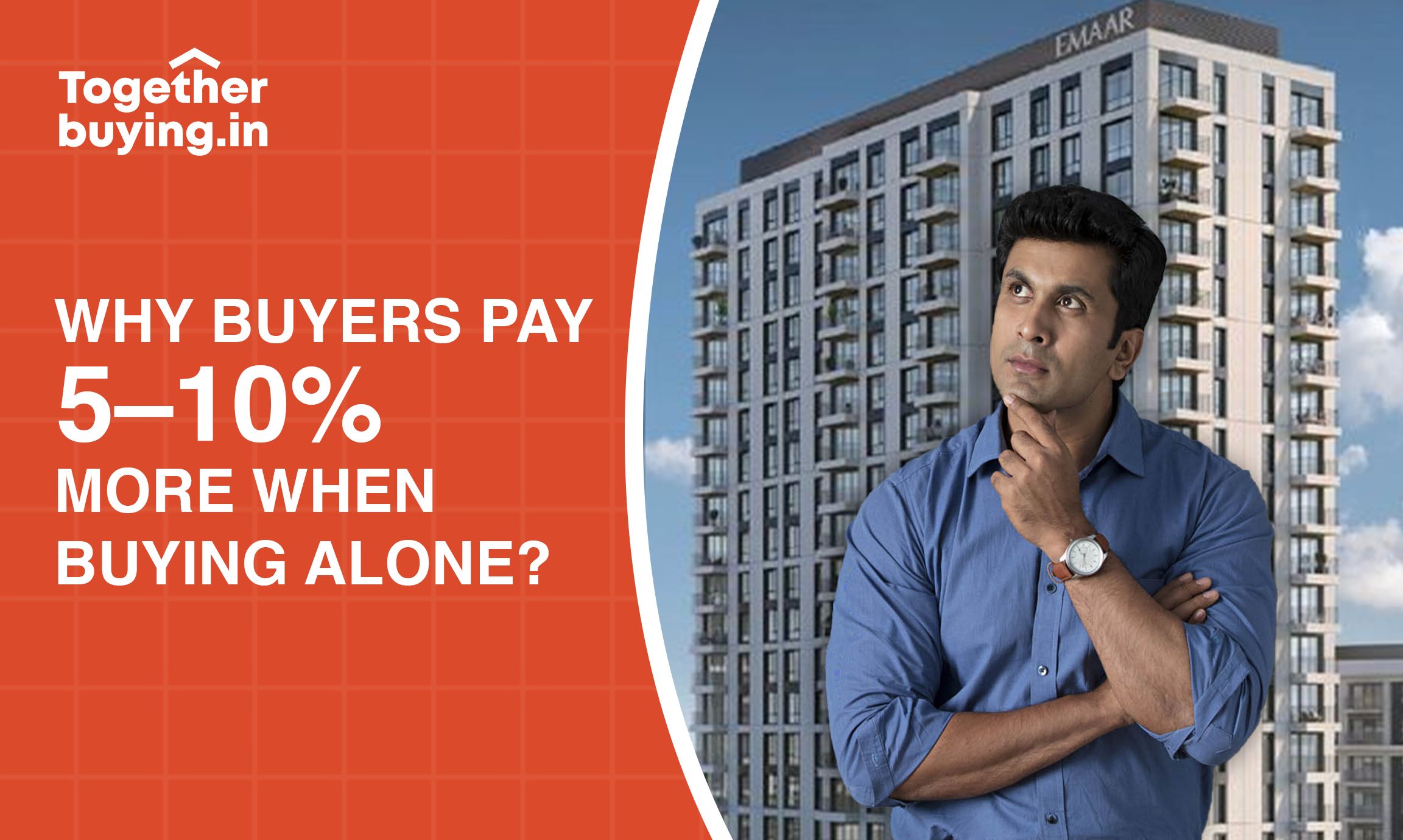
Why Buyers Pay 5–10% More When Buying Alone?
18 Oct 2025
Group Buying
18 Oct 2025
Content
No Blogs content found
It looks like there haven’t been any blogs yet!
Buying a home alone sounds strong and independent, until you see the bill. Most buyers don’t realise this, but when you walk into a sales office solo, the builder already knows something: you have no backup.
And that small fact quietly adds 5–10% to your cost. Not because builders are evil, but because the system is built to reward groups, not individuals.
Let’s unpack why this happens, and how you can turn it around.
A single buyer walking in sounds emotional. They want their dream home. A builder hears that tone and knows they don’t need to drop prices, not yet!
You may ask for a discount, but when you’re alone, there’s no urgency for them. They have 50 more hopeful buyers lined up. You might walk away, but they’ll wait for someone else who won’t.
That’s the invisible 5–10% you pay for being just one voice.
Real estate pricing isn’t like supermarket billing. It changes per buyer, per mood, per day.
Sales teams test prices like fishermen test bait. If they sense you’re inexperienced, they’ll quote the “standard” rate. If you sound informed, they’ll magically “check with the manager” and return with a new, lower offer.
Two people can buy the same flat at two different prices on the same day, just because one knew how to talk, and the other didn’t.
When you buy alone, you see one project at a time. You get attached to one, forget the rest, and the negotiation ends before it begins.
But developers compare too, they know who’s visiting other sites, who’s serious, and who’s desperate. If you’re the “only one,” your bargaining power fades before the first coffee.
You can’t compare when you’re isolated, and that’s exactly how builders like it.
There’s the price builders tell you, and then there’s the price they actually sold to someone else last week. Those are rarely the same.
Sales teams never publish their final deal numbers. Without data from other buyers, you accept what you’re told. That 5–10% premium quietly gets added as “market rate.”
The less you know, the more you pay, simple economics.
Buying alone also means facing the full list price of parking, PLC, club charges, maintenance, and GST without backup.
Even if you argue, builders bundle everything back into the total and tell you it’s “final.” When you’re alone, they don’t have to justify it. When you’re part of a group, they suddenly find “adjustments.”
That’s not luck, that’s leverage.
Now imagine not walking in alone. Imagine walking in as part of a small group, all serious, all ready, all interested in the same project. That’s where the entire game flips.
Builders know one buyer can walk away, but five buyers together mean five bookings gone. That’s pressure. And that’s exactly what TogetherBuying, India’s first group buying real estate platform, was built to do.
They connect 3–7 buyers looking at the same project, form a verified group, and negotiate directly with the developer for collective discounts.
You don’t have to talk louder, you just show up together.
When multiple buyers come through TogetherBuying, the developer saves on marketing, brokerage, and repeated follow-ups. It’s less effort for them, more savings for you.
Those savings, usually 10–25%, are shared with the group as direct price cuts or waived add-ons. Everyone wins.
So instead of begging for a deal, you become the deal.
Builders love emotional buyers, they’re easy to sway. But TogetherBuying removes that completely.
They negotiate with logic, not excitement. They use verified price data, past transaction records, and builder-side costs to set a fair base price.
The conversation changes from “please give me discount” to “here’s what we’re willing to close at.” Builders respect that tone.
When data speaks, discounts follow.
TogetherBuying ensures the group sees every number like GST, club, PLC, parking, everything. You’re not guessing what’s real; you’re seeing the full sheet.
This transparency alone saves 5–10% because no one can inflate anything silently. And since the negotiation is collective, no buyer gets a different version of the truth.
Builders behave differently when they know everyone’s looking at the same spreadsheet.
Real estate is full of uncertainty, delayed possession, confusing paperwork, and sudden price jumps. Most buyers hesitate because they feel alone in that maze.
But when you move with a TogetherBuying group, that uncertainty fades. You have verified information, a coordinated process, and shared clarity.
The group energy keeps everyone sharp, calm, and informed. That’s confidence and it’s worth more than any festive offer.
The system was never designed for single buyers. Developers negotiate in volumes, sell in batches, and think in units, not emotions.
When you buy alone, you fit their comfort zone. When you buy together, you step into power. Platforms like TogetherBuying make that possible, not by changing your dream, but by changing the way you reach it.
The difference between a full-price buyer and a smart one isn’t luck. It’s company.
Because individual buyers have no leverage. Builders know a solo buyer won’t affect their sales numbers if they walk away, so there’s less reason to drop prices.
On average, 5–10% higher than group-negotiated deals. Sometimes even more once add-ons and taxes are included.
By grouping 3–7 buyers of the same project, negotiating collectively, and securing discounts through volume. Builders prefer one group over seven separate negotiations.
No. TogetherBuying manages the coordination and negotiation. Each buyer still signs their own agreement directly with the builder — the group exists only to secure better pricing.
They’re real because they come from cost savings. Developers cut marketing, sales, and brokerage expenses when they sell to a group, and part of that is passed as a discount.
You can still join a TogetherBuying group for that project. If others are also looking there, you’ll be matched and can unlock the same collective benefit without changing your choice.
Contact Us
Fill out this form
& we'll get back
to you
Recommended for you