Market Trends
Yashobhoomi to Gurugram Rajiv Chowk Metro Corridor: Route, Stations, Cost & Timeline
27 Jul 2026
Market Trends
27 Jul 2026
Content
No Blogs content found
It looks like there haven’t been any blogs yet!
Delhi Metro is planning a new underground line that would extend the Airport Express Line from Yashobhoomi, India's largest convention centre, straight into the heart of Gurugram at Rajiv Chowk. If it goes ahead, it would be the first direct rail link between Gurugram's old city core and Delhi's Dwarka and airport corridor, cutting out the interchange that this trip currently requires. It is not approved yet. Delhi Metro Rail Corporation (DMRC) submitted a draft Detailed Project Report (DPR) to the Ministry of Housing and Urban Affairs (MoHUA) around June 19, 2026, and the ministry has since asked for technical revisions before the project can move toward Cabinet approval.
Once built, the corridor would primarily benefit commuters and businesses along Udyog Vihar, IFFCO Chowk and Old Gurugram, plus the MICE and hospitality ecosystem around Yashobhoomi, which today depends on a single rail line and a congested road network. This article lays out exactly what is confirmed, what is proposed, and what remains genuinely uncertain, station by station.
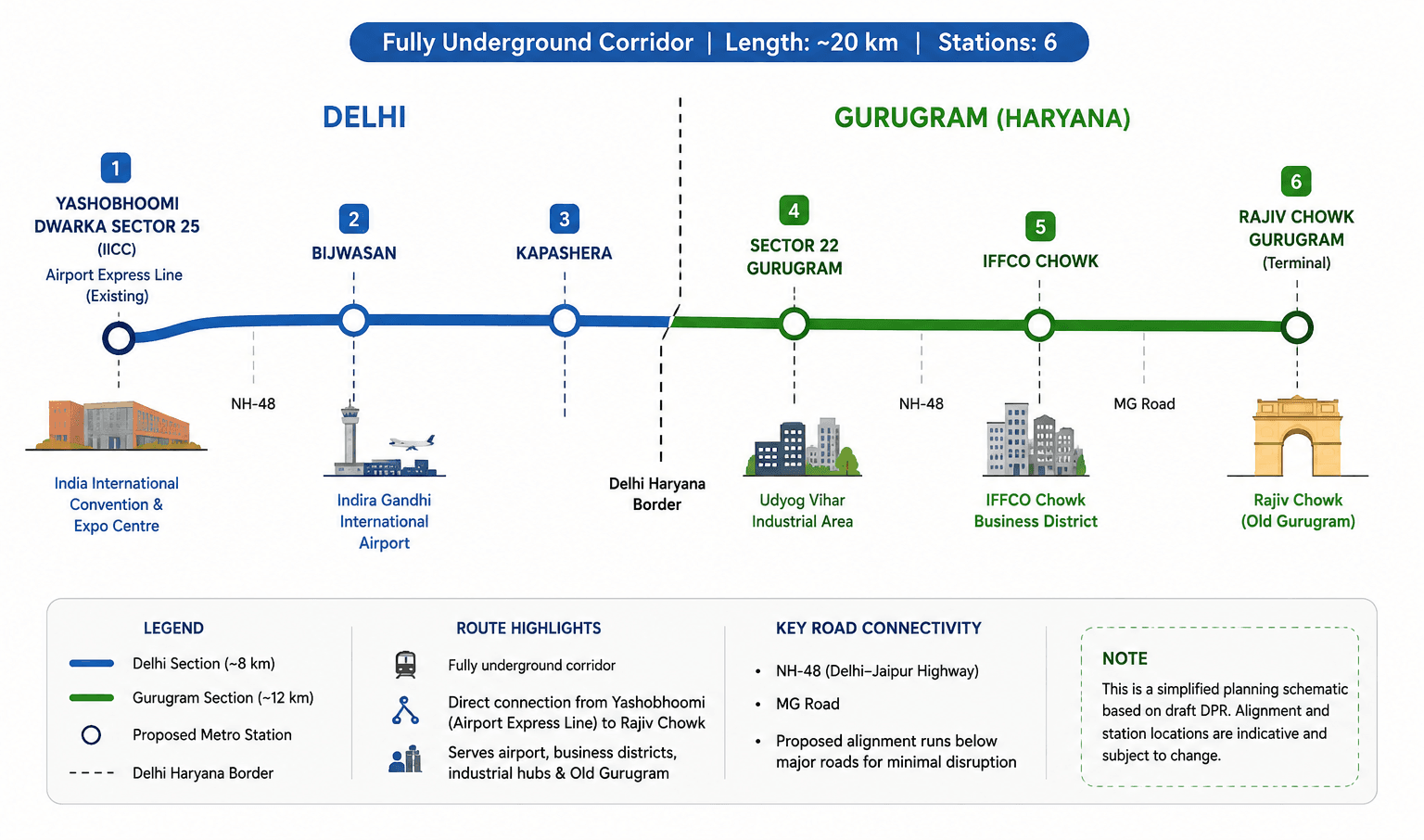
The Yashobhoomi to Rajiv Chowk Gurugram metro corridor, sometimes referred to as the Airport Express extension to Gurugram, is a proposed extension of the Delhi Metro Airport Express Line, intended to connect the Yashobhoomi Dwarka Sector 25 metro station with a new terminal station in Gurugram, Haryana, named Rajiv Chowk.
The corridor is being planned by DMRC at the direction of MoHUA, working alongside the Haryana Mass Rapid Transit Corporation (HMRTC), since the alignment crosses from Delhi into Haryana. A senior HMRTC official described this proposal as a merger of two previously separate alignments DMRC had studied independently: one from Yashobhoomi to Rajiv Chowk, and a second from Dwarka Sector 21 to IFFCO Chowk. MoHUA directed the two to be combined into one continuous underground line, which is why the current draft DPR looks somewhat different from earlier route concepts reported in 2024 and 2025.
Current stage as of July 2026: draft DPR submitted, under technical review by MoHUA. No Cabinet approval, no funding sanction and no construction start date exists yet. Readers evaluating this for a property or commuting decision should treat every timeline figure in this article as indicative, not committed.
Search results and news coverage on this topic frequently blur together two unrelated projects that both use the name Rajiv Chowk in Gurugram. This is one of the most common sources of confusion for readers, so it is worth stating plainly before going further.
| DMRC Yashobhoomi to Rajiv Chowk corridor (this article) | GMRL Millennium City Centre to Cyber City corridor | |
|---|---|---|
| Executing agency | DMRC, coordinating with HMRTC | GMRL, a Government of India and Government of Haryana joint venture |
| Approval status | Draft DPR under MoHUA review; not Cabinet approved | Cabinet approved June 7, 2023; foundation stone laid February 16, 2024; under construction |
| Structure | Fully underground | Fully elevated |
| Length | About 20 km | 28.5 km, including a 1.85 km spur to Dwarka Expressway |
| Cost (indicated) | Around Rs 13,500 crore | Around Rs 5,452.72 crore |
| Rajiv Chowk station location | Terminal station near the Delhi Jaipur Highway (NH-48), in the same general zone as the traditional Rajiv Chowk junction on NH-48 and Sohna Road | One of 27 elevated stations on the Old Gurugram loop, close to the actual Rajiv Chowk junction |
| Target opening | Not available; still pre approval | Targeted mid 2027 for the overall corridor, per GMRL and news reporting |
The two lines are physically close to each other near the historic Rajiv Chowk junction in Old Gurugram (NH-48 and Sohna Road), which is why the names get conflated. If both projects eventually proceed, a future interchange between the DMRC Airport Express extension and the GMRL Old Gurugram loop at or near Rajiv Chowk is a reasonable planning expectation, but no official document reviewed for this article confirms an interchange design. Treat any claim of a confirmed interchange as speculative until DMRC or GMRL states it directly.
A third, related but separate project also touches this same junction: the Delhi Gurugram SNB Rapid Rail Transit System (RRTS) corridor along NH-8, whose finalized 22 station alignment also lists Rajiv Chowk as a planned multimodal transit hub, alongside Cyber City and Hero Honda Chowk. That is a regional rapid rail project, a different technology from a metro, and is being planned and approved separately from both the DMRC and GMRL projects above. Three different agencies, three different technologies, one shared junction name. When you read "Rajiv Chowk metro" in a headline, always check which of these three projects the article is actually about.
| Parameter | Detail | Reliability |
|---|---|---|
| Proposed length | About 20 km (about 8 km in Delhi, about 12 km in Gurugram) | DMRC/HMRTC indicated |
| Alignment type | Fully underground | DMRC/HMRTC indicated |
| Number of stations | 5 new stations | DMRC/HMRTC indicated |
| Starting point | Yashobhoomi Dwarka Sector 25 (interchange with Airport Express Line) | DMRC/HMRTC indicated |
| Ending point | Rajiv Chowk, Gurugram, near the Delhi Jaipur Highway (NH-48) | DMRC/HMRTC indicated |
| Estimated cost | About Rs 13,500 crore | DMRC/HMRTC indicated |
| Executing agency | DMRC, with HMRTC for the Haryana stretch | DMRC/HMRTC indicated |
| Approving authority | MoHUA, then Union Cabinet | Confirmed process, pending outcome |
| Land acquisition status | Not publicly detailed | Not yet available |
| Depot location | Not publicly disclosed | Not yet available |
| Construction method | Likely Tunnel Boring Machines for the underground stretch, per preliminary reporting | Not yet available, unconfirmed by DMRC |
| Expected completion | Not announced | Not yet available |
Each station on this proposed corridor sits inside a distinct employment, residential or logistics zone. Understanding what each stop actually serves matters more than the station name alone, so here is a fuller picture of each one.
The corridor begins at the current western terminus of the Airport Express Line, inside the India International Convention and Expo Centre (IICC), popularly known as Yashobhoomi. This is already an operational station, opened September 17, 2023, lying 17 metres underground with three subway links: one direct into IICC's exhibition halls and central arena, one crossing under the Dwarka Expressway, and one into the Phase 2 exhibition foyer. See the dedicated Yashobhoomi entity section below for why this venue anchors the entire rationale for the corridor.
Bijwasan sits just inside Delhi, close to Bijwasan railway station, an Indian Railways station on the Delhi Jaipur line that also serves Delhi's suburban rail network and is planned to connect to the under construction Haryana Orbital Rail Corridor further south. The area is a mix of low rise residential colonies, transient hospitality (several budget hotels serve IICC overflow demand) and open land, much less densely built up than Kapashera or Udyog Vihar just a few kilometres away. A metro station here would mainly serve residents and IICC adjacent hospitality staff rather than a major existing employment cluster.
Kapashera is one of the busiest and most crowded points on the entire Delhi Haryana border, sitting directly on the Old Delhi Gurgaon Road at the Kapashera border crossing. It is roughly 0.5 km from Udyog Vihar, Gurugram's largest industrial estate, which is why a very large share of Kapashera's population works across the border. The area is dense, low cost, and chronically affected by peak hour congestion and monsoon waterlogging at the border itself, the same bottleneck that regularly produces multi hour delays for anyone travelling between Delhi and Gurugram by road. A metro station here would plug directly into one of the highest volume informal commuter flows in the entire NCR.
This station lands the corridor inside the Udyog Vihar industrial belt itself. Udyog Vihar is a planned industrial estate developed by the Haryana State Industrial and Infrastructure Development Corporation (HSIIDC) starting in 1976, now spanning Phases I through VI across roughly 326 acres, with more than 1,200 registered industrial and commercial units ranging from textiles and manufacturing to IT, BPO and pharmaceuticals. It sustains employment for a very large workforce drawn from across India, and currently relies on NH-48, the Rapid Metro and road transport for its daily commute. A direct underground station here would be the single biggest workforce access improvement on the entire proposed corridor.
This is a new, underground station distinct from the existing elevated Yellow Line IFFCO Chowk station in Sector 29, which has been operational since 2010. The area around IFFCO Chowk and the adjoining MG Road is one of Gurugram's established commercial corridors, home to office towers, retail and the MG Road metro station catchment. Whether the new underground station and the existing elevated Yellow Line station are planned as a walking or paid interchange has not been confirmed in any source reviewed for this article, and this is a genuine open question worth watching for in the revised DPR.
The corridor's proposed terminus sits at the Rajiv Chowk junction on NH-48 and Sohna Road, one of the busiest and most functionally important junctions in Gurugram. It connects Old Gurugram, Civil Lines, Sector 32 and 33, Medanta hospital, Sadar Bazaar and Hero Honda Chowk, and serves as a gateway toward Rewari, Bhiwadi, Jaipur and Faridabad. Unlike the newer, still developing Dwarka Expressway sectors, this is a mature, dense part of the city with limited room for large new construction, meaning any benefit here is likely to show up as improved access and commercial footfall rather than new residential supply.
Understanding this corridor requires understanding what it is actually built to serve. Yashobhoomi is not just a metro station, it is the anchor asset that makes the entire proposal worth building.
What it is. Yashobhoomi, officially the India International Convention and Expo Centre, is a Government of India project developed by the Department for Promotion of Industry and Internal Trade (DPIIT) through a dedicated public sector company, IICC Limited. It sits on 221 acres in Sector 25, Dwarka, connected by the Dwarka Expressway on its east and the Urban Extension Road II on its north, about 11 km from IGI Airport.
Scale. Phase 1 alone, inaugurated by the Prime Minister on September 17, 2023 at a cost of about Rs 5,400 crore, includes a convention centre with a built up area of about 73,000 sq m, capable of holding 11,000 delegates across its auditorium, meeting rooms and ballroom when fully occupied. The plenary hall alone seats 6,000. Across its full planned footprint of about 890,000 sq m, the project is budgeted at over Rs 25,700 crore (about USD 4 billion) and is envisioned to function at the scale of a Central Business District, with 303,000 sq m of exhibition space, 60,000 sq m of convention area, a 50,000 sq m multipurpose arena, plus supporting hotels, retail and office space.
Why it matters for NCR transport planning. DPIIT's own project documentation states plainly that the Airport Express Line was extended from Dwarka Sector 21 specifically to serve this complex, and that development of IICC is projected to generate over five lakh direct and indirect jobs. A facility of this scale, built to compete for a MICE (meetings, incentives, conferences and exhibitions) industry where India currently captures only a small share of Asia's event volume, cannot function on a single rail line indefinitely, particularly one that currently has no direct link to Gurugram, home to a large share of the corporate demand IICC is trying to attract. That gap is the entire planning logic behind this proposed corridor.
History. The Airport Express Line, also called the Orange Line, opened February 23, 2011, built to connect New Delhi Railway Station to IGI Airport in time for the 2010 Commonwealth Games. It had a rocky start: the line was shut down for safety inspections related to viaduct bearing defects from July 2012 to January 2013, and ridership remained well below projections for years afterward because of comparatively high fares relative to the rest of the Delhi Metro network. By January 2019, daily ridership had recovered to about 82,000.
Where it stands today. Following the Yashobhoomi extension, the line now runs 24.6 km across seven stations, New Delhi, Shivaji Stadium, Dhaula Kuan, Delhi Aerocity, IGI Airport, Dwarka Sector 21 and Yashobhoomi Dwarka Sector 25, at an operating speed of up to 120 km/h, the fastest of any Delhi Metro line. DMRC states the New Delhi to Yashobhoomi run takes about 21 minutes. The line offers three interchange points: Yellow Line at New Delhi, Pink Line at Dhaula Kuan, and Blue Line at Dwarka Sector 21.
Relevance to this proposal. Every claim in this article about a future Yashobhoomi to Gurugram travel time should be read against this existing line's actual performance, not the original 2011 sales pitch. The Airport Express Line's own history, a fast, technically capable line that took years to build ridership because of cost and limited network integration, is the most useful precedent available for judging how this new extension might perform in its early years, if it is ever built.
This is how the proposed corridor would sit within NCR's existing and planned transport network, if built as currently proposed.
| Network | Connection Point | Status |
|---|---|---|
| Airport Express Line (Orange Line) | Direct extension from Yashobhoomi Dwarka Sector 25 | Existing, operational |
| Yellow Line | Possible but unconfirmed link near IFFCO Chowk, where a new underground station would sit close to the existing elevated one | Existing line; interchange not confirmed |
| GMRL Old Gurugram Metro (Millennium City Centre to Cyber City) | Possible but unconfirmed link near Rajiv Chowk terminus | Under construction, targeting 2027 |
| Delhi Gurugram SNB RRTS | Shares Rajiv Chowk as a named transit hub in its own separate 22 station plan | Alignment finalized along NH-8; Cabinet approval pending as of the most recent public reporting |
| Dwarka Expressway | Crossed near Yashobhoomi and Bijwasan | Existing, fully operational since 2025 |
| NH-48 / Delhi Jaipur Highway | Corridor terminus sits near this highway at Rajiv Chowk | Existing, chronically congested |
| Bijwasan Railway Station (Indian Railways) | About 2 km from the proposed Bijwasan metro station, not a direct interchange | Existing; future link to Haryana Orbital Rail Corridor planned separately |
| IGI Airport (Terminal 3) | Reached via the existing Airport Express Line from Yashobhoomi, not directly by this new corridor | Existing |
| Dwarka Sector 21 ISBT | Near the existing Airport Express interchange, not on this new corridor directly | Existing |
The practical takeaway: this corridor is designed to plug Gurugram's Old City and Udyog Vihar into a network that is already reasonably well connected to the airport and central Delhi. It does not, by itself, create a new airport link; it extends the reach of one that already exists.
Delhi's Airport Express Line was always designed with an eye toward eventual Gurugram connectivity, since Gurugram and Dwarka sit on roughly the same west to southwest axis from central Delhi, separated mainly by the Delhi Haryana state line. Two structural reasons explain why a direct link has taken this long to reach even a draft DPR stage.
First, Yashobhoomi itself is recent. The Airport Express Line only reached Dwarka Sector 25 in September 2023, once IICC's Phase 1 was ready. Before that, there was no anchor destination on the Delhi side to justify pushing the line toward Gurugram; the corridor would simply have ended at Dwarka Sector 21, which already interchanges with the Blue Line.
Second, interstate metro projects require a fundamentally slower approval chain than single state projects. A corridor entirely within Delhi needs Delhi government and DMRC sign off before heading to the Union Cabinet. A corridor crossing into Haryana additionally needs Haryana government and HMRTC concurrence, and a joint technical alignment that satisfies both states' urban planning bodies. That is precisely why DMRC originally studied two separate alignments, Yashobhoomi to Rajiv Chowk, and Dwarka Sector 21 to IFFCO Chowk, rather than one combined corridor: each began as a narrower, easier to evaluate proposal before MoHUA directed DMRC to merge them.
How many DPR revisions have there been? Based on the sources reviewed for this article, only one round of MoHUA feedback has been publicly reported so far, the request for technical modifications issued after the draft DPR's submission in June 2026. No official count of prior internal DMRC revisions before that submission has been published, and this article will not estimate one.
How does this compare with past Delhi Metro extensions? The closest parallel is the Dwarka Sector 21 to Yashobhoomi extension itself, a comparatively simple 1.878 km, single station addition that still took from trial runs in June 2022 to public opening in September 2023, over a year, despite being entirely within Delhi and adding only one new station. A 20 km, five station, interstate, fully underground corridor is a materially larger undertaking, involving a different state government, a merged alignment, and a funding structure that has not yet been disclosed. Judged against that comparison, and against Phase V(B)'s own roughly year long path from DPR to state approval with Cabinet clearance still pending, a multi year runway before this corridor reaches even a construction start looks like the realistic base case.
NH-48 is chronically overloaded. This corridor carries traffic volumes well beyond its designed capacity, and remains the only direct road link from large parts of Gurugram to the airport for anyone not using the Dwarka Expressway. Waterlogging, accidents and even routine wedding season traffic have repeatedly produced multi hour delays here, including an 8 km jam near Kherki Daula during heavy rain in July 2026, when a road cave in near Narsinghpur shut two lanes and pushed travel times on the Rajiv Chowk to Narsinghpur stretch to 40 to 50 minutes for a normally much shorter trip.
The Dwarka Expressway has helped, but hasn't solved the underlying bottleneck. A transport study prepared for Delhi International Airport Limited (DIAL) and reported in 2026 still flags NH-48 as the road that most feeder routes eventually merge back into, meaning even Dwarka Expressway users often rejoin congested NH-48 traffic before reaching their final destination in Old Gurugram or central Delhi.
Multimodal integration is the underlying planning logic. If built, this corridor would link three things that currently do not share a single seamless public transport connection: the airport, via the existing Airport Express Line; Yashobhoomi's convention economy; and Gurugram's Old City commercial core around Rajiv Chowk, IFFCO Chowk and Udyog Vihar.
| Mode | Route | Approximate Current Time | Notes |
|---|---|---|---|
| Car or taxi | Gurugram (Rajiv Chowk area) to Yashobhoomi/Dwarka | 45 to 75 minutes in normal conditions; well over 90 minutes in monsoon or peak congestion | NH-48 and Dwarka Expressway both prone to peak hour and weather related delays |
| Existing metro (Yellow Line plus Airport Express, changing lines at New Delhi or Dwarka Sector 21) | IFFCO Chowk to Yashobhoomi | Well over an hour including the interchange wait, per public transit routing data | Requires at least one line change; there is no direct trip today |
| Airport Express Line alone, for comparison | New Delhi to Yashobhoomi | About 21 minutes, per DMRC | Shows what the existing high speed line can already do once you are on it; the missing piece is getting from Gurugram onto it |
| Proposed new corridor (DMRC/HMRTC indicated, unconfirmed) | Rajiv Chowk Gurugram to Yashobhoomi | Some early reporting on a related high speed underground concept cites under 25 minutes | This figure has not been confirmed by DMRC and should be treated as an early planning estimate, not a committed travel time |
Because the corridor has not reached the stage of a finalized DPR with published operating parameters (design speed, maximum speed, dwell times), this article does not present a peak versus off peak table with fabricated precision. Any such table you see elsewhere is almost certainly an estimate dressed up as fact.
| Item | Figure | Reliability |
|---|---|---|
| Total estimated cost | About Rs 13,500 crore | DMRC/HMRTC indicated, from draft DPR reporting |
| Cost per km | Not officially published; works out to roughly Rs 675 crore per km based on the indicated total and length | Calculated from unconfirmed figures, treat accordingly |
| Underground versus elevated cost split | Not applicable; entire corridor proposed as underground | DMRC/HMRTC indicated |
| Funding source | Not officially disclosed | Not yet available |
| Central government share | Not officially disclosed | Not yet available |
| Haryana government share | Not officially disclosed | Not yet available |
For context, Delhi Metro's own Phase V(B) package, seven corridors totalling 97.16 km and 65 stations entirely within Delhi, mostly elevated, carries an approved cost of Rs 48,205 crore, about Rs 496 crore per km. GMRL's Old Gurugram corridor, 28.5 km and fully elevated, is budgeted at about Rs 5,452.72 crore, about Rs 191 crore per km. The Yashobhoomi to Rajiv Chowk proposal's indicated per km cost is three to four times higher than either of those, which is consistent with a fully underground alignment; underground construction routinely costs several times more per km than elevated construction in Indian metro projects.
| Stage | Status | Approximate Date |
|---|---|---|
| Airport Express Line reaches Dwarka Sector 21 | Confirmed | 2010 to 2011 |
| Airport Express Line extended to Yashobhoomi Dwarka Sector 25 | Confirmed | Trials from June 2022; opened September 17, 2023 |
| DMRC studies two separate alignments (Yashobhoomi to Rajiv Chowk; Dwarka Sector 21 to IFFCO Chowk) | Confirmed as background context | Prior to 2026 |
| MoHUA directs DMRC to merge the two alignments into one | DMRC/HMRTC indicated | Ahead of June 2026 |
| Draft DPR submitted to MoHUA | DMRC/HMRTC indicated | Received by HMRTC around June 19, 2026 |
| MoHUA requests technical revisions | DMRC/HMRTC indicated | June to July 2026 |
| Revised DPR submission | Not yet available | Pending |
| State (Haryana and Delhi) government approvals | Not yet available | Pending |
| Union Cabinet approval | Not yet available | Pending |
| Tendering | Not yet available | Pending |
| Construction start | Not yet available | Pending |
| Expected opening | Not yet available | Pending |
It is worth being precise about which expansion package this corridor belongs to, since several DMRC announcements are often reported together in the same news cycle.
This section separates connectivity fundamentals, which are reasonably well established, from price projections, which are not. Where a claim is a projection or opinion rather than a fact, it is labeled as such.
Metro corridors in NCR have historically produced a fairly consistent, three stage pattern once a line is actually confirmed and under construction, not merely proposed: first, commercial leasing activity and rental demand near upcoming stations firms up ahead of opening, particularly for office and retail space; second, once a line opens and ridership stabilizes, walk to station residential catchments see steadier absorption than similar stock further away; third, the biggest measurable shift tends to be in commercial rents and occupancy near stations that also function as interchanges, more than in raw resale price appreciation, which is driven by many other factors simultaneously.
This pattern has shown up to varying degrees around Yellow Line stations like IFFCO Chowk and MG Road since their 2010 opening, and it is a reasonable analytical framework to apply here, once and if this corridor reaches Cabinet approval and a confirmed construction timeline. It is not a prediction of specific numbers for this corridor, since none exist yet.
| Parameter | Today | If this corridor is built |
|---|---|---|
| Direct rail link, Old Gurugram to Yashobhoomi/IICC | None; requires a change of line and, in most routings, a change of station | Direct, single line |
| Direct rail link, IFFCO Chowk area to Airport Express network | None | Direct, single line |
| Stations to reach Yashobhoomi from IFFCO Chowk | Multiple, via an interchange | Five stations, no interchange required |
| Road dependency for the same trip | Entirely dependent on NH-48 or Dwarka Expressway | Reduced, with rail as an alternative |
| Interchanges required (metro) | At least one, via a hub like Rajiv Chowk in Connaught Place | Zero, for the specific Yashobhoomi to Gurugram Rajiv Chowk trip |
| Approval status | N/A | Draft DPR, pending Cabinet approval |
Only challenges that are reasonably well evidenced are listed here.
Key takeaways: this is a genuine, actively discussed metro proposal, not a rumour, but it is also genuinely early stage. DMRC has produced a draft DPR, submitted it to the central government, and been asked to revise it. No Cabinet approval, funding sanction or construction timeline exists yet.
Who benefits most: if built, the clearest beneficiaries are commuters and businesses in Old Gurugram, Udyog Vihar and IFFCO Chowk who need direct rail access to Delhi's Dwarka and airport corridor, and the MICE ecosystem around Yashobhoomi, which currently depends on a single rail line and a congested road network.
Current project status: draft DPR under technical review by MoHUA, submitted around June 19, 2026.
What approvals remain: a revised DPR incorporating MoHUA's requested changes, concurrence from the Delhi and Haryana governments, Union Cabinet approval, financial sanction, and only then tendering and construction.
Realistic expectations: based on how long comparable Delhi Metro corridors have taken to move from DPR to Cabinet approval to an operational line, and given the added complexity of an interstate, fully underground alignment, this corridor is unlikely to be operational before the early to mid 2030s even in an optimistic scenario, and could easily take longer or be modified further during MoHUA's review.
Future outlook: the underlying case for the corridor, connecting a single rail served convention hub to a major, currently road dependent employment and commercial zone, is sound on connectivity grounds. Whether it proceeds on the timeline suggested by current reporting depends on decisions that have not yet been made. Readers should track official DMRC and MoHUA announcements rather than secondary news aggregation for updates, since much of the current coverage recycles the same original reporting without new confirmation.
No. As of July 2026, it is a draft DPR under technical review by MoHUA. It has not received Cabinet approval.
No construction start date has been announced. The project must first clear a revised DPR, state government approvals and Union Cabinet sanction.
Yashobhoomi Dwarka Sector 25 to Bijwasan to Kapashera to Sector 22 Gurugram to IFFCO Chowk to Rajiv Chowk, Gurugram.
Five new underground stations: Bijwasan, Kapashera, Sector 22 Gurugram, IFFCO Chowk and Rajiv Chowk, plus the existing Yashobhoomi station as the origin.
Approximately 20 km, about 8 km in Delhi and about 12 km in Gurugram, per the draft DPR reporting.
Yes. It is proposed as a direct extension of the Airport Express Line from its current terminus at Yashobhoomi Dwarka Sector 25.
No, and this is a common point of confusion. The Rajiv Chowk station currently under construction is part of GMRL's separate, Cabinet approved Millennium City Centre to Cyber City corridor, targeted for around 2027. The DMRC proposal covered in this article is a different, earlier stage project.
No. Phase V(B) covers seven corridors entirely within Delhi. This is a separate, interstate proposal handled through MoHUA and HMRTC.
Around Rs 13,500 crore, based on draft DPR reporting. This figure has not been officially confirmed by DMRC or MoHUA in a public release.
The Dwarka Expressway corridor's growth to date has been driven primarily by the expressway itself, not by this proposed metro line. If the metro corridor is eventually built, it would add a rail option for the Old Gurugram end of the alignment, not directly serving most Dwarka Expressway sectors, which are located further south along Sectors 81 to 115.
Based on the stations proposed, the most directly affected areas are Bijwasan and Kapashera in Delhi, and Sector 22, Udyog Vihar, IFFCO Chowk and the Rajiv Chowk junction in Old Gurugram, Haryana.
Any price movement attributed specifically to this proposal at its current pre approval stage is speculative. This article does not make a price prediction; treat connectivity fundamentals and Cabinet approval status as the relevant facts, not price forecasts.
They are different projects using different technology, metro versus regional rapid rail, and are being planned separately. The RRTS corridor also passes through Rajiv Chowk and Cyber City as a transit hub in its own plan, adding to the naming overlap in this area, but it is not the same project as either the DMRC metro extension or the GMRL Old Gurugram loop.
That is the stated intent of the proposal, and a single seamless rail line would remove today's need to interchange. A specific committed travel time has not been published by DMRC.
DMRC had studied two alignments independently, Yashobhoomi to Rajiv Chowk, and Dwarka Sector 21 to IFFCO Chowk. MoHUA directed DMRC to combine both into the single alignment now under review.
A separate proposal to connect Gurugram with Dwarka Sector 21 via a spur from Rezangla Chowk is reportedly also under consideration, distinct from the main Yashobhoomi to Rajiv Chowk alignment.
Not officially disclosed. No confirmed central or Haryana government funding share has been published.
That is the primary stated rationale: giving Gurugram based delegates, exhibitors and hospitality operators a direct rail link to IICC, India's largest MICE venue, without relying solely on NH-48 or the Dwarka Expressway.
MoHUA has asked DMRC for technical modifications to the draft DPR; a revised version has not yet been reported as submitted, as of this article's publication.
Not directly. The existing elevated Yellow Line IFFCO Chowk station remains a separate station from the new underground IFFCO Chowk station proposed in this corridor. Whether the two are physically or fare integrated has not been confirmed.
Kapashera sits directly on the Delhi Haryana border, about 0.5 km from Udyog Vihar, and already carries an outsized share of daily cross border commuter traffic on the Old Delhi Gurgaon Road. A metro station here would serve one of the highest volume informal commute corridors in the entire NCR.
The proposed Bijwasan metro station is about 2 km from the existing Bijwasan railway station on the Delhi Jaipur rail line. No direct interchange has been confirmed; they should currently be treated as separate, nearby facilities rather than an integrated hub.
Contact Us
Fill out this form
& we'll get back
to you
Recommended for you