Market Trends
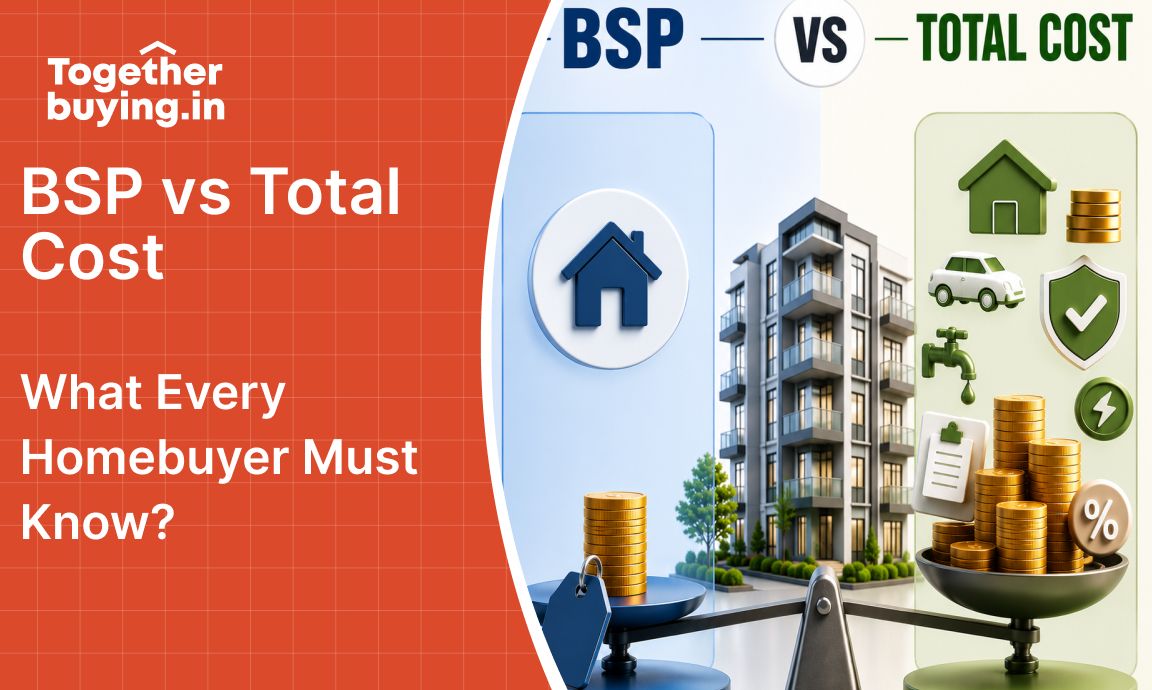
BSP vs Total Cost: What Homebuyers Must Know?
23 Jul 2026
Market Trends
23 Jul 2026
Content
No Blogs content found
It looks like there haven’t been any blogs yet!
A builder's hoarding outside a Gurugram sector reads: "Starting at ₹1.20 crore." A buyer books a unit, excited about the number. Six weeks later, the final cost sheet arrives. The number has become ₹1.38 crore.
In almost every case, the answer is the same. The advertised figure was the Basic Sale Price (BSP). It was not the full amount the buyer would actually pay to own the home. These two numbers are related. They are not the same thing, and the gap between them is exactly where most homebuyers get their budgeting wrong.
This guide breaks down what BSP is, what makes up Total Cost, which charges come from the government versus the builder, which ones you can actually negotiate, and how to read a cost sheet without getting caught off guard. Charges like stamp duty, registration, and GST vary by state and by project category. Figures used below are illustrative or drawn from currently published rates. Always verify the exact rate for your state and project before booking.
Think of BSP as the base price of the home. It is the core rate the builder charges for the apartment itself, usually quoted per square foot and multiplied by the unit's area. That's it. Everything else gets added on top.
BSP typically covers the base construction and land cost apportioned to the unit, plus the developer's margin on it.
BSP does not include location premiums (floor rise, corner unit, park-facing), parking, club charges, GST, stamp duty, registration, or maintenance deposits.
BSP is the smallest number in the whole cost structure. Quoting "Starting at ₹X" using BSP alone makes a project look more affordable in listings and hoardings than what a buyer will actually pay. This isn't necessarily deceptive. It's standard industry practice. But it means the responsibility falls on the buyer to ask for the full cost sheet before comparing two projects.
No. GST is worked out separately on the taxable components of the cost sheet, and only for under-construction properties.
No. Stamp duty and registration are state government charges. They're collected when the sale deed is executed, completely separate from BSP.
No. Car parking, whether open, covered, or in the basement, is almost always billed as its own line item. There are some developers who include car parking in the BSP.
No. Maintenance deposits, IFMS (Interest Free Maintenance Security), and corpus fund contributions are collected separately, either at possession or as an advance.
Total Cost is everything a buyer actually pays to legally own and take possession of a property, not just the apartment price. Here's why the distinction matters. Two builders can advertise the same BSP for similar-sized apartments. One might charge ₹5 lakh for parking. The other includes it for free but adds a steeper club membership fee. The builder with the "cheaper" BSP isn't always the cheaper home.
A simple way to think about it:
Total Cost = BSP + PLC + Parking + Club Charges + IFMS + GST (if applicable) + Stamp Duty + Registration + Other Applicable Charges
Depending on the project, developer, city, and whether the unit is under construction or ready to move, Total Cost can include:
| Component | What It Covers |
|---|---|
| Basic Sale Price (BSP) | Core price of the unit |
| PLC (Preferential Location Charge) | Premium for corner, park-facing, higher floor, or view |
| Floor Rise Charges | Premium that climbs with each floor above ground |
| Club Membership | One-time or recurring fee for clubhouse and amenity access |
| Car Parking Charges | Cost of one or more allotted parking slots |
| IFMS | Refundable or adjustable security deposit for maintenance |
| Maintenance Deposit | Advance maintenance, usually 12 to 24 months' worth |
| Power Backup Charges | Cost of the diesel generator capacity allotted to your unit |
| Electric Meter and Connection Charges | Cost of getting a discom meter installed |
| Water Connection Charges | One-time fee from the local water authority |
| Legal and Documentation Charges | The builder's own fee for drafting the sale agreement |
| GST | Central tax, applicable only on under-construction property |
| Stamp Duty | State tax on the sale deed |
| Registration Charges | State fee for recording the sale deed |
| Corpus Fund | One-time contribution to a long-term maintenance corpus |
| Lease Rent | Applies to leasehold-land projects, common in parts of Delhi-NCR |
| EDC/IDC | Development charges levied by the state or authority, common in Haryana and UP projects |
Not every project has every charge. The mix depends on the developer, the city, the land tenure, and whether the property is under construction or already has an Occupancy Certificate. Always ask for the itemized cost sheet. Don't assume a standard structure applies.
Expert Tip: Never compare two projects using only the BSP. Always request the complete itemized cost sheet and calculate the Total Cost before making a decision. A property with a higher BSP can still work out cheaper overall if it carries lower additional charges.
This is what a realistic cost sheet might look like for a unit with a quoted BSP of ₹1 crore. The figures are illustrative only.
| Charge | Amount (₹) |
|---|---|
| Basic Sale Price (BSP) | 1,00,00,000 |
| PLC (park-facing, mid-floor) | 3,00,000 |
| Car Parking (1 covered slot) | 3,50,000 |
| Club Membership | 1,50,000 |
| GST (5%, non-affordable, no ITC) | 5,00,000 |
| IFMS + Advance Maintenance | 1,20,000 |
| Power Backup + Water/Electric Connection | 80,000 |
| Legal and Documentation | 50,000 |
| Stamp Duty (illustrative 6%) | 6,30,000 |
| Registration Charges (illustrative 1%) | 1,05,000 |
| Total Cost | 1,22,85,000 |
That's roughly 23% above the advertised BSP. This is exactly the gap that trips up buyers who compare only headline prices across projects.
The only fair way to compare two projects is side by side, line by line. Here's an example:
| Charge | Builder A | Builder B |
|---|---|---|
| BSP | ₹1 crore | ₹1.05 crore |
| Parking | ₹5 lakh | Included |
| PLC | ₹4 lakh | ₹1 lakh |
| Club Membership | ₹2 lakh | Included |
| Approximate Total (excluding GST/stamp duty/registration) | ₹1.11 crore | ₹1.06 crore |
Builder A has the lower BSP, but Builder B has the lower Total Cost. If a buyer only compared the headline BSP figures, they would have picked the more expensive option without realizing it. This is exactly why the full cost sheet, not the advertised price, should drive the decision.
Buyers routinely underestimate or overlook these:
Watch for these warning signs before you sign anything or make a payment:
If you spot even one of these, ask the builder to clarify in writing before you pay anything. Always cross-check every charge against the Builder Buyer Agreement and the project's RERA registration details.
| Aspect | BSP | Total Cost |
|---|---|---|
| Definition | Base rate for the unit | Everything payable to own and take possession |
| Purpose | Used in marketing and initial pricing | Used for real budgeting and loan discussions |
| Includes | Just the unit price | BSP, PLC, parking, club, GST, stamp duty, registration, maintenance, and more |
| Excludes | Almost everything else | Nothing. It's the all-inclusive figure |
| When Paid | Per the payment plan | Spread across booking, construction milestones, and possession |
| Negotiable | Sometimes, especially in a buyer's market | Partially. Statutory charges are fixed |
| Impact on Loan | Banks usually sanction against the agreement value, not the full amount | Registration and stamp duty are usually excluded from financing |
| Impact on Registration | Not directly relevant | Stamp duty is calculated on the higher of agreement value or circle rate |
Some parts of the Total Cost come from the developer, so there's room to push back:
Statutory charges don't move. GST, stamp duty, and registration are government levies. No developer can discount them, no matter how good a deal you negotiate on everything else.
| Government-Levied | Developer-Levied |
|---|---|
| Stamp Duty | PLC / Floor Rise |
| Registration Charges | Car Parking |
| GST (on under-construction units) | Club Membership |
| TDS (1% under Section 194-IA, where applicable) | IFMS, Maintenance Deposit, Corpus Fund |
| EDC/IDC (in some states) | Power Backup, Legal, Documentation charges |
No, and this trips up a lot of buyers. Agreement Value is the figure written into the Builder-Buyer Agreement. It's usually BSP plus a few charges like PLC and parking. It may or may not include GST, club fees, or maintenance. That depends entirely on how the developer structures the document.
Agreement Value matters because it's typically the base used for stamp duty and registration. The state applies duty on whichever is higher: the agreement value or the government circle rate for that area.
Under Section 2(k) of the RERA Act, 2016, carpet area is legally defined as the net usable floor area of an apartment. It excludes the area under external walls, service shafts, exclusive balconies, verandahs, and open terraces, but it includes the internal partition walls. This was the first time carpet area got a standardized legal definition in Indian real estate, replacing the inconsistent use of terms like built-up and super built-up area.
Here's how the three terms differ:
Under RERA, developers are required to disclose the carpet area as defined under the Act, and sale agreements are based on carpet area. Buyers should confirm that the quoted price actually corresponds to the RERA-disclosed carpet area, not to built-up or super built-up area, before comparing rates across projects.
Check this:- CARPET AREA VS BUILT UP AREA VS SUPER BUILT UP AREA
Usually not. External Development Charges (EDC) and Internal Development Charges (IDC) are levied by the state or development authority in certain markets, particularly in Haryana and Uttar Pradesh. They're typically shown as separate line items, not folded into BSP.
Generally no, once the Builder-Buyer Agreement is signed and the price is locked in. Some payment plans include escalation clauses tied to construction stage or floor allotment, so read the agreement carefully before signing. RERA requires the agreed price to be disclosed upfront and discourages arbitrary post-booking changes.
An "all-inclusive" price, when a builder advertises one, is meant to fold in most standard charges like PLC, parking, and club fees into a single number. BSP is just the base. Even an all-inclusive quote often excludes GST, stamp duty, and registration, so always ask the builder to confirm exactly what "all-inclusive" leaves out.
No. Floor rise is billed as a separate premium that increases with each floor, and it sits outside the BSP in almost every project.
There's no fixed rule, since it depends on the project and city. As a rough planning buffer, many buyers budget an additional 15 to 25% above BSP to cover PLC, parking, club charges, GST, stamp duty, registration, and maintenance. Always confirm the actual figure from the project's own cost sheet rather than relying on a general estimate.
It can be, but not always. Some developers quote BSP per square foot of carpet area, while others still use super built-up area. Confirm which basis your quoted BSP actually uses before comparing it to another project.
Because BSP was never designed to be the final number. It's the base rate for the unit alone. Every other cost, from parking to GST to registration, sits on top of it. Builders quote BSP because it's the smallest, most marketable figure in the entire cost structure.
Sometimes. Developers may offer a discount on BSP during inventory clearance, festive periods, or for early bookings. Statutory charges like GST, stamp duty, and registration stay fixed regardless of any discount you negotiate on BSP itself.
Because pricing components like PLC, floor rise, and negotiated discounts vary by buyer and by booking timeline. A buyer who books early or during an inventory sale might get a lower BSP or waived parking charge, while a later buyer pays the standard rate. Statutory charges, though, stay the same for everyone regardless of when they book.
BSP is just the starting point of a property transaction. It's not the number to plan your budget around. A well-informed buyer looks past the advertised price and works through the complete cost sheet: PLC, parking, club charges, GST, stamp duty, registration, maintenance, and everything else that adds up to Total Cost. Knowing which charges come from the government and which come from the developer tells you exactly what's negotiable and what isn't. In the end, the smartest comparison between two properties, or two developers, is never BSP versus BSP. It's Total Cost versus Total Cost.
BSP, or Basic Sale Price, is the core rate a builder charges for a unit, usually quoted per square foot. It excludes charges like PLC, parking, club membership, GST, stamp duty, and maintenance. All of those get added separately to reach the Total Cost.
No. GST is worked out separately on the taxable value of an under-construction unit. It's typically 1% for affordable housing or 5% for other residential units, both without input tax credit for the developer. Ready-to-move units with an Occupancy Certificate are exempt.
No. Registration is a state government fee, generally around 1% of the property's registered value, paid separately when the sale deed is registered.
No. Parking, whether open, covered, or in the basement, is almost always billed as its own line item.
It can be, especially in a buyer's market or during inventory clearance. Once GST, stamp duty, and registration get added, though, those statutory charges stay fixed no matter what discount you get on BSP.
Yes. Developers sometimes discount BSP for unsold inventory, festive periods, or bulk bookings. Those discounts never extend to government-levied charges.
PLC, or Preferential Location Charge, is a premium for a unit with a specific advantage, like a corner spot, a park-facing view, or a preferred floor. The developer sets this entirely on their own.
Total Cost includes BSP plus every other applicable charge: PLC, parking, club membership, GST, stamp duty, registration, and maintenance. It's often 15 to 25% higher than BSP alone.
Agreement Value is the price recorded in the Builder-Buyer Agreement. It's generally BSP plus charges like PLC and parking. It typically forms the base for stamp duty and registration, subject to the state's circle rate comparison rule.
Not usually. Banks generally sanction loans against the agreement value or a set loan-to-value ratio. Stamp duty, registration, and some other charges typically come out of the buyer's own funds.
GST on under-construction units, stamp duty, and registration are mandatory and non-negotiable. Some developer charges, like club membership, can also be effectively mandatory depending on the project's terms.
Yes, if the property is ready to move with a valid Occupancy Certificate at the time of purchase. GST only applies to under-construction units sold before completion.
No. A ready-to-move property with a completion or occupancy certificate is exempt from GST. Stamp duty and registration, being state charges, still apply either way.
It depends on the developer. Sale agreements under RERA are based on carpet area, so confirm which basis is being used for the quoted BSP before comparing projects.
Compare Total Cost, not BSP. Request the itemized cost sheet from each developer, confirm the carpet area basis, and account for GST, stamp duty, registration, and every developer charge before deciding which project is actually cheaper.
TogetherBuying encourages buyers to compare projects using the complete cost sheet instead of just the advertised BSP. By negotiating as a group, members may receive better commercial terms, discounts, or waivers on certain builder-imposed charges where developers agree. Statutory charges such as GST, stamp duty, and registration remain fixed regardless of group negotiation.
Contact Us
Fill out this form
& we'll get back
to you
Recommended for you