Market Trends
Gurugram's New Metro Corridor: Sector by Sector Investment Potential and Growth Analysis
08 May 2026
Market Trends
08 May 2026
Content
No Blogs content found
It looks like there haven’t been any blogs yet!
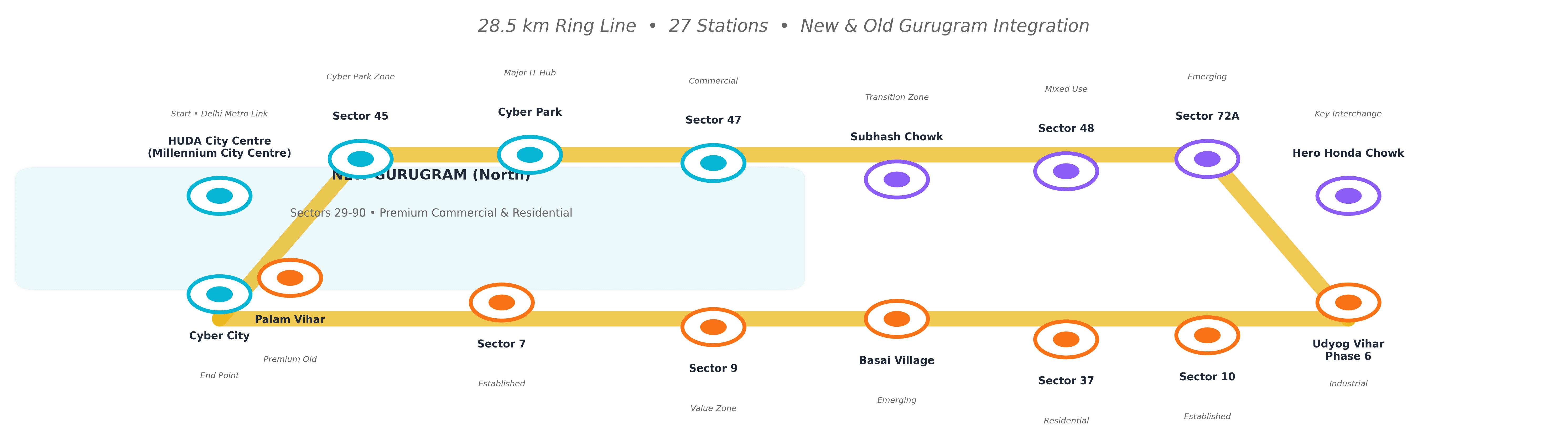
Gurugram is about to undergo one of the most transformative infrastructure projects in its history. The new 28.5 kilometer metro corridor from Millennium City Centre to Cyber City, approved by Prime Minister Narendra Modi in February 2024, represents a watershed moment for the city's real estate and connectivity landscape.
This is not just another metro line. The Gurugram Metro Rail Limited project, estimated at Rs 5,452.72 crore, will connect 27 stations across Old and New Gurugram, fundamentally reshaping how investors and homebuyers view different sectors of the city. Unlike previous infrastructure projects, this corridor will directly impact property values across multiple underutilized zones, creating investment opportunities that investors should understand sector by sector.
In this analysis, we examine how the metro corridor will transform each sector along its route, identify which areas offer the strongest investment potential, and explain the mechanism through which infrastructure investment drives real estate appreciation.
Before diving into sector specific analysis, understanding the project fundamentals is essential for making informed investment decisions.
Total Corridor Length: 28.5 kilometers
The corridor will stretch from Millennium City Centre (also known as HUDA City Centre) in New Gurugram to Cyber City in Old Gurugram. An additional 1.85 kilometer spur will connect the main corridor to Dwarka Expressway at Sector 101 via Basai Village, providing critical connectivity to this high growth corridor.
All stations will be constructed as elevated structures, ensuring minimal disruption to existing ground level infrastructure. This elevated design is crucial for Gurugram's context where dense commercial and residential activity requires preserving surface level space.
This substantial investment from the Government of India and Haryana Government underscores the strategic importance of this corridor. The 50 50 funding partnership ensures committed long term support for the project.
The Gurugram Metro serves a critical purpose: connecting Old Gurugram with New Gurugram across National Highway 48. New Gurugram (Sectors 29 to 90) developed in the past two decades as an IT and financial hub, while Old Gurugram (Sectors 1 to 25) remained largely underdeveloped. This metro corridor will bridge that gap.
Additionally, the metro will provide interchange connectivity with the Delhi Metro's Yellow Line at Millennium City Centre, enabling direct access to Delhi. Future RRTS integration at Hero Honda Chowk will provide connectivity to the Regional Rapid Transit System. This multi modal integration positions Gurugram as a truly connected metropolitan hub.
Before analyzing specific sectors, understanding how metro infrastructure creates property value is essential for investors.
The recent transformation along Dwarka Expressway provides a real world case study of how infrastructure investment drives real estate appreciation in the Gurugram region. Between 2020 and 2024, property prices along Dwarka Expressway nearly doubled, jumping from approximately Rs 9,434 per square foot to Rs 18,668 per square foot. This represents a 98 percent increase in just four years.
Most remarkably, in Q4 2024 and Q1 2025, the corridor recorded a 58 percent year on year price increase, the highest appreciation rate across any property market in India. This unprecedented surge was driven by infrastructure completion, improved connectivity to Delhi and IGI Airport, and strong investor confidence in future growth.
The Dwarka Expressway example demonstrates the formula for real estate appreciation in Gurugram: infrastructure completion plus connectivity enhancement equals rapid property value growth. The metro corridor will follow a similar pattern.
Also Read:- The Gurugram Noida RRTS Corridor Everything You Need to Know
Now we examine each major section of the corridor to understand investment potential. The analysis follows the metro route from Millennium City Centre to Cyber City.

Current Status: Already Mature
The corridor starts at Millennium City Centre, which is already an established commercial and retail hub with Delhi Metro Yellow Line connectivity. This area includes Sectors 29, 37, 42, and Cyber Park, which are among Gurugram's most developed and expensive zones.
Investment Characteristics
Investment Verdict
This section is suitable for conservative investors seeking price stability and rental income. However, appreciation potential is limited because prices have already incorporated expectations of metro connectivity. The metro will enhance existing value but create few new opportunities. Most suitable for: stable income focused investors, corporate relocations, and retail businesses.
Station Sequence: District Shopping Centre (Sector 47), Subhash Chowk, Sector 48, Sector 72A This section represents a transition from established New Gurugram into less developed areas. Sectors 47 and 48 are mid segment residential neighborhoods with existing commercial activity but still underutilized compared to premium sectors.
The metro corridor makes these sectors attractive to office workers who cannot afford premium sector apartments but want good connectivity. Professionals working in Cyber Park, Millennium City Centre, and other nearby IT hubs will prefer renting in Sectors 47 48 at lower prices rather than expensive premium sectors.
This creates strong rental demand. Investors purchasing apartments here can expect stable tenant occupancy and growing rental yields as the metro becomes operational and more professionals discover the area.
This section offers an excellent balance of value and growth potential. Prices have not yet fully incorporated metro connectivity benefits, creating opportunity for investors with a 5 to 7 year horizon. The strong rental demand makes this suitable for income focused investors. Best Entry: Within the next 12 months before construction starts and price gains accelerate.
Strategic Importance: This is the single most important station on the entire corridor. Hero Honda Chowk serves as the interchange point between the metro corridor and the proposed RRTS corridor that will eventually connect to Jewar Airport. This is a critical multimodal transit hub with enormous long term potential.
Currently, Hero Honda Chowk is a congested commercial area with mixed industrial and commercial use. However, once the metro arrives and the RRTS interchange is developed, the entire area will be reevaluated as a major mobility hub. Developers will rush to build premium mixed use projects here.
This is the single strongest investment opportunity along the entire corridor for investors with a 5 to 10 year horizon. The presence of the RRTS interchange differentiates this from other metro stations and creates exceptional long term value creation potential. Land investments here could generate returns exceeding 100 percent. Best Suited For: Long term investors, developers, commercial real estate funds.
Station Sequence: Udyog Vihar Phase 6, Sector 10, Sector 37
This section of the corridor passes through a mixed industrial and residential area where small and medium enterprises operate alongside residential colonies. The metro will transform this area into a more integrated mixed use corridor.
Udyog Vihar is home to hundreds of SMEs and manufacturing units. The metro will improve worker access to this industrial zone, making it more productive and valuable. Simultaneously, the improved mobility will make these industrial areas more attractive as residential destinations for workers.
Investors will see: steady commercial activity, predictable tenant demand, industrial space appreciation, and residential spillover growth as prices in premium sectors push workers to seek accommodation here.
This section offers lower risk compared to other areas along the corridor, making it suitable for conservative investors seeking steady returns with less volatility. Industrial areas typically show more predictable real estate cycles. Best Suited For: Value focused investors, long term hold investors, those seeking lower entry costs.
Station: Basai Village, plus 1.85 km spur to Dwarka Expressway (Sector 101)
This section represents the frontier of Gurugram's expansion. Basai Village and surrounding areas have historically been agricultural land or underdeveloped villages. The metro connection to Dwarka Expressway will transform this entire region.
The Dwarka Expressway has already proven its investment credentials. Between 2020 and 2024, it delivered 98 percent property appreciation. Now, adding a metro connection will turbocharge the corridor further.
Investors who bought properties along Dwarka Expressway 3 to 4 years ago have already seen significant gains. The metro connection will create a second wave of appreciation as fresh buyers and developers rush to the area.
This is the highest risk, highest reward section of the corridor. Investors with a strong risk appetite and a 5 to 10 year investment horizon could see exceptional returns. The Dwarka Expressway precedent suggests appreciation potential could exceed 100 percent. However, investors must account for construction delays, land acquisition challenges, and market cycle risks.
Best Suited For: Growth focused investors, those seeking maximum capital appreciation, investors with 5-10 year horizons, those willing to accept volatility for higher returns.
Station Sequence: Sector 9, Sector 7, Sector 4, Sector 5, Ashok Vihar, Sector 3, Palam Vihar Extension, Palam Vihar This section of the corridor is the transformation story of Old Gurugram. These are established, mature neighborhoods that have historically been considered inconvenient due to poor connectivity. The metro will change that narrative fundamentally.
Old Gurugram sectors have much lower property prices than New Gurugram, typically in the Rs 5,500 to 7,000 per square foot range. However, these areas have strong social infrastructure: good schools, established neighborhoods, community centers, and parks. What they lacked was mobility.
With the metro, residents of Palam Vihar can commute to Cyber City in 15 to 20 minutes instead of 45 minutes to an hour. This transforms the entire value proposition of these neighborhoods. End users will recognize that these areas offer better value, better community infrastructure, AND good connectivity. This recognition will drive property appreciation.
When the Delhi Metro Red Line extended to areas like Bahadur Garh Rao and Bawana in 2006-2007, property prices in these previously isolated areas nearly tripled over 5 years. Old Gurugram will follow a similar pattern.
Old Gurugram represents the middle ground between established premium areas and emerging frontier zones. It offers end user value combined with growth potential. Most suitable for: End users upgrading to a better lifestyle, Delhi based families seeking Gurugram properties, value conscious investors with a 5 to 7 year horizon.
The corridor culminates at Cyber City, Gurugram's largest business district. The surrounding Sectors 22 and 23 and Udyog Vihar Phases 4 and 5 are transitional areas between industrial zones and premium commercial spaces. This final section will benefit from metro connectivity to Cyber City's office parks, hotels, and supporting commercial infrastructure. Rental demand will remain strong due to proximity to employment centers.
The greatest appreciation potential exists for investors who buy properties before construction begins. Once construction starts and media coverage increases, prices will accelerate. Smart investors should target early stage purchases.
Expected Appreciation Timeline
The Gurugram Metro from Millennium City Centre to Cyber City represents one of the most significant real estate value creation opportunities in the National Capital Region. Unlike previous infrastructure projects, this corridor touches multiple underutilized zones, creating diverse investment opportunities for different investor profiles.
The key insight for investors is that property appreciation is not uniform along the corridor. Each section has unique characteristics that determine investment potential:
The construction timeline starting in June 2025 and completion by 2029 provides a narrow window for pre construction purchases where the highest returns are possible. Investors who understand this corridor's unique characteristics and invest strategically across different zones stand to build significant real estate wealth over the next 5 to 7 years. The Gurugram Metro corridor is not just another transportation project. It is a wealth creation engine for informed investors who can identify undervalued properties before the market reprices them.
Contact Us
Fill out this form
& we'll get back
to you
Recommended for you