Market Trends
Bhondsi to Gurugram Railway Station Metro Corridor: Route, DPR Status
29 Jun 2026
Market Trends
29 Jun 2026
Content
No Blogs content found
It looks like there haven’t been any blogs yet!
Gurugram's Sohna Road belt — one of the city's most densely populated residential corridors — has no direct metro connectivity today. Residents of Bhondsi, Badshahpur, and the sectors strung along National Highway 248A depend entirely on road-based transport, travelling through two of Gurugram's most congested junctions at Subhash Chowk and Rajiv Chowk.
The Bhondsi to Gurugram Railway Station corridor is a proposed 17.09 km metro rail line designed to change this. Unlike many proposed transit projects that begin with informal ministerial statements, this corridor was first identified in a formal planning document — the GMDA Comprehensive Mobility Management Plan for the Gurugram Manesar Urban Complex (CMMP), prepared by the School of Planning and Architecture, Delhi. The CMMP classifies it as a Phase 3 priority line with a projected peak-hour demand of 23,060 passengers per hour per direction (PPHPD) at the highest-loaded section.
Following that planning foundation, HMRTC formally approved the preparation of a Detailed Project Report (DPR) for the corridor in August 2024. A consultant — RITES Ltd, a Government of India enterprise — has been appointed and preliminary work is underway. The full DPR has not yet been published.
As of June 2026: The corridor is in the DPR preparation stage. No construction has been sanctioned. Haryana Cabinet approval and Union Ministry of Housing and Urban Affairs approval both required before construction can begin have not been obtained.
| Parameter | Detail | Verified From |
|---|---|---|
| Proposed Corridor Length | 17.09 km | GMDA CMMP (Table 0.6); HMRTC Tender Ref. HMRTC/DPR/2025/20 |
| Southern Terminus | Bhondsi Village | HMRTC Board Approval (6 August 2024); GMDA CMMP |
| Northern Terminus | Gurugram Railway Station | HMRTC Board Approval (6 August 2024); GMDA CMMP |
| Route Description (as per CMMP) | Bhondsi Village – Subhas Chowk – Rajeev Chowk – Sohna Chowk – Railway Station | GMDA CMMP, Table 0.6 |
| Primary Road Alignment | Sohna Road (NH 248A) | HMRTC Board Approval (August 2024); HMRTC Tender Document |
| CMMP Planning Phase | Phase 3 (2026–2031 Horizon) | GMDA CMMP |
| CMMP Ridership Demand Forecast | 23,060 PPHPD (Peak Section) | GMDA CMMP, Table 0.6 |
| CMMP Multi-Modal Transit Hub | Bhondsi area identified as a regional-level MMTH in the GMDA CMMP | GMDA CMMP, Section 0.8.8 |
| Implementing Authority (DPR Stage) | HMRTC | HMRTC Tender Document |
| DPR Consultant | RITES Ltd. | HMRTC Official Communiqué; Multiple Secondary Reports |
| RITES Contract Reference | HMRTC/DPR/2025/20 | TenderDetail.com (citing NIC eTenders) |
| Tender Issued | 19 March 2025 | Rail Analysis (25 March 2025), sourced from HMRTC Tender |
| Corrigendum Extending Bid Deadline | 25 April 2025; New Submission Date: 28 April 2025 | TenderDetail.com (Official Tender Record) |
| Contract Security | ₹3.29 crore | Rail Analysis, sourced from HMRTC Tender |
| Contract Completion Period | 24 months | Rail Analysis, sourced from HMRTC Tender |
| Consultant Fee (Reported) | Approximately ₹14.1 million for both corridors combined | Multiple Secondary Reports citing HMRTC officials; not from a published award document |
| Standard Gauge Specification | 1,435 mm | The Statesman (19 March 2026), citing HMRTC 64th Board Meeting |
| Construction Type | Not finalised; elevated and underground options both under discussion | See Engineering Section |
| Official Project Cost (Bhondsi Corridor) | Not published | DPR not yet complete |
| Official Ridership Projections (DPR-Based) | Not published | DPR not yet complete |
| Haryana Cabinet Approval | Not obtained as of June 2026 | No official notification |
| Union Ministry of Housing and Urban Affairs Approval | Not obtained as of June 2026 | No official notification |
| Possible Future Sohna Extension | Under consideration; not confirmed | Ministerial statement (secondary reporting only) |
Check this:- Gurugram to Alwar in 90 Minutes: Route, Stations, Timeline & Real Estate Impact
Before examining HMRTC approvals and tender documents, it is worth establishing the official planning document that first placed this corridor on record.
The Gurugram Metropolitan Development Authority (GMDA) commissioned the School of Planning and Architecture (SPA), Delhi, to prepare a Comprehensive Mobility Management Plan (CMMP) for the Gurugram Manesar Urban Complex. This document, published through GMDA, contains the city's long-range transit demand forecasts and proposes a phased mass rapid transit network extending to 2041.
Table 0.6 of the CMMP explicitly lists the corridor as:
"Bhondsi village – Subhas Chowk – Rajeev Chowk – Sohna Chowk – Railway station" Length: 17.09 km | Phase 3 | PPHPD: 23,060
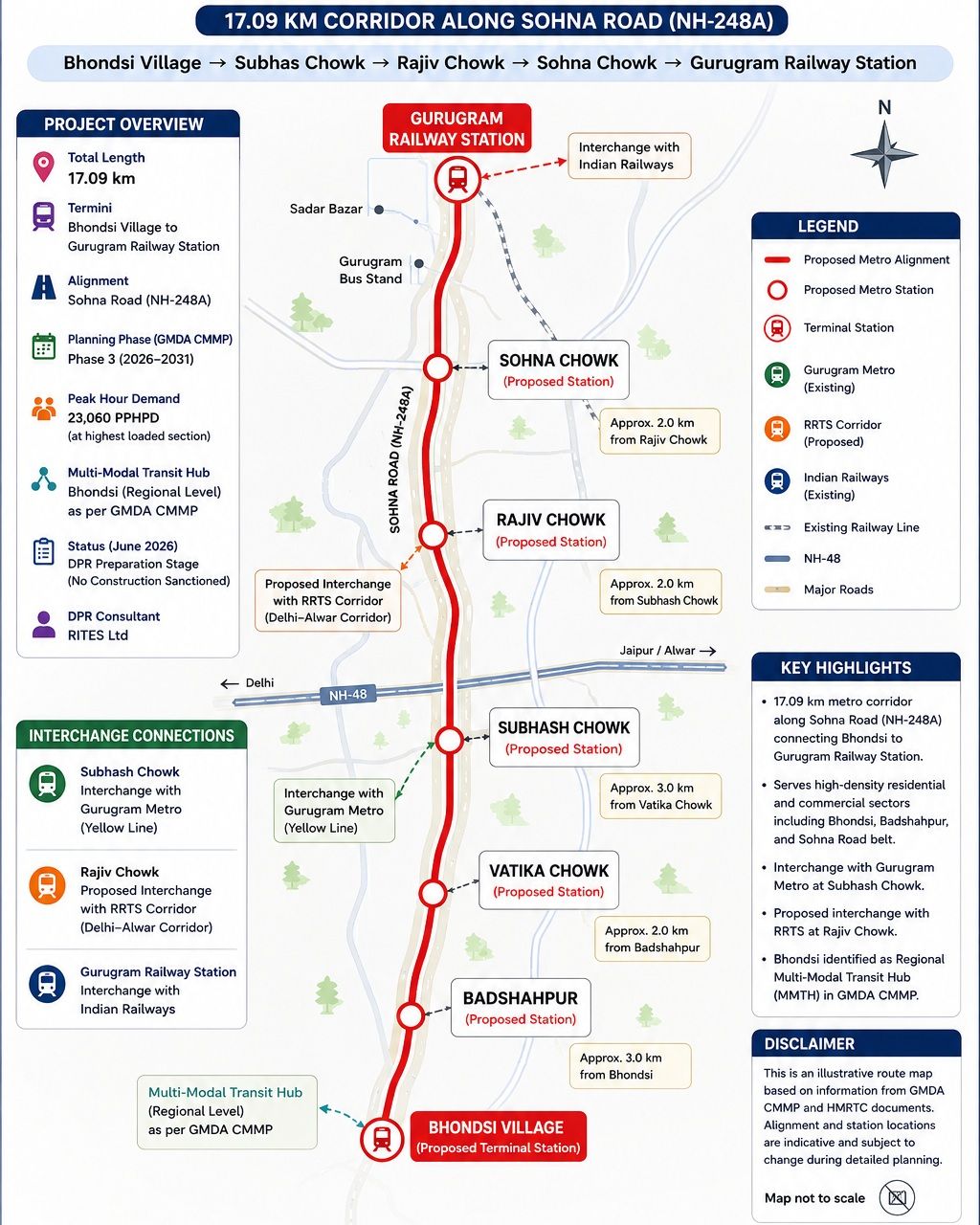
The CMMP classifies implementation phases as: Phase 1 (up to 2023), Phase 2 (2023–2026), and Phase 3 (2026–2031). The Bhondsi corridor falls in Phase 3. The CMMP further identifies Bhondsi area as one of five regional-level Multi-Modal Transit Hubs (MMTHs) — locations where regional and city-level transit lines are intended to converge.
The 17.09 km figure and the Bhondsi–Subhash Chowk–Rajiv Chowk–Sohna Chowk–Railway Station sequence that appears in all subsequent HMRTC board communications and tender documents traces directly to this CMMP.
The CMMP also established the planning rationale: a forecasted peak-hour mass transit demand of 2.32 lakh passenger trips with 61.5% modal share in the preferred scenario, and PPHPD loadings of 15,000 to 25,000 across various corridors — the Bhondsi corridor's 23,060 PPHPD sitting in this range, which the CMMP identifies as appropriate for mass transit systems including metro.
Why does this matter? The GMDA CMMP is an official government planning document. When GMDA Adviser Yash Sachdeva stated in August 2024 that the new corridors are "part of the authority's proposal to build a large metro network across the city by 2031," he was referring to a vision grounded in this CMMP — not to an informal target. The 2031 horizon is the CMMP's Phase 3 boundary, and the Bhondsi corridor was always a Phase 3 item in that document.
Sohna Road (NH 248A) stretches south from its junction with NH 48 near Rajiv Chowk toward the town of Sohna. Township development along this road accelerated through the 2010s across sectors from the Rajiv Chowk end down to Bhondsi. Despite this, for most Sohna Road residents the nearest metro station has remained Sector 55–56 on the Delhi Metro Yellow Line — accessible only after additional road travel.
The absence of rapid transit forces commuters onto the road network, where Subhash Chowk and Rajiv Chowk serve as major bottlenecks. The CMMP's ridership modelling — projecting 23,060 PPHPD on this corridor — reflects the scale of suppressed demand.
Old Gurugram — the railway station area, Sadar Bazar, and Sectors 4 to 9 — and the newer residential sectors on Sohna Road have historically been disconnected in public transport terms. The corridor's north-to-south alignment addresses this: it creates a transit spine linking the railway station at one end to Bhondsi at the other, with major intermediate junctions in between.
Three distinct transit networks are planned to connect to this corridor:
The GMRL Millennium City Centre to Cyber Hub metro at Subhash Chowk and the railway station area. The Delhi–Gurugram–Alwar RRTS at Rajiv Chowk. Indian Railways at Gurugram Railway Station.
No other proposed corridor in Gurugram's current pipeline offers this combination at a single alignment.
An HMRTC official stated in March 2025, as quoted by PropNewsTime: "The 17 km line will offer a seamless link from SPR to transit hubs. The interchanges with the metro, RRTS corridor and railway station will integrate regional and city travel."
GMDA Adviser Yash Sachdeva told Hindustan Times in August 2024 (widely reported): "These two routes cover the most densely populated areas of the city, along with key business districts. A large number of people will be connected once these routes become operational."
| Date | Event | Source |
|---|---|---|
| 2020 (Approx.) | GMDA CMMP published, placing the Bhondsi–Railway Station corridor in Phase 3 with a planned length of 17.09 km and a peak demand of 23,060 PPHPD. | GMDA CMMP, Table 0.6 (published on the GMDA website) |
| 6 August 2024 | HMRTC's 57th Board Meeting in Chandigarh, chaired by Chief Secretary TVSN Prasad, formally approved DPR preparation for two new Gurugram Metro corridors, including Bhondsi to Gurugram Railway Station. | HMRTC Official Communiqué; Metro Rail Today (20 August 2024) |
| August 2024 | GMDA Adviser Yash Sachdeva confirmed that the proposed corridors are part of the authority's plan to develop a comprehensive metro network by 2031. | Quoted in Hindustan Times; reported by multiple outlets |
| October 2024 | The DPR tender process was paused due to the Model Code of Conduct during the Haryana Assembly elections. | PropNewsTime (24 March 2025) |
| 19 March 2025 | HMRTC issued the DPR consultant tender (HMRTC/DPR/2025/20). The initial bid deadline was 22 April 2025, with a contract security of ₹3.29 crore and a contract period of 24 months. | Rail Analysis (25 March 2025, citing HMRTC Tender); TenderDetail.com |
| 17 April 2025 | Corrigendum issued extending the bid submission deadline. | TenderDetail.com (citing NIC eTenders) |
| 25 April 2025 | A second corrigendum revised the BOQ and changed the bid submission date to 28 April 2025. | TenderDetail.com (citing NIC eTenders) |
| May 2025 | A single bid from RITES Ltd. was received. Both technical and financial bids were opened, and HMRTC confirmed that the bid was under evaluation. | HMRTC Official Communiqué, as reported by Metro Rail Today |
| December 2025 | RITES Ltd. was reported to have been appointed as the DPR consultant. An appointment letter dated 4 December 2025 was cited by one outlet but has not been independently confirmed by HMRTC. | Multiple secondary reports; SKJ Landbase (March 2026) |
| January 2026 | RITES reportedly submitted a preliminary report covering project scope, study area, traffic analysis, alignment options, and the proposed work timeline. | SKJ Landbase (2 March 2026); date of 23 January 2026 reported by one source only |
| 25 January 2026 | GMDA CEO PC Meena chaired a review meeting with GMRL and HMRTC. GMRL stated the Bhondsi Metro could not be fully underground due to cost and land constraints, while HMRTC noted that combining an elevated metro with an elevated road may be impractical in some stretches. | PropNewsTime (25 January 2026) |
| 19 March 2026 | HMRTC's 64th Board Meeting, chaired by Chief Secretary Anurag Rastogi, reviewed DPR progress. The corridor was described as the 17.09 km Bhondsi–Subhash Chowk–Rajeev Chowk–Sohna Chowk–Railway Station line, with a standard gauge of 1,435 mm. | The Statesman (19 March 2026) |
| 22 June 2026 | RITES presented a tentative alignment to GMDA and discussed alternative route options. A senior GMRL official indicated that some sections of the corridor may need to be constructed underground. | NativePlanet (22 June 2026) |
Incorporated in 2012, HMRTC is the Haryana government's special purpose vehicle for planning and implementing mass rapid transit across the state. For this corridor, HMRTC is the current project authority: it approved DPR preparation, issued tender HMRTC/DPR/2025/20, and oversees the RITES engagement. Which agency ultimately executes construction will be determined only after the DPR is complete and government approvals are obtained.
Rail India Technical and Economic Service (RITES Ltd) is a Government of India enterprise under the Ministry of Railways. RITES was the sole bidder under HMRTC/DPR/2025/20 and was awarded the DPR consultancy covering both the Bhondsi corridor and the Golf Course Extension Road to Sector 5 corridor. The consultant fee of approximately Rs 14.1 million (for both corridors combined) is widely reported from media outlets citing HMRTC officials; it has not been confirmed from a published award document accessible to this research. RITES' scope covers traffic studies, geotechnical surveys, alignment evaluation, station design recommendations, ridership projections, and techno-economic feasibility.
Check this:- Delhi 55-kilometer Elevated Ring Road Corridor: Route, Cost, Status, Timeline and Property Impact
GMDA is the city-level planning body for Gurugram. It is not the implementing agency. GMDA's CMMP established the planning basis for this corridor. RITES has requested planning data from GMDA including road width and right-of-way details along the alignment, sector layout plans, and infrastructure project details. GMDA's CEO chaired a review meeting in January 2026 where both the metro and an associated elevated road on Old Railway Road were discussed.
A joint venture between the Government of India and Government of Haryana, incorporated February 2024, to implement the 28.5 km Millennium City Centre to Cyber Hub metro. GMRL is not the implementing agency for the Bhondsi corridor. However, GMRL's metro is planned to interchange with the Bhondsi corridor at two points, and GMRL officials have participated in planning discussions about the corridor's engineering, including the elevated vs underground debate.
Both must formally approve a metro project before construction can begin. The DPR forms the basis for these approvals. Neither has been obtained as of June 2026.
A Detailed Project Report is the foundational document that converts a planning-stage corridor into an approvable, fundable construction project. Readers unfamiliar with Indian metro planning processes should understand that before a DPR is completed, most specifics about a corridor remain provisional.
For this corridor, the RITES DPR is expected to determine:
Alignment: The precise route kilometre by kilometre, including any deviations from the Sohna Road median, entry into underground sections, and exit points.
Station locations and count: Exact station positions, names, and spacing — none of which have been officially confirmed for this corridor.
Construction type: Whether each section is elevated (on viaducts above road level) or underground, and the rationale for each decision based on right-of-way, cost, and engineering constraints.
Depot location: Where the maintenance depot will be built and how large an area it requires.
Ridership projections: Updated demand forecasts for the proposed opening year and horizon years, building on but going beyond the CMMP's 23,060 PPHPD figure.
Project cost: The first official cost estimate for this specific corridor. No such estimate exists today because alignment, station count, and construction type are unresolved.
Financial viability: Analysis of whether the project is economically justifiable on its own or requires viability gap funding, and under what funding model.
Environmental assessment: Preliminary environmental and social impact review.
Land acquisition requirements: Which land parcels, if any, need to be acquired or realigned to accommodate the metro.
Implementation schedule: Proposed construction phasing and timeline.
Until the DPR is published, every figure and detail in public circulation — including the nodes mentioned in this article — reflects the preliminary planning stage, not an engineered design.
The route described below follows the sequence established in the GMDA CMMP (the primary official planning document) and confirmed in HMRTC board communications. The August 2024 HMRTC board approval added Vatika Chowk, Sadar Bazar, and Gurugram Bus Stand to the sequence used in the CMMP; the March 2026 HMRTC 64th board meeting summary returned to the CMMP's original five-node description. The divergence is explained in a dedicated section below.
Because RITES is still finalising the alignment and has presented only tentative options to GMDA, this section discusses planning-stage nodes, not confirmed stations.
Bhondsi is a village in southern Gurugram, beyond Badshahpur on Sohna Road. The GMDA CMMP identifies Bhondsi area specifically as one of five regional-level Multi-Modal Transit Hubs in its 2041 plan — a recognition that this location sits at the convergence of multiple future transit and road network elements.
The locality currently has minimal metro-accessible transport. Residents rely on road-based services for all commuting. The Sohna Elevated Road (a 21.65 km NHAI access-controlled expressway fully opened in July 2022) has improved road connectivity toward Sohna, but does not substitute for a fixed-rail system.
A future extension from Bhondsi toward Sohna is under consideration, according to a ministerial statement reported by secondary sources. This would require a separate DPR and separate approvals; it is not part of the current project scope.
Why planners chose Bhondsi as the terminus: The CMMP identified it as the boundary between the city's developed fabric and its expanding fringe, as a regional MMTH site, and as a logical starting point for a line that follows the Sohna Road spine into the urban core.
Residential catchment: South Gurugram fringe sectors, Badshahpur belt, peri-urban development areas. Road access: NH 248A (Sohna Road), Sohna Elevated Road.
Subhash Chowk is one of Gurugram's most congested junctions, where Sohna Road meets the road network connecting to Sector 48, Sector 49, and the Huda City Centre area. The junction handles significant volumes of commuter traffic from residential zones on Sohna Road heading toward Cyber City and MG Road.
The planning significance of Subhash Chowk for the Bhondsi corridor is twofold. First, it is a major ridership catchment point in its own right, drawing from the densely populated Sectors 47 to 49 belt. Second, the GMRL Millennium City Centre to Cyber Hub metro — under construction — has a station planned at or near Subhash Chowk, making it one of two planned interchange points between the Bhondsi corridor and the GMRL network.
The GMDA CMMP, HMRTC board approvals, and the HMRTC 64th board meeting summary all consistently include Subhash Chowk in the route description — it is the most consistently confirmed intermediate node.
Why planners chose Subhash Chowk: High ridership catchment from Sectors 47–49; location of GMRL interchange; one of Sohna Road's worst congestion points, where a metro station would absorb the most commuter demand.
Residential and commercial catchment: Sectors 47, 48, 49; Central Park area; office complexes and retail zones on Sohna Road. Planned interchange: GMRL Millennium City Centre–Cyber Hub metro (proposed; under construction on the GMRL side).
Rajiv Chowk is the junction of Sohna Road with NH 48 (formerly NH 8) — the main Delhi–Gurugram expressway. It is one of the most strategically important road intersections in the NCR, handling daily commuter flows between Gurugram and Delhi.
For the metro, Rajiv Chowk is the planned interchange with the Delhi–Gurugram–Alwar RRTS, a 164 km semi-high-speed rail corridor being developed by NCRTC connecting Delhi, Gurugram, Rewari, Shahjahanpur–Neemrana–Behror, and Alwar. The RRTS interchange would allow Bhondsi corridor commuters to transfer to a regional rapid transit network serving the broader NCR.
Important qualification: The RRTS interchange at Rajiv Chowk is referenced consistently in HMRTC planning communications. NCRTC has not publicly confirmed a station at Rajiv Chowk on the Delhi–Gurugram–Alwar corridor. The interchange remains a planning intention from the HMRTC side only, pending NCRTC alignment decisions.
Why planners chose Rajiv Chowk: NH 48 junction is the logical point to connect a north-south Sohna Road line to a regional east-west transport system; the RRTS interchange potential is a major rationale for this corridor's network value.
Planned interchange: Delhi–Gurugram–Alwar RRTS (HMRTC planning intention; not confirmed by NCRTC).
Sohna Chowk appears in the GMDA CMMP's route description and in the HMRTC 64th board meeting summary. It is a junction on Sohna Road between Rajiv Chowk and the railway station area, connecting toward Old Gurugram's inner sectors.
Local context: Serves the transition zone between the commercial Rajiv Chowk area and the older residential and commercial fabric approaching the railway station.
These two nodes appear in the August 2024 HMRTC board approval (as reported across multiple media outlets) but are not in the CMMP's route description and do not appear in the March 2026 HMRTC 64th board meeting summary. Their appearance in early HMRTC communications may reflect a more detailed preliminary understanding of intermediate stops near the northern terminus.
Sadar Bazar is Old Gurugram's primary commercial zone — a dense, mixed-use area with narrow roads that present significant engineering challenges for elevated metro construction. The Gurugram Bus Stand is the city's main interstate bus terminal.
Whether these become confirmed stations, or whether the final DPR identifies different stopping points in this northern section, will emerge from RITES' alignment work.
Note on right-of-way: The northern section near Sadar Bazar and the bus stand involves some of the most constrained road widths on the entire corridor. This is the section where the elevated vs underground construction debate is most acute.
Gurugram Railway Station serves Indian Railways trains linking Gurugram to Delhi, Jaipur, and other destinations. As the northern terminus of the proposed metro corridor, it would create an integrated transit hub where metro, Indian Railways, and intercity bus services converge.
The GMRL Millennium City Centre to Cyber Hub metro also extends toward the railway station area, making this the second planned interchange between the Bhondsi corridor and the GMRL network. The exact interchange configuration — whether on the same platform, in an integrated concourse, or via a covered walkway — is a DPR-level design decision.
Why planners chose Gurugram Railway Station: The GMDA CMMP identified a regional-level MMTH at or near this location. Terminating here creates maximum multimodal integration: metro, GMRL metro, RRTS (via Rajiv Chowk transfer), Indian Railways, and bus services all connect within or near this zone.
Connectivity: Indian Railways, GMRL metro (planned interchange), Gurugram Bus Stand, local and intercity buses.
A reader comparing sources will find slightly different node lists:
The GMDA CMMP lists five nodes: Bhondsi – Subhash Chowk – Rajiv Chowk – Sohna Chowk – Railway Station.
The August 2024 HMRTC board approval adds Vatika Chowk, Sadar Bazar, and Gurugram Bus Stand.
The March 2025 DPR tender description (as reported by PropNewsTime citing HMRTC) adds Sector 4–7 Chowk and Railway Road.
The March 2026 HMRTC 64th board meeting summary returns to the CMMP's five-node sequence.
This variation is not a contradiction. The CMMP was a high-level planning document from around 2020. The August 2024 HMRTC board approval reflected more detailed preliminary thinking about intermediate stops. The 64th board meeting summary returned to the five-node CMMP description, likely because RITES' preliminary work is still evaluating intermediate station placement and a definitive list cannot yet be confirmed.
This article treats the CMMP's five-node sequence as the primary official description, notes the additional nodes from HMRTC board communications, and is explicit that the DPR will settle the final station list.
| Node | In GMDA CMMP | In Aug 2024 HMRTC Board | In Mar 2026 HMRTC 64th Board | Potential Interchange |
|---|---|---|---|---|
| Bhondsi | Yes (Terminus) | Yes (Terminus) | Yes (Terminus) | Regional MMTH (CMMP); future Sohna extension (under consideration) |
| Vatika Chowk / SPR | No | Yes | No | GMRL Sector 56–Panchgaon Spur (both under planning) |
| Subhash Chowk | Yes | Yes | Yes | GMRL Millennium City Centre–Cyber Hub Metro |
| Rajiv Chowk | Yes | Yes | Yes | Delhi–Gurugram–Alwar RRTS (NCRTC station unconfirmed) |
| Sohna Chowk | Yes | Yes | Yes | None confirmed |
| Sadar Bazar | No | Yes | No | None confirmed |
| Gurugram Bus Stand | No | Yes | No | Bus services |
| Gurugram Railway Station | Yes (Terminus) | Yes (Terminus) | Yes (Terminus) | Indian Railways; GMRL Metro interchange |
This 28.5 km metro loop — under construction as of 2026 — will connect Gurugram's older metro (at Millennium City Centre/HUDA City Centre) with the Cyber Hub area via a loop through Old Gurugram. Its Phase 1 civil work (Millennium City Centre to Sector 9, approximately 15 km) began in late 2025. The Bhondsi corridor is planned to interchange with it at Subhash Chowk and the railway station area, giving Sohna Road users access to the Cyber Hub and Millennium City Centre without changing to road transport.
The RRTS is a 164 km semi-high-speed corridor under development by NCRTC, eventually linking Delhi to Alwar through Gurugram and Rewari. The planned interchange at Rajiv Chowk would be the corridor's most significant regional connectivity point, allowing Bhondsi corridor users to access the broader NCR semi-high-speed network. The RRTS station location at Rajiv Chowk has not been confirmed by NCRTC.
The Gurugram Railway Station terminus provides rail connectivity to Delhi, Jaipur, and other destinations. Metro passengers would be able to transfer to national rail services without road travel.
No direct interchange is planned between the Bhondsi corridor and the Delhi Metro Yellow Line. The Yellow Line terminates at Millennium City Centre; connection would require a transfer via the GMRL metro at the railway station area or at Millennium City Centre.
This is the most technically consequential unresolved question about the corridor. Two contradictory positions from GMRL officials are on record:
January 25, 2026 (PropNewsTime, citing GMDA review meeting): "GMRL officials noted that the railway station Bhondsi metro cannot be constructed underground due to cost and land limitations, making an elevated corridor the only feasible option." HMRTC officials simultaneously noted that fitting both elevated metro and a proposed elevated road in the same narrow corridor "may be near-impossible in certain areas."
June 22, 2026 (NativePlanet, citing RITES alignment work): "Another senior official from Gurugram Metro Rail Limited said the Bhondsi-Railway Station corridor may need to be built underground because it passes through some of Gurugram's busiest roads."
These statements reflect active and unresolved internal debate. The DPR will determine the construction type for each section individually — it is possible that some sections will be elevated and others underground, as is common in metro projects that traverse both open roads and dense urban cores.
RITES has formally requested from GMDA road width and right-of-way data along the Bhondsi–Railway Station alignment. The corridor's southern sections — along the broader Sohna Road stretch — have more room for an elevated structure. The northern sections approaching Old Gurugram, Sadar Bazar, and the railway station involve considerably narrower carriageways where pier placement for elevated metro would reduce road capacity significantly.
GMDA is separately studying a proposed elevated road on Old Railway Road, approximately 7.4 km from Rajiv Chowk to near Atul Kataria Chowk, estimated at Rs 750 crore. This proposed road would partially share the same corridor as the metro in the northern section of the alignment. Fitting both structures in parallel has been acknowledged by agencies as a significant spatial challenge, with the Bhondsi metro corridor and the GMRL metro corridor also potentially sharing a depot at Sector 33.
To prepare the DPR, RITES has formally asked GMDA for road width and right-of-way plans along the alignment, sector layout plans for Sectors 62 to 67A, revenue maps of Sector 66, details of planned infrastructure works (cloverleaf at Vatika Chowk, elevated road from Vatika Chowk to Kherki Daula, flyover from Ghata village to Vatika Chowk, underpass at Bakhtawar Chowk), and right-of-way details for the Bhondsi–Railway Station and Golf Course Extension Road–Sector 5 corridors. These data requests confirm that the DPR is still in its data-gathering phase as of June 2026.
The GMDA CMMP — the primary planning document — projects a peak-hour peak-direction demand of 23,060 passengers per hour (PPHPD) on the highest-loaded section of the Bhondsi–Railway Station corridor. This projection was made for the 2041 horizon year and was based on the CMMP's transport modelling assumptions.
For context, the CMMP set a PPHPDT threshold of 15,000 to 25,000 for justifying mass transit systems including metro or light metro. The Bhondsi corridor at 23,060 sits within the upper range of this justification threshold, supporting the case for full metro rather than a lighter system.
No updated ridership projections for the corridor have been published. Official DPR-based ridership figures will be produced by RITES as part of the DPR.
Several media reports have cited a figure of Rs 5,452 crore in connection with metro work in Gurugram. Cross-checking reveals this figure refers to the GMRL Millennium City Centre to Cyber Hub loop (the Old Gurugram metro), not the Bhondsi corridor. No DPR-based or officially published cost estimate exists specifically for the Bhondsi to Gurugram Railway Station corridor.
The reason is structural: project cost depends on decisions that have not yet been made. The alignment is not finalised. The station count is not finalised. Whether sections are elevated or underground — the single biggest determinant of cost per kilometre — is not finalised. RITES' DPR will produce the first authoritative cost estimate once these variables are settled.
Important: The DPR for this corridor has not been completed. No construction has been sanctioned. Planning-stage announcements can affect buyer sentiment but do not guarantee price appreciation. This section describes the existing market context of areas along the proposed route and does not forecast returns or recommend property investment decisions.
Sohna Road (NH 248A) is a mature and active residential market with a range of supply across segments. The Sohna Elevated Road, fully opened in July 2022, reduced road travel time to Sohna and stimulated further development in the southern part of the belt. The corridor passes through, or adjacent to, several distinct micro-markets.
This zone is at the outer edge of Gurugram's developed residential market. Land use is mixed: village settlement, institutional uses, and some residential development. Developers active in nearby South Gurugram include Signature Global (Daxin project, a 125-acre township) and smaller builders in the Badshahpur belt. The market is generally positioned in the affordable to mid-segment range. Infrastructure announcements at the planning stage attract attention in fringe zones, but buyer activity typically follows construction progress rather than DPR announcements.
Sector 48 is one of the more established residential sectors on Sohna Road. It is connected to both Golf Course Extension Road (via the SPR link) and the broader Sohna Road spine. Developers with projects in this belt include Godrej, Elan, and Experion. Sector 49 also carries demand from corporate professionals given its proximity to SPR and the broader corridor leading to Golf Course Extension Road employment hubs.
Major hospitals near this belt include Medanta The Medicity (Sector 38), Artemis Hospital (Sector 51), and Fortis Memorial Research Institute (Sector 44). Schools in catchment include GD Goenka World School, Ryan International School, and DPS International.
A metro station at or near Subhash Chowk — one of the most consistently confirmed nodes across all planning documents — would improve transit access for residents in Sectors 47 to 49 who currently commute by road.
Sectors 65, 66, 67, 68, 69, and 70 sit within the SPR and Golf Course Extension Road influence zone. Vatika Chowk — a possible interchange node (mentioned in August 2024 HMRTC communications but absent from the CMMP route description) — lies at the boundary of this belt and Sohna Road. Developers active in this zone include M3M, Godrej, and Signature Global.
This belt's real estate dynamic is influenced by its access to both SPR and Golf Course Extension Road as much as by Sohna Road itself. A confirmed metro node at or near Vatika Chowk would materially improve transit options; however, whether Vatika Chowk will be a station on the Bhondsi corridor has not been confirmed by the DPR.
Old Gurugram's Sectors 4–9 and the Sadar Bazar area are primarily commercial and mixed-use with older residential stock. The railway station terminus would give this dense area its first metro access. The practical effect on the market would depend on station entrances and access routes, which are DPR-level decisions.
No. HMRTC's 57th board meeting approved preparation of a DPR — a study, not a construction sanction. Construction requires a completed DPR, Haryana Cabinet sanction, and Union Ministry of Housing and Urban Affairs approval. None of these had been obtained as of June 2026.
The GMDA Comprehensive Mobility Management Plan for the Gurugram Manesar Urban Complex (CMMP), prepared by the School of Planning and Architecture, Delhi. The CMMP placed this corridor at 17.09 km as a Phase 3 priority with a projected demand of 23,060 PPHPD.
17.09 km, as stated in both the GMDA CMMP and the HMRTC tender document (HMRTC/DPR/2025/20).
The GMDA CMMP describes it as: Bhondsi village – Subhash Chowk – Rajiv Chowk – Sohna Chowk – Railway Station. The HMRTC 64th board meeting (March 2026) used the same sequence. The August 2024 board approval additionally mentioned Vatika Chowk, Sadar Bazar, and Gurugram Bus Stand; these have not been confirmed in the DPR.
No official station count has been published. This will be a primary output of the RITES DPR.
Unresolved as of June 2026. Officials from GMRL stated in January 2026 that the corridor cannot be built underground due to cost and land constraints. The same officials were reported in June 2026 as suggesting underground sections may be needed. The DPR will determine construction type section by section.
No. The Rs 5,452 crore figure that appears in some reporting refers to the GMRL Millennium City Centre to Cyber Hub metro, not this corridor. The Bhondsi corridor's cost cannot be estimated until alignment, station count, and construction type are finalised through the DPR.
The GMDA CMMP — the primary planning document — projects 23,060 PPHPD on the highest-loaded section for the 2041 horizon year. No DPR-based ridership projection has been published; that will be produced by RITES.
No construction timeline exists. The DPR is still being prepared. After it is complete, state and central approvals are required. A realistic construction start is several years away at minimum.
The executing agency will be determined after DPR completion and government approvals. HMRTC is the current project authority.
No. The RRTS interchange at Rajiv Chowk is referenced in HMRTC communications as a planning intention. NCRTC has not publicly confirmed a station at that location.
Tender reference HMRTC/DPR/2025/20 covers DPR preparation for two corridors: Railway Station–Bhondsi (17.09 km) and Sector 5–Golf Course Extension Road (13.60 km). The contract period is 24 months. The scope includes surveys, geotechnical investigation, alignment evaluation, station design recommendations, ridership projections, financial viability, environmental assessment, and land acquisition mapping.
The primary source is HMRTC's official website (hmrtc.org.in). HMRTC tender documents are published on the NIC eTenders portal. The Statesman (Chandigarh edition), Metro Rail Today, PropNewsTime, and Rail Analysis have published the most consistent and detailed secondary reporting on this project.
Contact Us
Fill out this form
& we'll get back
to you
Recommended for you