Market Trends
Delhi 55-kilometer Elevated Ring Road Corridor: Route, Cost, Status, Timeline and Property Impact
29 Jun 2026
Market Trends
29 Jun 2026
Content
No Blogs content found
It looks like there haven’t been any blogs yet!
Delhi is planning one of its biggest road infrastructure projects in decades — a proposed 55 km double-decker corridor above the existing Ring Road. If completed, it could reduce travel time by up to 40%, improve connectivity across North, Central and South Delhi, and influence property markets in several established micro-markets.
Because the proposed corridor passes through several of Delhi's busiest residential and commercial districts, it has become a key point of interest for commuters, businesses, homebuyers, and investors alike. For anyone with a stake in property or daily commutes along this stretch — from Azadpur and Netaji Subhash Place to Rajouri Garden and the DND approach — understanding exactly what's approved, what's still on paper, and what the real cost and timeline look like is essential before making any decision.
One clarification before we go further: This project (the Mahatma Gandhi Road / Ring Road elevated double-decker corridor) is separate from Delhi's four standalone double-decker metro-cum-road flyovers planned under Metro Phase IV (Bhajanpura, Saket, Madhuban Chowk, Peera Garhi) and from the Mehrauli-Badarpur Road double-decker package. This article covers only the 55-km Ring Road corridor project.
| Parameter | Details | Status |
|---|---|---|
| Project Type | Elevated double-decker corridor built above an existing at-grade road | Confirmed |
| Total Length | 55 km, above the Mahatma Gandhi Road / Ring Road loop | Confirmed |
| Total Phases (Structural Division) | 6 | Confirmed |
| Current Stage | Phase 1 approved; DPR for full corridor submitted and under review | Approved (Phase 1 only) |
| Implementing Agency | Public Works Department (PWD), Govt. of NCT of Delhi | Confirmed |
| DPR Consultant | AECOM India Pvt. Ltd. | Confirmed |
| Estimated Cost (Latest) | ₹12,000 crore | Approved figure, June 2026 |
| Phase 1 Length | ~25 km, made up of 3 packages (already cleared) | Approved |
| River Crossings | 2 new Yamuna bridges (Chandgi Ram Akhara; Lohe Ka Pul / Iron Bridge) | Approved as part of Phase 1 |
| Interchanges (Planned) | 15 | Per project blueprint |
| Access Points (Planned) | 23 | Per project blueprint |
| Metro Integration | Linked with Metro stations and transport hubs along the route; not a metro-carrying deck | Planned |
| Expected Travel Time Savings | Up to 40% | Government projection, not yet verified |
| Construction Start | Targeted end of 2026, after DPR finalisation | Stated target, unconfirmed |
Delhi's Ring Road system carries a traffic load the city's flat road network can no longer absorb. During rush hours, it can take up to two hours to cover 30 km on certain corridors. Delhi had over 8.41 million registered vehicles as of the most recent official count (2024), with two-wheelers and cars together making up 92% of that fleet — and more than 700,000 new vehicles were added in 2024 alone.
Older but widely cited CRRI-linked research found that Delhi's congestion roughly doubled over an eight-to-ten-year stretch, with millions of productive hours and significant fuel value lost annually to gridlock. The same research argued that widening the Ring Road was the only road-level fix available — because the city had largely run out of room to expand horizontally.
This is the underlying logic for going vertical: Delhi can't expand its road footprint much further in a dense, already-built city, so PWD's approach is to add a second deck rather than acquire new land. CRRI experts quoted in recent reporting echo this — calling the project technically demanding but necessary precisely because horizontal expansion isn't realistic on these stretches anymore.
The corridor begins at Azadpur Flyover, travels east toward Kashmere Gate, crosses the Yamuna near Chandgi Ram Akhara, continues past ISBT and ITO to the DND Flyway, then loops west toward Moti Bagh, Rajouri Garden, Pitampura, Netaji Subhash Place, and finally reconnects at Azadpur — a full 55-km loop above the existing Ring Road.
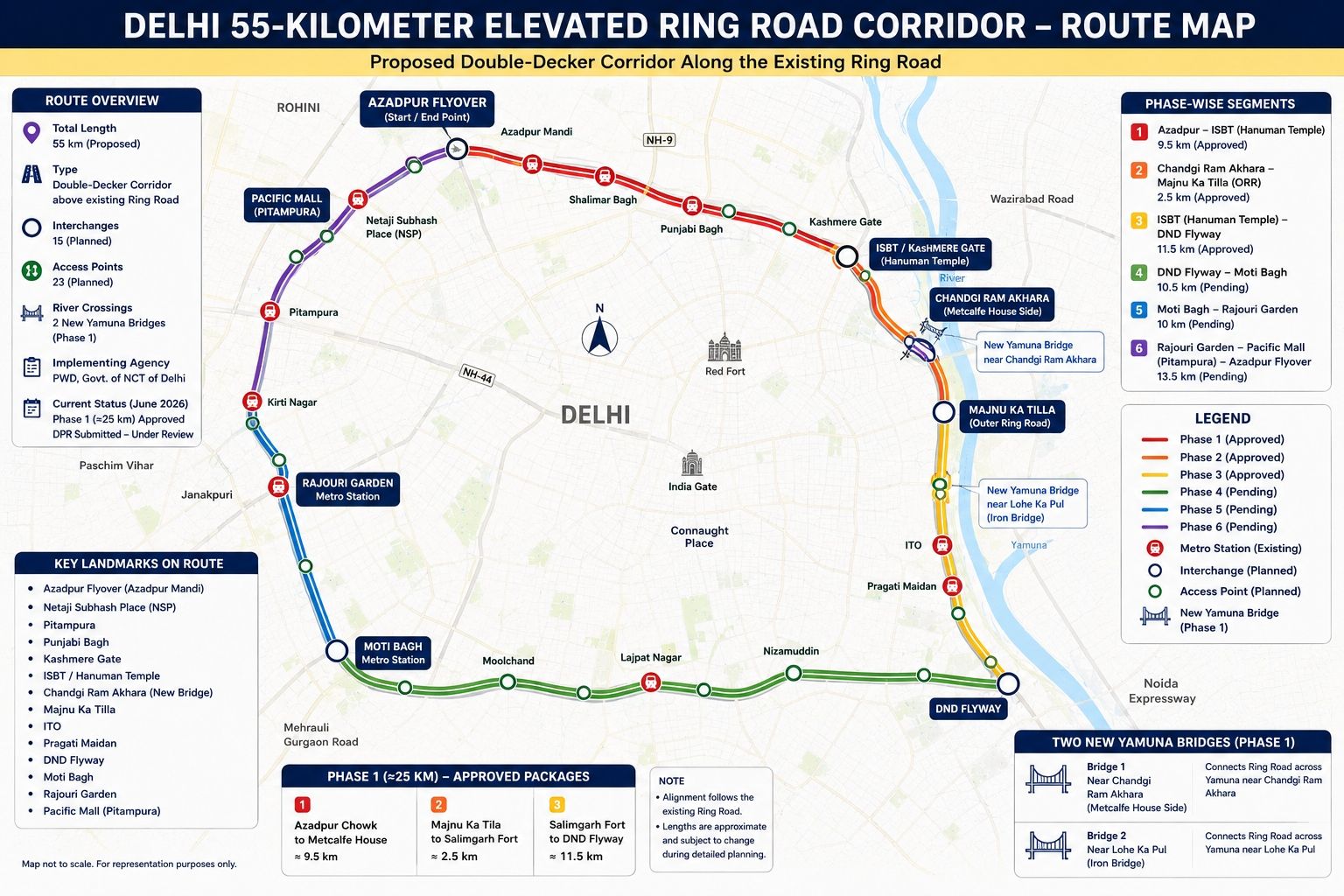
Structurally, it is divided into six phases:
| Segment | Approx. Length | Metro/Landmark Context | Phase Status |
|---|---|---|---|
| Azadpur Flyover (Mandi) – Hanuman Temple (ISBT) | 9.5 km | Azadpur Metro; Azadpur Mandi | Phase 1 — Approved |
| Chandgi Ram Akhara – Majnu Ka Tilla (Outer Ring Road) | 2.5 km | New Yamuna bridge here | Phase 1 — Approved |
| Hanuman Temple (ISBT) – DND Flyover | 11.5 km | Kashmere Gate, ITO vicinity | Phase 1 — Approved |
| DND Flyover – Moti Bagh Metro Station | 10.5 km | Moti Bagh Metro | Later Phase — Pending |
| Moti Bagh Metro Station – Rajouri Garden | 10 km | Rajouri Garden Metro | Later Phase — Pending |
| Rajouri Garden – Pacific Mall (Pitampura) – Azadpur Flyover | 13.5 km | NSP, Pitampura | Later Phase — Pending, closes loop |
Also Read this:- Shiv Murti to Nelson Mandela Marg Tunnel: Route, Cost, Timeline, Benefits & Impact on Delhi Gurugram Travel
Phase 1 (approved, ~25 km) breaks down into three specific packages:
The core concept: an additional road level is built directly above the existing Ring Road carriageway, largely within the current footprint, rather than acquiring new land alongside it.
Note: PWD has not published project-level engineering specifications. Engineering details below are based on comparable Indian elevated corridor projects and confirmed design elements where available. Nothing in this section should be read as confirmed specifics for this corridor.
Confirmed design elements:
Environmental and structural studies (confirmed): AECOM India has been tasked with topographical and environmental-impact assessments alongside core structural design, folded into the DPR.
| Date | Milestone | Status |
|---|---|---|
| June 2025 | Project formally announced under Delhi's city decongestion plan; six phases outlined; cost cited at ₹7,000 crore. | Announced |
| July 2025 | A separate contemporaneous report described a ₹6,000 crore, toll-based variant of the elevated corridor proposal (~80 km including loops/ramps); PWD directed to fast-track consultant appointment. | Reported — Possibly an early/alternate framing of the same plan |
| November 2025 | PWD formally launched redevelopment; AECOM India appointed for DPR across all six phases; 24-week DPR timeline set. | DPR Commissioned |
| April 2026 | DPR submitted by consultants and placed under government review; cost still cited at ₹7,000 crore in most coverage. | DPR Under Review |
| June 19–21, 2026 | Delhi Government approved the project; Phase 1 (3 packages, ~25 km) cleared; cost revised to ₹12,000 crore; two new Yamuna bridges confirmed. | Phase 1 Approved |
| End of 2026 (Target) | Construction expected to begin on Phase 1. | Targeted, Unconfirmed |
| Not Yet Announced | Start dates for the remaining phases. | Pending |
The cited cost moved from ₹6,000 crore (mid-2025) to ₹7,000 crore (late 2025/early 2026) to ₹12,000 crore at the June 2026 Phase 1 approval. None of the available sources explain this escalation explicitly, but a few plausible drivers stand out:
Check this:- Delhi Metro Phase V(B): 7 New Corridors, 65 Stations, Cost, Timeline and Route Details
| Project | Length | Cost | Status (Mid-2026) | Real Estate Impact Observed |
|---|---|---|---|---|
| Delhi Ring Road Double-Decker Corridor | 55 km | ₹12,000 crore (latest) | Phase 1 (25 km) approved; construction not started | Too early — unbuilt |
| Dwarka Expressway | 29 km | ~₹4,100 crore (Haryana segment) | Operational | Prices rose roughly 3.5× between 2020 and 2025, from ~₹6,300/sq ft to ₹21,700–24,000/sq ft. |
| Delhi–Meerut Expressway | ~96 km | — | Operational | Indirapuram saw ~73% price growth over four years, partly attributed to the expressway and the RRTS corridor. |
| Delhi–Dehradun Expressway | 213 km | ₹12,000 crore | Operational (April 2026) | Experts project 15–25% appreciation in key micro-markets over 18–24 months after opening. |
| Bengaluru Elevated Corridors (11-Corridor Package) | 75.6 km | ₹13,262 crore | Cabinet-approved (April 2026); construction not yet started | Too early — unbuilt; comparable approval-to-construction timeline to Delhi's project. |
| Santacruz–Chembur Link Road, Mumbai (India's first double-decker flyover) | 6.45 km | ₹454 crore | Operational since 2014 | Handles over 75,000 vehicles daily; travel time reduced from 60–90 minutes to 15–20 minutes. |
Mumbai's SCLR is the closest direct double-decker precedent in India, but it still took over 11 years to complete — delayed by land acquisition disputes, utility shifting complexity, engineering revisions, and litigation that collectively pushed the project well past its original schedule. Delhi's corridor is nearly nine times longer. That context matters, but it also doesn't mean Delhi will automatically repeat the same pattern: Delhi's project is built above an existing road with minimal land acquisition required, which removes one of the biggest delay factors that hobbled Mumbai's SCLR. Bengaluru's 11-corridor package, approved around the same time as Delhi's Phase 1, offers a useful live parallel in terms of scale and pre-construction uncertainty.
On the real estate side, genuine large appreciation in comparable Delhi-NCR corridors has historically materialised over a multi-year horizon after substantial construction progress — not at the announcement or DPR stage.
The single most useful distinction for property decisions is when a location's benefit is likely to arrive — not just whether it sits "on the corridor."
Phase 1 beneficiaries (approved, construction expected first):
Long-term beneficiaries (later phases, unapproved, no confirmed timeline):
These areas sit on parts of the loop with no approved start date. Their benefit timing depends entirely on whether and when those phases get approved — which could be years away, or could stall indefinitely.
Based on comparable corridors, announcement-stage appreciation has historically been limited. The strongest price movement typically occurs after visible construction progress and before commissioning — not at approval or DPR stage.
The corridor's residential influence zone covers established North and West Delhi neighbourhoods — largely built out, with limited new land supply, meaning demand shifts are more likely to show up as price appreciation on existing stock than as a wave of new launches. Buyers along Phase 1 stretches should factor in years of construction-adjacent disruption before any connectivity benefit materialises.
Check this:- Shastri Park to Mayur Vihar Phase 3 Metro Route Map, Cost, Timeline and Benefits
| Metric | Figure |
|---|---|
| Premium Office Rent | ₹90–180/sq ft/month |
| Standard Office Rent | ₹60–120/sq ft/month |
| Connectivity | Outer Ring Road; Red–Pink Metro interchange |
| Investment Outlook | Incremental gains likely; mature market with limited new supply |
NSP is already North Delhi's most established commercial hub, anchored by the Metro Station (Red-Pink Line interchange). It draws IT/ITES firms, BPO and back-office operations, consultancies, and SME corporates — businesses that need a professional, well-connected address without paying Connaught Place or Gurgaon rents.
NSP vs. Connaught Place: CP remains Delhi's prestige CBD, commanding higher rents and attracting legal, government-adjacent, and heritage-brand corporates. NSP competes on value: comparable Metro connectivity, substantially lower rent, and a more IT/ITES-oriented tenant base.
NSP vs. Gurugram: Gurugram's Cyber City and Golf Course Road corridors offer larger Grade A campuses and a denser concentration of MNC headquarters and GCCs, but at a real commute cost for North and West Delhi-based talent. NSP's pitch is the reverse: smaller-format flexible office stock, shorter commutes for North Delhi residents, and meaningfully lower occupancy costs — better suited to SMEs and mid-sized teams than large campuses.
Grade A vs. Grade B stock: NSP's commercial stock is a mix — modern twin-tower developments like Aggarwal Cyber Plaza and PP Towers offer Grade A-adjacent specifications, while a larger share of older buildings sit in the Grade B range. This is why NSP's rent range is wide (₹60–180/sq ft/month) rather than a tight band.
Why hasn't NSP grown as fast as Gurgaon? Primarily because Gurgaon had an enormous advantage in undeveloped land — it could build large-format campuses from scratch in the 2000s and 2010s while Delhi's established zones like NSP had little room for greenfield development. NSP's stock grew incrementally within an already-dense built environment, which naturally limits the scale of new supply and attracts a different, typically smaller-format occupier profile. Road-level congestion has been the other consistent drag — repeatedly flagged by businesses as NSP's most persistent weak point, and directly relevant to what this corridor is designed to address.
Is connectivity the current bottleneck? Yes — NSP's Metro connectivity is already a genuine strength, but road-level congestion at peak hours is the recurring weak point cited by businesses and commuters. This is precisely the kind of constraint the double-decker corridor is designed to address, which is why NSP is reasonably positioned to benefit if and when its phase of the corridor is approved and built — though that remains a later, unapproved phase.
Known as Delhi's "steel hub," Wazirpur Industrial Area hosts over 2,000 industrial units, increasingly mixed with corporate offices and showrooms. The area is undergoing separate internal infrastructure upgrades independent of the Ring Road project. Its gradual shift toward a mixed industrial-commercial zone, combined with potential freight gains from the corridor, makes it a longer-horizon redevelopment play rather than a near-term residential investment.
Home to Asia's largest wholesale fruit and vegetable market and a key Metro/rail interchange point. Azadpur marks the starting point of multiple Phase 1 packages, making it one of the first areas to see construction activity. Benefits accrue mainly to logistics and wholesale trade.
| Metric | Figure |
|---|---|
| Average Price per sq ft | ₹9,950–15,000 |
| Monthly Rent Range | ₹14,000–45,000 |
| Investment Outlook | Stable, end-user-driven; unlikely to see speculative repricing on announcement alone |
| Metric | Figure |
|---|---|
| Average Flat Rate | ₹11,100–14,100/sq ft |
| Affordable Sectors | Sectors 16, 34, Narela, Burari (~₹8,000/sq ft) |
| Upscale Sectors | Sectors 9, 13, 14 |
| Recent 1-Year Appreciation | ~13.3% (broader Delhi market trend, not corridor-specific) |
Rohini's scale and sector diversity mean any corridor-driven uplift will likely be sector-specific rather than market-wide.
| Metric | Figure |
|---|---|
| Average Flat Rate | ₹13,450–19,850/sq ft |
| Builder Floor 1-Year Change | ~+5.3% |
| Phase Relevance | Later phase (Moti Bagh–Rajouri Garden); unapproved, further out |
| Area | Current Price Range | Investment Outlook |
|---|---|---|
| Netaji Subhash Place (Office) | ₹60–180/sq ft/month rent | Incremental gains; mature market |
| Wazirpur | Mixed industrial/commercial pricing | Long-horizon redevelopment play |
| Shalimar Bagh | ₹9,950–15,000/sq ft | Stable, end-user driven |
| Rohini | ₹11,100–14,100/sq ft | Sector-specific gains likely |
| Punjabi Bagh | ₹13,450–19,850/sq ft | Later-phase, longer horizon |
| Area | Short-Term (0–18 Months) | Long-Term (3–5+ Years) |
|---|---|---|
| Azadpur, Majnu Ka Tilla, Salimgarh Fort (Phase 1) | Construction disruption; limited price movement | Genuine connectivity upside once complete |
| NSP, Wazirpur | Largely unaffected near-term | Freight and commercial efficiency gains over time |
| Rohini, Shalimar Bagh, Punjabi Bagh | No direct near-term impact | Depends entirely on later-phase approval timing |
End users (residential): Treat this as a long-term structural positive for the corridor, not a reason for urgent action — especially in Phase 1 areas, which will see years of construction disruption first.
Commercial buyers: NSP and Wazirpur-adjacent commercial assets are reasonable medium-term considerations given existing maturity and direct corridor proximity, but factor in construction-phase disruption to footfall and access.
Investors (capital appreciation focused): The more reliable signal isn't this approval news itself, but visible tender awards, ground-breaking, and Phase 1 progress reports over the next 12–18 months. Comparable corridors show the bulk of appreciation arrives after, not before, construction is visibly underway.
Retail shop owners/lessees: Footfall-dependent retail near Phase 1 construction zones should expect temporary disruption before any connectivity-driven footfall increase.
Warehousing/logistics operators: Wazirpur and Azadpur-adjacent logistics operations are well-positioned for freight-efficiency gains once the corridor is operational — though on a multi-year horizon.
| Time Horizon | Outlook |
|---|---|
| 0–2 Years | Construction disruption is likely to outweigh any gains in Phase 1 areas. Later-phase locations (NSP, Rajouri Garden, Punjabi Bagh, and Moti Bagh) are unlikely to see direct project impact because those phases have not yet been approved. |
| 3–5 Years | If Phase 1 remains broadly on schedule, connectivity benefits in the Azadpur–DND corridor should begin to emerge. This period should also provide greater clarity on whether later phases receive approval or face further delays. |
| 5–10 Years | There is potential for sustained appreciation across the full corridor if all phases are completed. However, this outcome depends heavily on timely approvals and disciplined project execution, as a significant portion of the corridor remains unapproved. |
An elevated road corridor being built directly above the existing Mahatma Gandhi Road (Ring Road), creating a two-level system where long-distance traffic uses the upper deck and local traffic continues on the existing ground-level road.
The name refers to the road structure itself, not a Metro line. The project adds a second, elevated road level directly above the existing Ring Road. This is a common point of confusion because Delhi separately has four standalone double-decker structures under Metro Phase IV that do carry Metro rail on their upper deck — but this 55-km Ring Road project is road-only on both levels.
Phase 1 (~25 km, three packages) was approved by the Delhi Government in June 2026, with Chief Minister Rekha Gupta's sign-off reported alongside the clearance. The remaining phases are not yet approved and have no confirmed timeline.
No. As of late June 2026, the DPR is under technical review and construction is only a stated target for "end of 2026" on Phase 1 — not a confirmed start date.
It follows the existing 55-km Ring Road loop across six phases: Azadpur–Hanuman Temple (ISBT), Chandgi Ram Akhara–Majnu Ka Tilla, Hanuman Temple–DND Flyover, DND Flyover–Moti Bagh, Moti Bagh–Rajouri Garden, and Rajouri Garden–Azadpur (via Pitampura).
The latest figure, tied to the June 2026 Phase 1 approval, is ₹12,000 crore — up from ₹6,000–7,000 crore reported through 2025 and early 2026.
Some appreciation over time in directly affected micro-markets is plausible, based on comparable corridors. But significant price movement has historically taken several years and tracked actual construction progress — not the announcement or DPR stage this project is currently at.
PWD officials have indicated Phase 1 construction could begin by the end of 2026, once the DPR is fully finalised. This is a stated target, not a contractually committed date.
No official completion date exists for either Phase 1 or the full corridor. With the later phases lacking approved timelines, full-corridor completion is likely several years out at minimum.
Two — one near Chandgi Ram Akhara (close to Metcalfe House) and one near Lohe Ka Pul (Iron Bridge), both part of the approved Phase 1 scope.
Cost escalation (already nearly doubled within about a year), utility-shifting complexity in dense commercial zones, environmental clearance near the Yamuna floodplain, and technical conflicts with existing Metro infrastructure on phases beyond Phase 1.
That depends on your time horizon and risk tolerance. Comparable projects suggest waiting for visible construction progress — not just approval news — typically leads to better-timed entry, since most appreciation in similar corridors has historically come after, not before, ground-breaking.
The PWD Delhi web portal (pwddelhi.gov.in) is the primary official source, though it doesn't yet carry a dedicated public project page for this corridor. Official PWD/Delhi government press statements remain the most reliable update source.
Contact Us
Fill out this form
& we'll get back
to you
Recommended for you