Investments
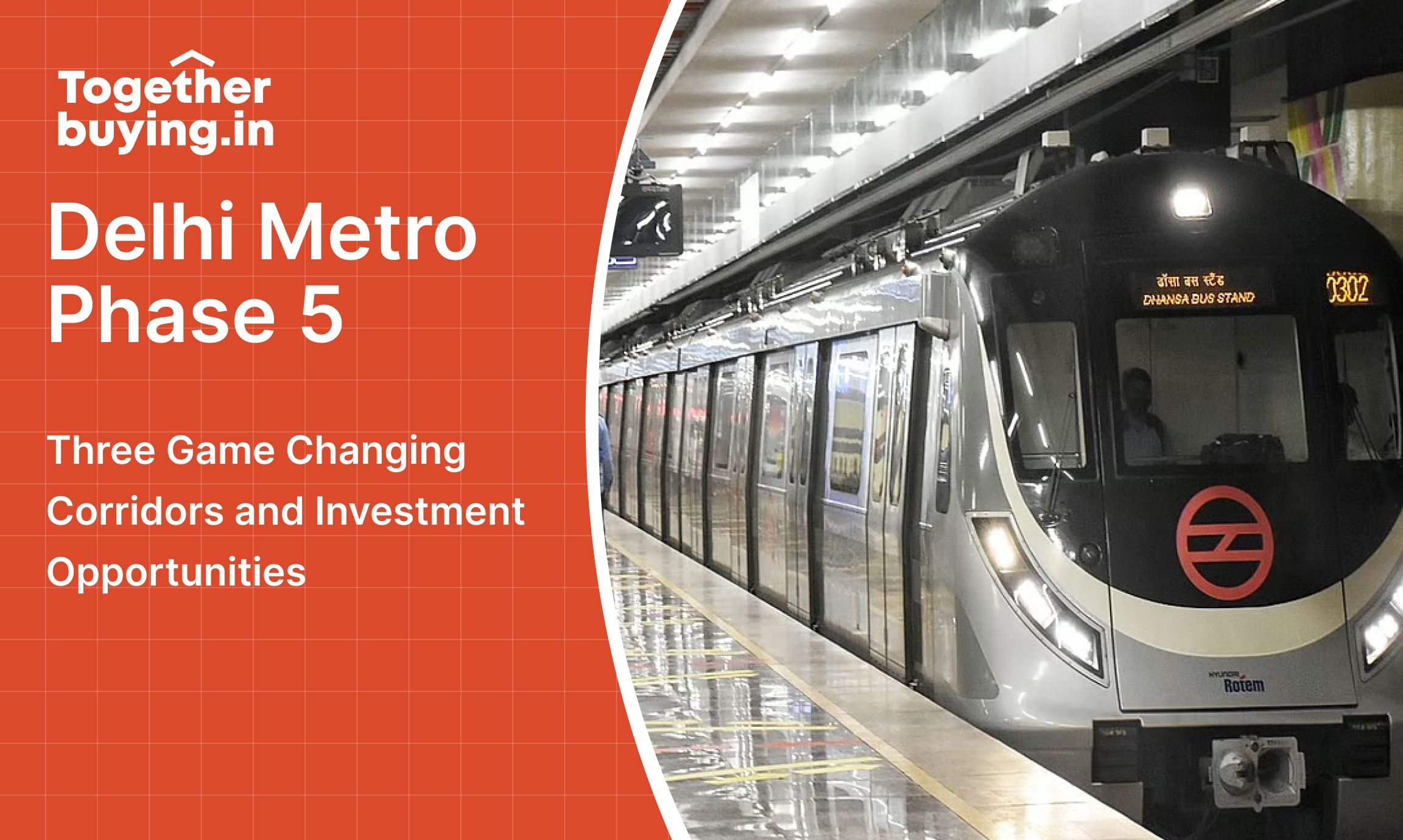
Delhi Metro Phase 5: Three Game Changing Corridors and Investment Opportunities
09 May 2026
Investments
09 May 2026
Content
No Blogs content found
It looks like there haven’t been any blogs yet!
On December 24, 2025, the Union Cabinet chaired by Prime Minister Narendra Modi approved one of the most significant urban transit expansions in India's history. The approval of three new Delhi Metro corridors under Phase 5A marks a transformational moment for the nation's capital. This Rs 12,014.91 crore project will add 16.076 kilometers of new metro lines, creating 13 additional stations across three strategically important corridors.
Delhi's metro network, already the third largest in the world after China and the USA, will soon exceed 400 kilometers of track. More importantly for investors and commuters, Phase 5A will connect three previously underserved regions: Central Vista's government district, the airport area, and South Delhi's residential zones. These three corridors represent far more than transportation infrastructure. They are catalysts for urban transformation, commercial growth, and real estate appreciation across Delhi.
This comprehensive analysis examines each of the three Phase 5A corridors, their investment implications, and the opportunities they create for property buyers, investors, and businesses across the National Capital Region.
Cabinet Decision: December 24, 2025
The Union Cabinet gave formal approval to the Delhi Metro Phase 5A project, marking the official commencement of one of India's largest metro expansion initiatives. The project was developed by the Delhi Metro Rail Corporation in consultation with the Government of Delhi and has been designated as a priority infrastructure project under India's sustainable urban mobility agenda.
Total Project Cost: Rs 12,014.91 Crore
The substantial investment reflects the scale and complexity of the project. Funding will come from three sources: the Government of India, the Government of Delhi, and international funding agencies including multilateral development banks. This tri-partite funding structure ensures long term financial commitment and reduces dependence on single sources.
Total Network Addition: 16.076 Kilometers
The three corridors will collectively add 16.076 kilometers to Delhi's metro network, bringing the total length to approximately 410 kilometers. This represents a significant expansion that will increase the metro's coverage and reach into previously underconnected parts of the city.
Number of New Stations: 13 (10 Underground, 3 Elevated)
The distribution of underground and elevated stations reflects careful urban planning considerations. Underground stations minimize surface level disruption in congested areas, while elevated sections allow for faster construction and lower environmental impact in less densely developed regions.
Expected Completion Timeline: 3 Years (Late 2028)
Construction is expected to commence in 2026 with phased completion by late 2028. This aggressive timeline is achievable through parallel construction on multiple sections and advanced project management techniques that have been successfully employed in previous Delhi Metro phases.
Expected Daily Ridership: Over 10 Lakh Passengers
Conservative estimates suggest that once operational, Phase 5A will attract over 10 lakh (1 million) daily passengers. The R.K. Ashram Marg to Indraprastha corridor alone is expected to serve 60,000 government office workers and 2 lakh visitors daily just from the Kartavya Bhawan complex.
Corridor Length: 9.913 kilometers
Number of Stations: 9 (All Underground)
Extension of: Botanical Garden-R.K. Ashram Marg Corridor (Magenta Line)
Station Names:
The R.K. Ashram Marg to Indraprastha corridor is far more than a transportation line. It is the centerpiece of Delhi's urban transformation. By connecting the new Kartavya Bhawan complex, the India Gate precinct, Bharat Mandapam, and the National Museum area, this corridor will fundamentally reshape how Delhi functions as a capital city.
The Central Vista Redevelopment Project is one of India's most significant national initiatives, creating new government office spaces, public plazas, and institutional facilities. For decades, Central Delhi has suffered from congestion and poor connectivity. The new metro corridor will be transformative.
The Kartavya Bhawan stations will provide direct metro access to the Ministry of Defence, Ministry of External Affairs, and other critical government offices. Currently, 60,000 government employees must navigate Delhi's congested streets to reach these offices. With the metro, commute times will be reduced by 50 to 60 percent, making Central Delhi far more functional as a government district.
The Kartavya Bhawan complex alone is expected to generate 60,000 daily office goers and 2 lakh (200,000) visitors. These are phenomenal passenger volumes that will make this corridor one of Delhi's busiest metro lines.
The section from Shivaji Stadium to India Gate will experience dramatic commercial transformation. This is some of Delhi's most valuable real estate, home to premium hotels, government buildings, and heritage landmarks. The metro will dramatically increase foot traffic, making these areas far more attractive for retail, restaurants, and services.
Hotels and hospitality businesses around India Gate and Central Secretariat will see increased guest traffic. Retail establishments will benefit from easier access for customers. Office spaces will command premium rents due to superior connectivity. The corridor will decongest Connaught Place and surrounding areas by providing an alternative transit route.
Also Read this:- The Gurugram Noida RRTS Corridor Everything You Need to Know
Property Appreciation Potential
The corridor will spawn significant commercial development. Areas immediately surrounding stations will see new office buildings, premium retail centers, and hospitality facilities. Real Estate Investment Trusts and commercial developers should focus on station catchments, particularly around Kartavya Bhawan and India Gate stations where demand will be exceptionally high.
Corridor Length: 2.263 kilometers
Number of Stations: 2 (Both Elevated)
Station Names:
Extension of: Aerocity to Tughlakabad Corridor (Golden Line)
Strategic Importance: Completing Airport Connectivity
Aerocity is Delhi's premium hospitality and business district. Housing luxury hotels like Leela Palace, Rosewood, and numerous five star properties, Aerocity already serves as a major transit hub. However, the lack of direct metro connectivity to Terminal 1 of Indira Gandhi International Airport has been a critical gap in Delhi's transit infrastructure.
This 2.263 kilometer extension will directly connect Aerocity to Terminal 1, eliminating the need for taxicabs or airport shuttles. International tourists arriving at Terminal 1 will be able to walk directly from baggage claim to the metro station and be in Aerocity hotels in under 15 minutes. Business travelers and airline staff commuting from South Delhi will have seamless connectivity.
Airport Connectivity Excellence
Once Phase 5A is complete, all three terminals of IGI Airport will be connected by metro. Terminal 1 (Domestic) will connect via this new Golden Line extension. Terminal 3 (International) is already connected via the Airport Express Line. Terminal 2 has connectivity via the metro system. This makes Delhi the only Indian city with comprehensive metro connectivity to all airport terminals.
This is an enormous competitive advantage that will enhance Delhi's position as India's preeminent international hub. Airlines will appreciate the connectivity. Tourists will prefer Delhi for its transport efficiency. Corporate relocations will be facilitated.
Check this:- Gurugram's New Metro Corridor: Sector by Sector Investment Potential and Growth Analysis
Aerocity Premium Hotel and Commercial Real Estate
Aerocity is already one of India's most expensive hospitality districts. The new metro connectivity will further enhance its premium positioning. Investors should focus on:
Property Appreciation Potential in Aerocity
Station Names:
Extension of: Aerocity to Tughlakabad Corridor (Golden Line)
South Delhi has historically been underserved by the metro network. Areas like Sarita Vihar, Kalkaji, Khanpur, and Kalindi Kunj have grown significantly but lacked adequate public transport. This extension will finally provide the metro connectivity that these communities have needed for years.
The Tughlakabad to Kalindi Kunj corridor serves multiple purposes. Residents of South Delhi will gain access to employment centers across the city. The corridor also provides connectivity for residents traveling to the airport, as the line connects to the existing Aerocity Tughlakabad corridor which eventually links to Terminal 1. Additionally, the corridor supports the booming commercial activity in South Delhi.
Sarita Vihar Depot is home to Delhi's major DMRC depot and logistics facilities. The metro connection will improve access for maintenance workers and support staff. Additionally, the area around the depot has significant commercial and industrial development potential.
Madanpur Khadar has traditionally been an underdeveloped area with limited commercial activity. Metro connectivity will catalyze residential and commercial development. Builders will recognize this as an emerging opportunity for mid segment residential projects at lower costs than established South Delhi areas.
Kalindi Kunj is a major residential area with schools, markets, and commercial establishments. Metro connectivity will dramatically improve its accessibility to the rest of Delhi and particularly to the airport. This is a premium location that will see significant appreciation.
Residential Market Transformation
This corridor will be primarily focused on residential demand. South Delhi has some of Delhi's most affluent residential areas. Metro connectivity will enhance the desirability of existing properties and create new development opportunities.
Property Appreciation by Area:
Residential Investment Strategy
Investors looking for residential real estate appreciation in South Delhi should prioritize Madanpur Khadar. This emerging area offers:
The three Phase 5A corridors will remove significant vehicular traffic from Delhi's already congested roads. Conservative estimates suggest that once operational, these corridors will reduce road traffic by 10 to 15 percent along key routes. Air pollution will be particularly reduced in Central Delhi, where government offices currently generate massive vehicular traffic. With 60,000 government employees able to use the metro instead of private vehicles, Delhi's air quality will improve measurably.
The Rs 12,015 crore investment will create substantial employment:
Phase 1: Pre Construction (2025 to Mid 2026)
Current Period: Properties are being purchased before construction begins. Investors willing to buy now can expect modest initial appreciation of 5 to 10 percent as market awareness grows.
Phase 2: Early Construction (Mid 2026 to 2027)
Once construction commences, media coverage and project visibility increase. Property prices will begin to accelerate. Expected appreciation: 15 to 25 percent.
Phase 3: Late Construction (2027 to 2028)
As the project approaches completion and commissioning timelines become clearer, buyer demand intensifies. Appreciation accelerates further. Expected appreciation: 25 to 40 percent.
Phase 4: Post Commissioning (2028 Onwards)
Once the metro becomes operational, final appreciation occurs as buyers recognize the full value of connectivity. Expected appreciation: 40 to 80 percent cumulative from purchase date.
Aerocity: Premium commercial properties, hospitality real estate, and office spaces will see 30 to 50 percent appreciation. This is ideal for investors with long term hold strategies seeking stable income and capital appreciation. Central Secretariat and Kartavya Bhawan Area: Government office space and commercial properties will experience strong demand from both public sector and private corporations seeking to establish presence near government offices. Expect 25 to 40 percent appreciation.
Madanpur Khadar: This emerging area offers the highest potential returns (40 to 60 percent) for investors with 5 to 7 year horizons. Lower current prices provide significant upside.
Kalindi Kunj: Premium residential area with strong end user demand. Expected appreciation of 30 to 45 percent for existing and new properties.
Retail spaces around India Gate, Shivaji Stadium, and Aerocity stations will see strong foot traffic and customer demand. Focus on premium retail catering to high income customers in these areas.
Delhi Metro Phase 5A represents one of the most significant infrastructure investments in India's history. The three corridors approved on December 24, 2025, will transform how Delhi functions as a city. More importantly for investors, they create clear, measurable opportunities for property appreciation and wealth creation.
The R.K. Ashram Marg to Indraprastha corridor will revolutionize Central Delhi, connecting the new Central Vista district and making government offices, museums, and heritage sites accessible via world class transit. The Aerocity to IGI Terminal 1 extension will complete Delhi's airport connectivity, making the city the most airport connected metropolis in India. The Tughlakabad to Kalindi Kunj extension will unlock South Delhi's residential potential.
Investors who understand these three corridors and position themselves strategically in undervalued properties today stand to see significant returns once the metro becomes operational in late 2028. The window for pre construction purchases is narrow. Smart investors should act within the next 12 to 18 months to capture maximum appreciation. Delhi Metro Phase 5A is not just a transportation project. It is a catalyst for urban transformation and an engine for real estate wealth creation. The question for investors is not whether to invest along Phase 5A corridors, but where and when.
Contact Us
Fill out this form
& we'll get back
to you
Recommended for you