Investments
NOIDA METRO AQUA LINE EXTENSION: SECTOR BY SECTOR GROWTH ANALYSIS
15 May 2026
Investments
15 May 2026
Content
No Blogs content found
It looks like there haven’t been any blogs yet!
Noida is undergoing one of Northern India's most significant metro infrastructure expansions. The Delhi Metro Rail Corporation, in coordination with the Noida Authority, has approved extension of the Aqua Line (Line 5) from its current terminus in Sector 142 all the way to Botanical Garden. This expansion will fundamentally reshape Noida's real estate landscape, particularly in the emerging office and residential corridors.
The Aqua Line extension is not just another metro project. It connects three distinct economic zones within Noida. The first zone is the IT and corporate corridor where companies like Microsoft, TCS, Infosys, and numerous multinational corporations maintain major offices. The second zone is the mid level office space area hosting smaller corporations and service providers. The third zone is the premium residential belt with high end housing developments and educational institutions.
Understanding how this metro extension will impact each sector requires examining not just the route, but the current economic activity, population density, and real estate dynamics in each area. This article provides that detailed analysis. Sources for this article include official statements from the Delhi Metro Rail Corporation (DMRC), Noida Authority publications, real estate research from major financial institutions, and publicly available government data on Noida's development plans. When specific data points are cited, the source is provided.
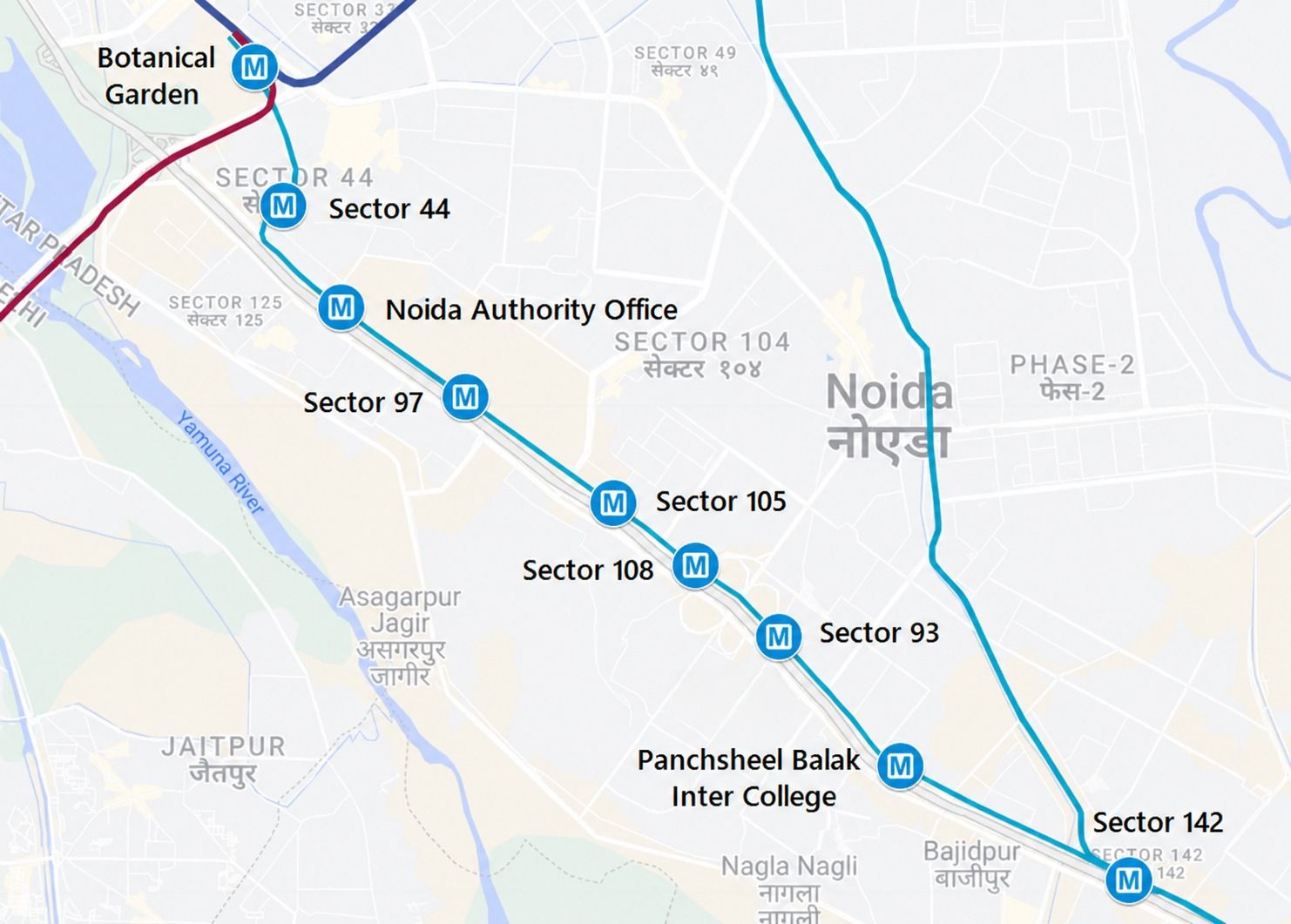
A: The Aqua Line extension is an approved metro project by the Delhi Metro Rail Corporation extending existing metro service from Sector 142 (current terminus) through multiple Noida sectors to eventually reach Botanical Garden. The route covers approximately 15 to 18 kilometers of new metro corridor with an estimated 12 to 15 new stations. According to the Noida Authority's Master Plan documentation, this extension is prioritized for completion by 2029 to 2031.
A: The Delhi Metro Rail Corporation has estimated the project cost between Rs 8,000 crore to Rs 10,000 crore. Funding comes from a combination of central government allocation, state government contribution, and multilateral funding agencies. The DMRC has successfully completed similar metro expansions across Delhi and Noida using this tripartite funding structure.
A: Construction timelines for metro projects typically extend over 4 to 5 years from groundbreaking. If construction commences in 2025 to 2026 as currently planned, operational status could be expected by 2029 to 2031. However, metro projects in India frequently experience 1 to 2 year delays due to land acquisition issues, environmental clearances, and underground construction complexities. A realistic expectation is operational status by 2031 to 2032.
A: Metro extensions historically drive significant real estate appreciation in India. The Delhi Metro's expansion to areas like Rohini, Dwarka, and Noida itself have all resulted in 25 to 50 percent property appreciation over 5 year periods following metro opening. The Aqua Line extension will create similar dynamics. Properties within walking distance of metro stations (approximately 500 to 1000 meters) typically see the highest appreciation.
The extension is particularly significant for Noida because it connects the city's IT corridor with residential areas. Currently, thousands of office workers commute between Sector 142 (tech hub) and residential areas in Sector 93, Sector 128, and beyond using individual vehicles or buses. Metro connectivity will dramatically improve this commute, making residential areas more attractive and walkable office districts more viable.
Also Read this:- The Gurugram Noida RRTS Corridor Everything You Need to Know
Sector 142 is already Noida's primary IT and corporate office district. The sector hosts multiple tech parks including the Noida City Centre and numerous office buildings housing companies like Microsoft, TCS, Infosys, Wipro, and countless other multinational and Indian corporations. According to Noida Authority data, Sector 142 generates approximately 300,000 to 350,000 daily office going commuters.
A: Sector 142 was developed specifically as an IT and office destination when the Noida Authority planned its expansion beyond the original city limits. The sector's proximity to the National Capital Region and accessibility via the Noida Expressway made it ideal for corporate office development. The combination of ready infrastructure, large land parcels, and proximity to Delhi attracted major tech companies.
A: Metro connectivity will strengthen Sector 142's position as a premium office destination. Currently, office accessibility depends on individual vehicles or shuttle services. Metro connectivity will provide reliable, quick access for employees coming from across Noida, Delhi, and the broader NCR region. This will increase employee attraction and retention for companies, making Sector 142 office properties increasingly valuable. Office rental rates are expected to appreciate 15 to 25 percent over 5 years following metro opening.
Commercial real estate investors should note that Sector 142 office spaces are likely already expensive due to established demand. The metro will enhance values further, but entry costs are currently highest in this sector.
Sector 145 and Sector 157 are the immediate extensions of the existing office corridor. These sectors are currently developing, with multiple office projects in various stages of completion. The sectors have attracted mid size corporations and service sector companies that could not find suitable space in the fully occupied Sector 142.
A: Current commercial activity includes IT service providers, business process outsourcing (BPO) companies, consulting firms, financial services offices, and corporate support service providers. These are companies that need office space but may not have been able to secure premium locations in the fully developed Sector 142. The sectors are seeing steady office absorption.
Metro connectivity at these sectors will transform them from secondary office locations into prime office destinations. Companies currently located in Sector 142 may shift to these sectors to capture additional office space at lower costs. New companies will be attracted by the combination of modern office infrastructure and metro accessibility.
Check this:- Delhi Metro Phase 5: Three Game Changing Corridors and Investment Opportunities
A: These sectors offer strong office space appreciation potential. Office properties in these sectors are expected to see 25 to 40 percent appreciation over 5 years post metro opening. Rental yields are also attractive, with office space commanding rents from Rs 50 to Rs 80 per sq ft per month currently, expected to increase to Rs 65 to Rs 100 per sq ft post metro. This makes office space in these sectors attractive for both owner occupancy and rental income investors. However, office space investment requires understanding commercial real estate cycles and corporate demand patterns. Before investing, consult with commercial real estate professionals familiar with Noida's office market dynamics.
Sector 132 and Sector 135 represent a transitional zone. While these sectors have significant office space, they are also increasingly hosting residential developments. The combination makes these sectors unique. Office workers live in these sectors and work in nearby Sector 142. Residential dwellers commute to offices in Sector 142 and beyond.
A: Sector 132 is primarily office space with some small residential pockets. Sector 135 has a mix of offices, retail establishments, and residential buildings. Both sectors serve as buffers between the intensive office corridor of Sector 142 and the more exclusively residential zones beyond. Current property prices in these sectors are moderate compared to Sector 142, creating opportunity.
A: Metro connectivity will intensify mixed use development. These sectors will become increasingly attractive for both office and residential use. Developers will build more high density residential towers near metro stations to capitalize on office worker demand for convenient housing. Office developers will expand knowing the residential population will provide an additional customer base for support services and retail.
Investment potential in mixed use zones is moderate to strong. Residential properties in these zones are expected to see 20 to 35 percent appreciation. Office properties will see 25 to 40 percent appreciation. Mixed use development areas often show more stable growth patterns than either purely residential or purely commercial zones.
Also Check:- Gurugram's New Metro Corridor: Sector by Sector Investment Potential and Growth Analysis
Sector 127 is emerging as an alternative office destination for companies seeking space beyond the Sector 142 corridor but still requiring proximity to the main office hub. The sector has seen multiple office projects launched in recent years, and metro connectivity will significantly enhance its appeal.
A: Sector 127 offers lower land costs than Sector 142 and immediately adjacent sectors. For companies requiring large office spaces at moderate costs, Sector 127 provides excellent value. Metro connectivity will address the sector's primary disadvantage: accessibility. With the metro, Sector 127 becomes as accessible as Sector 142 for employees using public transport.
A: Residential pockets in and around Sector 127, including nearby residential colonies and affordable housing projects, will benefit significantly. Office workers will find Sector 127 office locations accessible via metro, potentially spurring residential demand in surrounding areas. Residential properties near Sector 127 metro station could see 25 to 35 percent appreciation.
Sector 128 marks a significant transition point in the metro extension route. While previous sectors were dominated by office space, Sector 128 is established as a premium residential zone with significant medical and healthcare institutions. The sector hosts multiple hospitals, nursing homes, and medical colleges. It also has high end residential societies and commercial shopping centers.
A: Sector 128 is important because it represents where the metro extension transitions from serving primarily office workers to serving residential communities. Metro connectivity here will benefit residents who need easy access to office areas for employment, while providing office workers with convenient residential options. The medical institutions in the sector will also benefit from improved accessibility.
The sector already has strong infrastructure: good hospitals, premium housing, shopping centers, and expressway connectivity. Metro will add public transit to this existing strength.
A: Sector 128 already commands premium residential prices due to its existing amenities. Metro connectivity will strengthen this premium positioning. Residential properties in Sector 128 are expected to see 20 to 30 percent appreciation over 5 years. The sector will become increasingly attractive to high income professionals working in Sector 142 and nearby office areas who seek premium residential living with excellent connectivity.
Investment in Sector 128 is suitable for investors seeking stable, premium residential properties with strong infrastructure and institutional backing. However, entry costs are higher than other sectors along the route.
Sector 125 and Sector 93 are mature residential sectors with established communities, educational institutions, and shopping centers. These sectors have been residential for decades and have developed stable, planned communities with schools, parks, and commercial establishments.
A: Both sectors host multiple schools from primary to senior secondary levels, colleges, and coaching institutes. This educational infrastructure makes the sector attractive for families. According to Noida Authority records, Sector 93 alone has approximately 8 to 10 major educational institutions. This density of schools and colleges attracts families even before metro connectivity.
A: Metro connectivity will enhance accessibility without radically changing the character of these established communities. Residents will gain convenient public transit options for commuting to offices, reducing dependence on personal vehicles. This will make these sectors increasingly attractive to working professionals. Students attending colleges and coaching centers will benefit from metro connectivity.
The growth in these sectors will be steady rather than explosive. These are mature, developed communities, not frontier areas. Appreciation is expected to be 15 to 25 percent over 5 years. This is attractive but more moderate than newer sectors.
Investment in Sectors 125 and 93 is suitable for conservative investors seeking stable, long term appreciation in established residential communities. The sectors offer good schools, developed infrastructure, and reliable demand from families.
The Aqua Line extension concludes at Botanical Garden, where it will connect with the existing Blue Line and Magenta Line of the Delhi Metro system. This connection is crucial because it creates a comprehensive metro network spanning from the IT office district of Sector 142 through Noida's residential zones and into central Delhi.
A: Botanical Garden is a major Delhi Metro interchange point. The Blue Line connects Botanical Garden to central Delhi (Rajiv Chowk, Connaught Place) and airports. The Magenta Line connects to other parts of Delhi. When the Aqua Line extension reaches Botanical Garden, it creates seamless connectivity from Noida's office and residential zones to central Delhi employment centers and airports. This makes the entire extended route highly valuable.
A: Direct airport connectivity is a major value driver in metro accessible properties. Professionals working in central Delhi can live in Noida and commute via metro. This dramatically expands the catchment area for Noida residential properties. Properties across the extension route will benefit from this expanded market. The value is highest for properties in office districts (Sectors 142, 145, 157) and premium residential (Sector 128), with moderate appreciation in mid range residential areas.
A: Highest appreciation potential is in Sectors 145, 157, and 127, which are emerging office zones currently undervalued but with strong growth drivers. These sectors could see 35 to 50 percent appreciation. However, office space investment requires understanding commercial cycles. Balanced appreciation with stability is in Sectors 132, 135, and 128, with expected appreciation of 20 to 35 percent. Conservative but stable is Sectors 125 and 93, with expected appreciation of 15 to 25 percent in established communities.
A: This depends on your risk appetite and investment horizon. Office space offers higher returns but involves commercial cycle risks. Residential space offers stable demand from individuals and families seeking homes. Before investing in office space, consult with commercial real estate advisors familiar with Noida's office market. Before investing in residential, understand the specific sector's current market rates and future growth drivers.
A: Optimal timing is before metro construction visibly begins. Once heavy equipment appears and construction is underway, awareness increases and prices accelerate. Properties bought now (2025 to 2026) before visible construction will see the best appreciation. However, ensure the project has received all necessary approvals and construction is genuinely about to commence.
Realistic expectation: Property values will appreciate 5 to 10 percent in the first 1 to 2 years before construction, 15 to 25 percent during construction years (2027 to 2029), and 20 to 35 percent in the 2 to 3 years following metro opening (2030 to 2033).
A: Metro projects in India frequently experience delays of 1 to 3 years beyond original timelines. Causes include land acquisition issues, environmental clearances, underground construction complexities, and monsoon season interruptions. If the Aqua Line extension is delayed from 2031 to 2033 or 2034, property appreciation timelines shift accordingly. Investors must be prepared for potential 2 to 3 year delays.
A: Real estate markets experience cycles. A recession during 2027 to 2029 could moderate appreciation. Properties bought at current rates might appreciate less than projected if broader economic conditions weaken. However, metro connected properties typically appreciate more resilience compared to non connected properties, even during downturns.
A: Office space absorption depends on continued corporate expansion in the region. If major companies relocate away from Noida or reduce expansion, office space demand could weaken. Residential absorption depends on continued migration and household formation. These are medium term risks that should inform investment decisions.
Contact Us
Fill out this form
& we'll get back
to you
Recommended for you