Investments
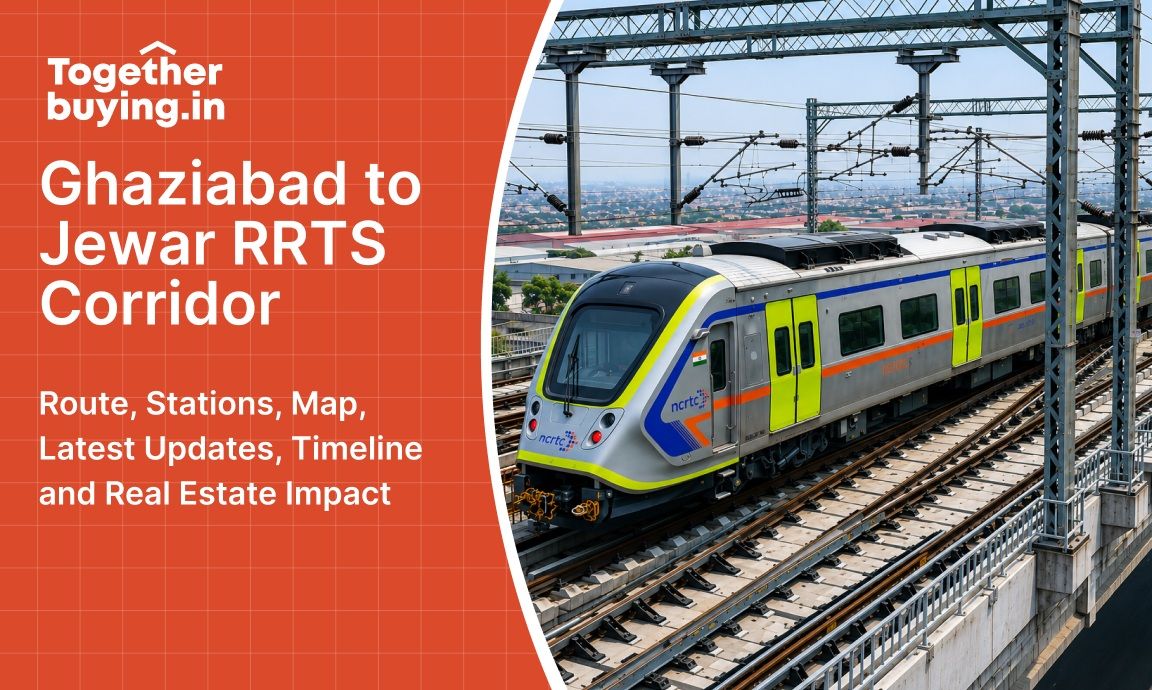
Ghaziabad to Jewar RRTS Corridor: Route, Stations, Map, Latest Updates, Timeline and Real Estate Impact
02 Jun 2026
Investments
02 Jun 2026
Content
No Blogs content found
It looks like there haven’t been any blogs yet!
The Ghaziabad to Jewar RRTS corridor is one of the most significant proposed transport infrastructure projects in the National Capital Region. It plans to connect the existing Ghaziabad RRTS station on the Delhi–Meerut Namo Bharat network with Noida International Airport at Jewar through a semi-high-speed rail corridor of approximately 72 km. The project is being developed under the planning framework of the National Capital Region Transport Corporation (NCRTC) and would function as a southward extension of the Namo Bharat rapid rail network.
The case for this corridor has become operationally urgent. Noida International Airport (IATA: DXN) was inaugurated on March 28, 2026, by Prime Minister Narendra Modi. The inauguration was confirmed by the Prime Minister's Office and the Press Information Bureau (PIB Ref: PRID 2245509). Commercial flight operations commenced on June 15, 2026, as announced by Yamuna International Airport Private Limited (YIAPL) on May 1, 2026. Business Standard confirmed this announcement the same day from the airport operator directly. At launch, the airport has no metro or RRTS connectivity. All passenger access is via the Yamuna Expressway and connecting roads only.
As of May 2026, the Ghaziabad Jewar RRTS is in a critical approvals phase. NCRTC submitted a Detailed Project Report (DPR) to YEIDA in April 2024. State-level support has been in place since December 2023. However, the Union Ministry of Housing and Urban Affairs (MoHUA) directed in December 2025 that the alignment must be reconsidered, with Sarai Kale Khan in Delhi as the preferred starting point rather than Ghaziabad. NCRTC is preparing a revised feasibility report. According to media reports citing government officials, central approval is expected within the current financial year. Formal central sanction has not been issued as of May 2026.
The Ghaziabad Jewar RRTS is a proposed Regional Rapid Transit System line planned by NCRTC. Its purpose is to provide a high-speed rail connection between the northern urban clusters of Ghaziabad and Greater Noida West and Noida International Airport at Jewar, passing through the Yamuna Expressway industrial development belt administered by YEIDA.
The UP government granted in-principle approval in December 2023. YEIDA issued the work order to NCRTC in January 2024. The DPR was submitted within three months — confirmed by YEIDA CEO Arun Vir Singh who stated the corridor would be operated by NCRTC on both RRTS and metro modes and that the design target was to achieve the NIA-to-IGI journey within 50 minutes at operating speeds up to 150 km/h.
The project is designed as a dual-mode corridor: high-speed RRTS trains serve longer-distance stations while metro-mode services cover the denser urban segments of Greater Noida West and Ghaziabad. It is classified as the fourth corridor under the Phase 1 RapidX program alongside the Delhi–Meerut, Delhi–Alwar, and Delhi–Panipat lines.
The original DPR alignment covers approximately 72.44 km from Ghaziabad to the Ground Transportation Centre at Noida International Airport Terminal 1.
The route is structured in two phases:

Phase 1: Ghaziabad to Kasna (approximately 39 km)
This section passes through Siddharth Vihar, Greater Noida West Sector 4, Greater Noida West Sector 2 (Gaur Chowk), Knowledge Park V, Surajpur, Pari Chowk, and Ecotech-6. It includes 7 proposed RRTS stations and approximately 11 metro-mode stations for local services.
Phase 2: Kasna to Noida International Airport (approximately 33 km)
This section passes through Dankaur, YEIDA North Sector 18, YEIDA Central Sector 21, and terminates at Noida International Airport. It includes 4 proposed RRTS stations and 9 future metro-mode stations. (Source: Metro Rail Guy – themetrorailguy.com, September 2025.)
To accelerate delivery, media reports citing government officials indicate both phases may now be executed simultaneously rather than sequentially. (Source: TravelBiz Monitor, January 2025.)
| Section | Major Areas Covered | Phase |
|---|---|---|
| Ghaziabad | Siddharth Vihar, Ghaziabad South | Northern Terminal |
| Greater Noida West | Sector 4, Sector 2, Gaur Chowk | Phase 1 |
| Knowledge Park | Knowledge Park V | Phase 1 |
| Surajpur | Surajpur industrial zone | Phase 1 |
| Pari Chowk | Commercial hub, metro interchange | Phase 1 |
| Kasna / Ecotech | Ecotech-6, industrial areas | Phase 1 / Phase 2 boundary |
| YEIDA Sectors | Sector 17, 18, 21 | Phase 2 |
| Noida International Airport | Ground Transportation Centre, Terminal 1 | Southern Terminal |
Revised Alignment Under Study (December 2025)
Following the MoHUA review meeting in December 2025, NCRTC was directed to study an alternative alignment starting from Sarai Kale Khan in Delhi. The preliminary route under study may pass through DND Flyway, Noida City Centre, NSEZ (Noida Phase-2), Surajpur, Knowledge Park-3, Pari Chowk, Ecotech-6, Dankaur, and YEIDA sectors 18 and 21. New Ashok Nagar is being explored as an alternate starting point if Sarai Kale Khan presents land or operational challenges. (Source: Metro Rail News, December 16, 2025; Metro Rail Today, December 15, 2025.)
No final alignment decision has been published as of May 2026. Media reports citing government officials state that the DPR is being amended rather than the project being cancelled. (Source: TravelBiz Monitor, January 2025.)
The DPR submitted by NCRTC to YEIDA in April 2024 proposed 22 stations across the 72 km corridor: 11 RRTS stations for semi-high-speed intercity service and 11 metro-mode stations for urban segments, plus provisions for 13 future expansion stations.
All station names and locations below are proposed as per the DPR and are subject to revision following the MoHUA-directed alignment review. They are not yet finally approved.
| Proposed Station | Zone | Interchange Potential |
|---|---|---|
| Ghaziabad | Northern Terminal | Delhi–Meerut RRTS, Delhi Metro Red Line |
| Siddharth Vihar | Ghaziabad | — |
| Greater Noida West Sector 4 | Greater Noida West | — |
| Greater Noida West Sector 2 / Gaur Chowk | Greater Noida West | Aqua Line Extension (Planned) |
| Knowledge Park V | Knowledge Park | — |
| Surajpur | Surajpur | Gurugram–Noida RRTS Interchange (Proposed) |
| Pari Chowk | Greater Noida | Aqua Line (Planned) |
| Ecotech-6 | Greater Noida | — |
| Dankaur | YEIDA Belt | — |
| YEIDA North Sector 18 | YEIDA | — |
| YEIDA Central Sector 21 | YEIDA | — |
| Noida International Airport | Southern Terminal | Airport GTC, Terminal 1 |
Metro-mode stations proposed for the urban sections include Char Murti Chowk, KP III, Alpha-1, Omega II, Malakpur, and Ecotech II.
A key feature of the DPR absorbs approximately 10 km of the proposed Aqua Line extension (Noida Sector 51 to Knowledge Park 5, including six stations) into the RRTS corridor. An integrated interchange is proposed at Char Murti Chowk. Gaur Chowk in Greater Noida West is proposed as the main RRTS–Aqua Line interchange hub. (Source: Whalesbook citing YEIDA, January 2026.)
Check this:- NOIDA METRO AQUA LINE EXTENSION: SECTOR BY SECTOR GROWTH ANALYSIS
This section addresses one of the most searched queries related to this project: ghaziabad jewar rrts map and jewar rrts route map. A searchable interactive alignment map is available on NCRTC's website at ncrtc.in. The indicative corridor alignment as described in the DPR runs as follows:
The line begins at the existing Ghaziabad RRTS station already operational as part of the Delhi–Meerut corridor in Patel Nagar, Ghaziabad. From there it moves southward through the Siddharth Vihar residential zone, entering the Greater Noida West belt via Sector 4 and Sector 2. At Gaur Chowk, it serves one of the highest-density residential zones in the NCR.
The corridor then continues south through the Knowledge Park cluster, the Surajpur industrial zone, and reaches Pari Chowk — Greater Noida's primary commercial junction. Beyond Pari Chowk the line enters the Kasna and Ecotech industrial zones, marking the Phase 1 / Phase 2 boundary.
From Kasna, the Phase 2 alignment follows a broadly south-southeast direction along the Yamuna Expressway development axis, passing through Dankaur, then into the YEIDA master plan sectors (18 and 21) before reaching the airport Ground Transportation Centre.
The entire alignment is planned to be elevated except for the terminal station at Noida International Airport. The corridor runs broadly parallel to the NH-9 / Greater Noida Expressway in the north and the Yamuna Expressway in the south.
Strategic placement of key nodes:
Surajpur is positioned as a future multi-corridor interchange. NCRTC's proposed Gurugram–Faridabad–Noida RRTS (Rs 15,000 crore, DPR stage) is also designed to terminate at Surajpur, creating a cross-NCR connection at this point.
Pari Chowk would become the corridor's central urban interchange, linking the RRTS with the Aqua Line metro and serving as the gateway between the Greater Noida commercial zone and the YEIDA development belt to the south.
The airport terminus at the GTC connects the corridor to Noida International Airport's terminal building. The GTC was designed specifically to support future rapid transit integration, including RRTS.
NCRTC submitted the Detailed Project Report to YEIDA on April 5, 2024, following a work order issued in January 2024. The DPR covered a 72.4 km corridor with 22 stations from Ghaziabad to Noida International Airport. Estimated cost: Rs 20,637 crore. YEIDA forwarded the DPR to the UP government for review.
Before the December 2025 MoHUA directive, the central government had already returned the DPR for amendments. The UP government directed the NCR Planning Board to address concerns on station placements in less-populated areas, route alignment, and cost feasibility. The NCR Planning Board began revising the framework. Concurrent construction of both phases was proposed at this stage. (Source: TravelBiz Monitor, January 2025.)
A review meeting attended by officials from the UP government, Noida International Airport Ltd (NIAL), Yamuna International Airport Pvt Ltd (YIAPL), Noida Metro, and other agencies concluded that MoHUA required the corridor to originate from Sarai Kale Khan rather than Ghaziabad. The ministry's position was that the Ghaziabad alignment would fail to meet projected ridership, as most airport-bound passengers were expected to originate from Delhi and central Noida. YEIDA ACEO Shailendra Bhatia confirmed: "A decision has been taken to explore the feasibility of developing an RRTS corridor from Sarai Kale Khan to Noida International Airport. NCRTC will prepare the feasibility report, and further action will follow."
Following the December 2025 MoHUA directive, YEIDA officials confirmed the authority continued to support the original Ghaziabad alignment and had submitted clarifications to MoHUA on multimodal integration. YEIDA reiterated the corridor's economic development role in Uttar Pradesh. (Source: Whalesbook citing YEIDA statement, January 17, 2026.)
According to media reports citing government officials, the Ghaziabad Jewar RRTS has not been cancelled. NCRTC has been asked to make amendments to the DPR. Central government approval is expected within the current financial year. (Source: TravelBiz Monitor, January 2025; media reports citing officials, 2026.)
Project planning continues and approval-related discussions are underway. The alignment question between the Ghaziabad start and the Sarai Kale Khan start remains unresolved. NCRTC is preparing an amended DPR. No formal central sanction has been issued. Construction is projected to begin between 2026 and 2027, subject to approval. Noida International Airport is now operational, with commercial flights from June 15, 2026, and no rapid transit connectivity at launch.
The DPR submitted in April 2024 estimated total project cost at Rs 20,637 crore. A later reference from one media report cites Rs 20,763 crore, reflecting possible revisions during the amendment process. The DPR figure of Rs 20,637 crore is the most consistently cited official estimate across YEIDA and MoHUA reporting. (TravelBiz Monitor, January 2025.)
| Component | Estimated Figure |
|---|---|
| Total Project Cost (DPR) | Rs 20,637 crore |
| Corridor Length | ~72.44 km |
| Total Proposed Stations | 22 (11 RRTS + 11 Metro-Mode) |
| Future Station Provisions | 13 Additional |
The funding structure has not been announced. No financial commitments from central or multilateral sources have been made public as of May 2026, as formal central approval is still pending. For context, the Delhi–Meerut RRTS received approximately $2 billion in multilateral loans from the Asian Development Bank, New Development Bank, and Asian Infrastructure Investment Bank. (Source: Hindustan Times via Pressreader, November 2022.) A similar structure is typical for NCRTC corridors, but no comparable arrangement has been confirmed for the Ghaziabad Jewar corridor.
Read this:- The Gurugram Noida RRTS Corridor Everything You Need to Know
The following table provides estimated travel time reductions based on DPR projections and operating speed parameters as reported by NCRTC and YEIDA. Actual travel times will depend on the final approved alignment and operating pattern.
| Route | Current Road Travel Time | DPR-Based RRTS Estimate |
|---|---|---|
| Ghaziabad to Noida International Airport | 90–120 min (variable by traffic) | ~60–70 min |
| Greater Noida West to Noida International Airport | 60–90 min (road) | ~35–45 min |
| Ghaziabad to Pari Chowk | 45–75 min (road) | ~20–30 min |
| Greater Noida to YEIDA Sectors | 40–60 min (road) | ~20–25 min |
The YEIDA CEO stated in February 2024 that the design target was a 50-minute NIA-to-IGI journey via RRTS at operating speeds of up to 150 km/h.
For comparison, the operational Delhi–Meerut RRTS covers 82.15 km from Sarai Kale Khan to Modipuram at an average operating speed of up to 100 km/h. Daily ridership reached 87,682 in March 2026. (Source: NCRTC via Metro Rail Guy, themetrorailguy.com, referencing operational data.)
Also Read this:- Delhi Metro Phase 5: Three Game Changing Corridors and Investment Opportunities
The Ghaziabad Jewar RRTS is planned as a direct extension of the Delhi–Meerut RRTS, sharing the Ghaziabad station as the interchange point. The Delhi–Meerut corridor became fully operational on February 22, 2026, when the final sections opened simultaneously: New Ashok Nagar to Sarai Kale Khan in Delhi, and Meerut South to Modipuram in Meerut. (Sources: PIB / Newsair, February 2026.)
Sarai Kale Khan RRTS station, which became operational on February 22, 2026, is the designated Phase 1 terminus for three planned RRTS lines: Delhi–Meerut (operational), Delhi–Alwar (pre-construction), and Delhi–Panipat/Sonipat (planning stage). MoHUA's preference for a Sarai Kale Khan start for the Jewar corridor reflects this station's role as the central hub of the Phase 1 RRTS network.
Under the original Ghaziabad alignment, a passenger from Meerut to Jewar Airport would interchange at Ghaziabad. Under the MoHUA-preferred Sarai Kale Khan alignment, through-running from Meerut to Jewar Airport without interchange may be possible.
| Corridor | Length | Status (May 2026) |
|---|---|---|
| Delhi–Meerut RRTS | 82.15 km | Fully operational (February 2026) |
| Ghaziabad–Jewar RRTS | ~72 km | DPR submitted; central approval pending |
| Delhi–Alwar RRTS | ~164 km | Approved; pre-construction activities ongoing |
| Delhi–Panipat / Karnal RRTS | ~103 km | Planning / DPR stage |
Inauguration and commercial operations — official sources:
Phase 1 of Noida International Airport was inaugurated by PM Modi on March 28, 2026. This is confirmed by: (1) PIB press release PRID 2245509 (pib.gov.in, March 26, 2026), (2) the Prime Minister's Office press release (pmindia.gov.in, March 28, 2026), and (3) NewsOnAir/All India Radio (newsonair.gov.in, March 28, 2026).
Commercial flight operations commenced on June 15, 2026. This is confirmed by: (1) YIAPL official announcement, May 1, 2026 (niairport.in), (2) Business Standard report citing airport operator announcement, May 1, 2026, and (3) Republic World citing NIA directly. IndiGo operated the inaugural service; Akasa Air and Air India Express followed. (Sources: Business Standard, May 1, 2026; Republic World, May 2026.)
Phase 1 specifications, confirmed from PIB and NewsOnAir:
At launch, the airport has no rapid transit connectivity. This is confirmed by YIAPL's own May 1, 2026 announcement: "No metro, no RRTS at launch."
| Airport | City | Rapid Transit at Operational Launch |
|---|---|---|
| Indira Gandhi International (IGI), Delhi | Delhi | Delhi Metro Airport Express Line (operational at launch) |
| Noida International Airport (DXN), Jewar | Greater Noida / NCR | None at launch (confirmed, June 2026) |
| Navi Mumbai International Airport | Navi Mumbai | Under planning; metro integration proposed |
The planned Ground Transportation Centre at Terminal 1 is designed to accommodate future RRTS integration. The GTC is the designated terminus for the Ghaziabad Jewar RRTS corridor in the DPR.
The Delhi–Meerut RRTS provides the most relevant benchmark. According to PropEquity data reported in Business Standard (February 23, 2026), property prices rose 131% in Ghaziabad and 54% in Meerut over four years following RRTS construction and operation. Properties within 1 km of RRTS stations appreciated 15–20% more than comparable properties farther away, and a 3BHK apartment near the Ghaziabad RRTS station priced at Rs 65 lakh in 2022 commanded Rs 85 lakh by 2025.
ANAROCK Research data cited in Realtynmore.com (May 29, 2026) confirms that NCR's infrastructure wave — including the operationalisation of Noida International Airport — has fundamentally repositioned formerly peripheral corridors as prime residential investment zones.
Yamuna Expressway property prices (multiple market reports aggregated by PropCompany, 2026): apartment prices moved from approximately Rs 3,950 per sq ft in 2020 to roughly Rs 10,200 per sq ft by 2025–26; plot values from approximately Rs 1,650 per sq ft to Rs 10,500 per sq ft over the same period. These movements reflect the airport development effect and the infrastructure pipeline. No single research house has published a specific post-RRTS price forecast for this corridor as of May 2026 — projections for the airport zone come from market tracking platforms rather than formal analyst reports.
| Location | Current Market Condition | Expected RRTS Impact |
|---|---|---|
| Ghaziabad / Siddharth Vihar | Established; prices up 131% since 2020 (PropEquity) | Incremental connectivity premium for southern corridor |
| Greater Noida West | High-density residential; limited rapid transit | Significant demand uplift; direct airport and interchange access |
| Knowledge Park / Pari Chowk | Mature commercial zone | Commercial intensification; interchange station premium |
| Surajpur | Industrial and residential mix | Multi-corridor interchange value uplift |
| Kasna / Ecotech-6 | Developing industrial | Land values tied to approval progress |
| YEIDA Sectors (17, 18, 21) | Early development stage | Long-term upside; airport-driven land appreciation already underway |
| Yamuna Expressway / Jewar Zone | Airport boom underway | Apartment prices up ~158%; plot values up ~536% since 2020 (PropCompany, 2026) |
| Proposed Station Zone | Residential Impact | Commercial Impact | Investor Interest |
|---|---|---|---|
| Siddharth Vihar | Connectivity premium; value uplift for existing stock | Limited commercial | Medium |
| Gaur Chowk (GNW Sector 2) | Highest residential demand in Greater Noida West belt | Retail and services at interchange | High |
| Pari Chowk | Moderate residential uplift; already established | Commercial office, retail intensification | Medium–High |
| Surajpur | Industrial workforce housing demand | Multi-corridor node; logistics | High (long-term) |
| YEIDA Sector 21 | Limited residential currently | Industrial, logistics, hospitality | High (speculative) |
| Airport GTC | Not applicable | Aviation-linked commercial, MRO | Specialist |
YEIDA's 2024 residential plot scheme attracted 91,380 applications for 821 plots, indicating investor demand at scale even before RRTS approval. (Source: YEIDA official scheme data cited in estatencr.com.)
Check this:- Gurugram's New Metro Corridor: Sector by Sector Investment Potential and Growth Analysis
Noida International Airport: Phase 1 operational from June 15, 2026. Eventual capacity of 70 MPPA. Primary anchor demand generator for the corridor. (Source: PIB, pmindia.gov.in, YIAPL / Business Standard.)
Film City (YEIDA zone): A large-scale entertainment and production complex planned in the YEIDA sectors. Expected to generate recurring employment and visitor demand.
Gurugram–Faridabad–Noida RRTS (DPR submitted): NCRTC finalised a DPR for a Rs 15,000-crore, 61-km RRTS connecting IFFCO Chowk in Gurugram to Surajpur in Greater Noida via Faridabad and Noida. This corridor is designed to interchange with the Ghaziabad Jewar RRTS at Surajpur. (Sources: Swarajya Mag citing NCRTC DPR, December 2025; Inframantra citing NCRTC, December 2025; Tribune India.)
Fintech City and SEZs (YEIDA): YEIDA allotted industrial plots worth Rs 1,000 crore in Sector 24 alone in 2024. Japanese and Korean manufacturing firms are among targeted investors.
Multimodal Logistics Park (GNIDA): GNIDA invited bids for a Rs 1,200-crore, 174-acre multimodal logistics park in Sector Kappa-2, near the airport. (Source: GNIDA bid data.)
MRO Facility (Jewar Airport): PM Modi laid the foundation stone for a 40-acre MRO facility during the airport inauguration on March 28, 2026. (Source: NewsOnAir, March 28, 2026.)
Alignment Dispute: The unresolved question of whether to start from Ghaziabad or Sarai Kale Khan is the critical path item. MoHUA requires Sarai Kale Khan for stronger Delhi connectivity and ridership viability. YEIDA supports Ghaziabad for economic development of the UP belt. Until this is resolved through the DPR amendment process, the project cannot advance to tendering or funding.
Ridership Projections: MoHUA's concern about the original DPR's ridership figures is a substantive planning issue. The original DPR projected 2.95 lakh passengers per day. MoHUA's review concluded that most airport-bound passengers would originate from Delhi and central Noida both bypassed by the Ghaziabad alignment. The amended DPR must address this.
Central Approval Pending: No formal central sanction from MoHUA has been issued as of May 2026. The sequential dependency — approval before funding before construction means that the approval delay directly delays the construction start.
Funding: No funding arrangement has been announced. Multilateral lenders require formal project approval before loan negotiations. For context, the Delhi–Meerut RRTS secured approximately $2 billion in multilateral financing. A comparable structure would be needed for the Ghaziabad Jewar corridor.
Land Acquisition: YEIDA-controlled land in the southern sectors is relatively straightforward to acquire. In the northern urban stretches Greater Noida West, Ghaziabad — more complex land ownership patterns require multi-agency coordination.
Multi-Agency Complexity: The project involves NCRTC, YEIDA, GNIDA, the UP government, MoHUA, and potentially the Delhi government and DMRC if the alignment includes Delhi. Each additional agency increases the coordination burden.
Delhi Integration via Sarai Kale Khan: If MoHUA's directed alignment is adopted, the corridor would originate at Sarai Kale Khan, enabling potential through-running with the operational Delhi–Meerut RRTS and creating a single continuous axis from Meerut to Jewar Airport.
Gurugram–Noida Cross-Corridor: NCRTC has submitted a DPR for the Rs 15,000-crore Gurugram–Faridabad–Noida RRTS, which terminates at Surajpur and is designed to interchange with the Ghaziabad–Jewar corridor. If both corridors are built, Surajpur becomes the only point in NCR where east-west and north-south RRTS lines intersect. (Sources: Swarajya Mag; Inframantra; Tribune India.)
Airport City and Multi-Phase Expansion: Noida International Airport is designed for eventual 70 MPPA capacity across four phases. Each expansion phase generates additional transit demand and may justify additional RRTS service frequency or new connecting lines.
NCR RRTS Network Completion: With Delhi–Meerut operational and Delhi–Alwar and Delhi–Panipat in various planning stages, the Ghaziabad–Jewar corridor fills the southeastern quadrant of the planned NCR RRTS network.
Noida International Airport is now operational. Commercial flights began June 15, 2026. At launch, every passenger reaches the airport by road. The Ghaziabad Jewar RRTS is the only planned infrastructure project that can provide rapid transit access to the airport from the northeastern NCR within any meaningful planning horizon.
The alignment debate reflects a genuine planning tension. The Ghaziabad origin better serves Greater Noida West residents and the Uttar Pradesh economic development agenda. The Sarai Kale Khan origin better serves Delhi and central Noida passengers, who are expected to be the primary airport catchment. The resolution will determine which group benefits first and most, as well as the project's financial viability through ridership projections.
For Greater Noida West, the RRTS matters most as a daily commuter service. This zone has hundreds of thousands of residents who commute entirely by road. RRTS access to Ghaziabad, Pari Chowk, the YEIDA zone, and the airport would transform the daily mobility profile of this zone.
For the YEIDA sectors, the RRTS is an enabler of the entire development vision. Industrial location decisions, residential demand, hospitality investment, and logistics capacity all improve with rapid transit workforce connectivity.
For real estate, property markets from Greater Noida West to the Yamuna Expressway have already moved in anticipation of this infrastructure. The airport effect alone has driven significant appreciation, as documented by PropEquity and market platforms. RRTS approval and construction start would provide an additional, sustained catalyst.
Project planning continues and approval-related discussions are underway.
| Milestone | Status / Date | Source |
|---|---|---|
| UP In-Principle Approval | December 2023 | YEIDA / Metro Rail Today |
| YEIDA Work Order to NCRTC | January 2024 | Metro Rail News |
| DPR Submitted to YEIDA | April 5, 2024 | Metro Rail Today |
| Central Government Returns DPR for Amendments | Early 2025 | TravelBiz Monitor, January 2025 |
| MoHUA Review: Sarai Kale Khan Directive | December 2025 | Metro Rail News; Metro Rail Today |
| YEIDA Reaffirms Original Alignment | January 2026 | Whalesbook citing YEIDA |
| DPR Amendments Underway | Early 2026 | Media reports citing officials |
| Noida International Airport Inaugurated (Phase 1) | March 28, 2026 | PIB (PRID 2245509); pmindia.gov.in |
| Commercial Flights Begin at Noida International Airport | June 15, 2026 | YIAPL (niairport.in, May 1, 2026); Business Standard |
| Central Approval (Expected) | FY 2025–26 | Media reports citing officials |
| Construction Start (Projected, Subject to Approval) | 2026–2027 | Media reports citing officials |
| Full Corridor Completion (Indicative) | Reported as 2041; not confirmed in DPR | themetrorailguy.com (September 2025) |
The Ghaziabad Jewar RRTS corridor is at a critical juncture. Noida International Airport is now open and receiving passengers by road only. The DPR has been submitted and state-level support is in place. The central government has returned the DPR for amendments rather than cancelling the project, and the amended DPR is being prepared. Central approval is expected within the current financial year.
The alignment question is the primary unresolved issue. A Sarai Kale Khan origin would provide stronger Delhi connectivity and higher projected ridership; a Ghaziabad origin would serve the UP economic development corridor more directly. Both alignments serve the airport. The resolution of this question will determine the project's final cost, scope, and construction timeline.
For homebuyers, Greater Noida West and Pari Chowk are the most immediately affected residential zones once the corridor is approved. For long-term investors, YEIDA sectors offer the highest potential upside. For airport travelers, the RRTS gap is already real: the airport is open, rapid transit is not yet available, and the road is the only option today.
It is a proposed 72 km Regional Rapid Transit System corridor under NCRTC connecting Ghaziabad with Noida International Airport at Jewar via Greater Noida West, Knowledge Park, Surajpur, Pari Chowk, and the YEIDA sectors. A revised alignment starting from Sarai Kale Khan is also under study as directed by MoHUA.
The original DPR alignment runs from Ghaziabad RRTS station through Siddharth Vihar, Greater Noida West Sector 4, Sector 2, Knowledge Park V, Surajpur, Pari Chowk, Ecotech-6, Dankaur, YEIDA Sector 18, YEIDA Sector 21, and terminates at Noida International Airport Terminal 1.
The DPR proposed 22 stations: 11 RRTS stations and 11 metro-mode stations, plus provisions for 13 future stations. Station counts may change following the revised DPR.
MoHUA directed a Sarai Kale Khan alignment study in December 2025. NCRTC is preparing DPR amendments. Media reports citing officials confirm the project is not cancelled. Central approval is expected within FY 2025–26. Noida International Airport began commercial operations on June 15, 2026, with no rapid transit access at launch.
State-level in-principle approval was granted in December 2023. Central government approval from MoHUA is pending as of May 2026.
The DPR estimated the project cost at Rs 20,637 crore, covering the full 72 km corridor including stations, systems, and civil infrastructure.
NCRTC is the implementing agency. YEIDA is the primary land authority for the southern sectors. MoHUA is the central approval authority.
Yes. The southern terminus is planned at the Ground Transportation Centre inside Noida International Airport Terminal 1, under both the original and the Sarai Kale Khan alternative alignments.
No officially approved construction completion date has been announced. Construction is projected to begin in 2026–2027 subject to central approval. The 2041 figure has been reported by transit tracking sources but has not been confirmed from DPR text.
The Delhi–Meerut RRTS precedent shows 15–20% higher appreciation for properties within 1 km of RRTS stations, and 131% overall price growth in Ghaziabad over four years, per PropEquity data (Business Standard, February 2026). A similar infrastructure-led premium is expected along the Ghaziabad Jewar alignment.
Yes. The corridor passes through Greater Noida West Sector 4 and Sector 2, with Gaur Chowk proposed as the RRTS–Aqua Line interchange hub.
YEIDA is the land authority for the southern sectors, commissioned the DPR from NCRTC, and has been the primary state-level driver of the project. YEIDA continues to support the original Ghaziabad alignment.
Yes. The northern terminus at Ghaziabad station directly connects with the operational Delhi–Meerut Namo Bharat corridor. Under the Sarai Kale Khan alternative, through-running with Delhi–Meerut RRTS may be possible.
Based on DPR projections, approximately 60–70 minutes, compared to 90–120 minutes by road. Actual times depend on the final approved alignment and operating pattern.
Proposed RRTS stations are at YEIDA North Sector 18 and YEIDA Central Sector 21. Sector 17 and surrounding areas along the alignment will also benefit from corridor proximity.
Under the original DPR, the northern terminus is at Ghaziabad with interchange to the Delhi–Meerut RRTS. Under the MoHUA-directed alternative, the corridor would originate in Delhi at Sarai Kale Khan.
NCRTC is preparing an amended DPR following MoHUA improvement directions. Media reports confirm the project is not cancelled and central approval is expected within the current financial year.
MoHUA directed NCRTC in December 2025 to study a revised alignment starting from Sarai Kale Khan. NCRTC is preparing this feasibility study. YEIDA supports the original Ghaziabad start. The final decision rests with the central government.
YEIDA sectors have the highest long-term upside given the combination of airport proximity and early-stage land values. Greater Noida West has the strongest near-term residential demand sensitivity. Pari Chowk and Gaur Chowk are positioned as key commercial nodes.
It is the only planned rapid transit project connecting the northeastern NCR urban clusters with Noida International Airport. The airport opened for commercial operations on June 15, 2026, with no rapid transit access. The corridor would extend reliable access to millions of residents in Ghaziabad and Greater Noida West, support the YEIDA industrial development belt, and create the southern leg of a cross-NCR RRTS network.
Contact Us
Fill out this form
& we'll get back
to you
Recommended for you